Showing posts with label danger. Show all posts

Friday, 14 April 2017

A question of perception: some thoughts on the Michael Mason case

(Disclaimer: I am in no way connected with this case, except that my partner was a Trustee of the Cyclists Defence Fund, the charity that took this case to court.)

Michael Mason was a lifelong cyclist who was cycling up Regent Street in Central London on 25 February 2014 when he was given fatal injuries through being struck from behind by a car travelling at speed. I wrote two years ago, after a vigil had been held at the site of the collision, and the Metropolitan Police had refused to initiate any legal proceedings agains the driver, that:
If this is allowed to stand without further legal or political challenge, the position seems to be that any good and responsible cyclist cycling in every way within the law can just expect to be be killed by a driver running them over from behind, there need be no rational explanation of the incident, and the driver may just walk away from such a killing with no legal procedure following and a blameless record. The implications are quite horrific for all who cycle on our roads.
As I anticipated then, a rare private prosecution subsequently took place, funded by donations to the Cyclists Defence Fund (CDF). And, as I acknowledged might happen, the jury did take the same view as the police, who did not want to prosecute this case, and acquitted the driver of the charge of causing death by careless driving.

The vigil at the site of the killing of Michael Mason in 2015
Nevertheless, I am absolutely certain that this case should have been brought to court. The CDF doing this brought to light a mass of evidence that was not available when I wrote in 2015. This eye-opening evidence would not have come to light otherwise. It is described in Duncan Dollimore's long blog post for Cycling UK, and this is essential reading as background to the rest of what I write here, or certainly the first nine sections of it (down to the heading There to be seen).

I'm going to set aside here any deficiencies in the police investigation of the case, which may be regarded as serious, and just base what I write on that report of what happened in court, on the evidence that was gathered and presented to the jury. In doing this, I am assuming that the account referenced is a fair, accurate and complete one, as I was not present in court. It is, admittedly, difficult to separate the court case from the administrative cock-up that preceded it. The jury may well have been influenced by knowledge that the police had not wanted the case to go to court, though, as Dollimore's account makes clear, the judge was of the opinion that it was a case that should be tried.

The key points that came to light, it seems to me, are that:

  • Michael Mason, cycling at night with lights and reflectors in a brightly-lit Regent Street, pulled out into the right-hand lane to overtake a stopping bus (as cyclists have to do constantly in UK towns and cities)
  • After he did that he was hit squarely from behind by Gail Purcell's (the defendant's) car, so hard that he was thrown into the air, a large dent was made in the front right-hand bonnet of the car, and he subsequently died from head injuries.
  • Purcell claimed never to have seen him, though she said she heard an impact
  • Purcell did not stop until made to do so by a witness who ran after her and caught her at traffic lights.

These are my reflections:

'Seeing' is an internal fact of a person's consciousness, a product of eye, brain and mind (if these are considered separate entities). No-one other than Gail Purcell can really know whether she saw Michael Mason on his bike before or during the collision, or whether she saw anything that might indicate to her she had been involved in a collision. Whether she saw anything or not is fundamentally unprovable in a court case. I daresay the jury took this view, and acquitted her, choosing to believe her account that she did not see anything, or to give her the benefit of the doubt, given that it could never be proved whether or not she was telling the truth about what she saw. They may even have considered that the fact that she did not stop after the crash tended to corroborate the view that she was telling the truth in claiming not to have seen anything. (An alternative interpretation, of course, is that she was aware of what had happened, and was fleeing the scene.)

However, that a driver should remain on the road when their perception of what is going on around them has been, on one tragic occasion, and could be again, so appallingly inadequate as to allow them to kill a human being right in front of their car who should have been plainly visible, that they should remain on the road, driving, with no sanction, is deeply worrying. Can driving with such deficient awareness be regarded as, by definition, 'careless' driving in the meaning of the law? This jury, and juries in many other comparable cases, have answered this question: 'no'. But are they competent to make this judgement, and where does that leave the protection of vulnerable road users?

I'm no fan of jury trials in general, not just in road traffic cases, but in normal criminal cases. I've been on a few juries, and not been impressed with how the system works. I don't think the British 'trial by jury' system leads to an honest, dispassionate search for the truth. I think jury trials tend to be a kind of costumed masque, a theatrical put-on, where a selection of the general public somewhat selected for their lower than average educational or professional attainments are attempted to be cajoled, or tricked, by slick professional actors into believing stories that are not true, or into believing that true accounts are a pack of lies. The side with the better, more convincing actors has a good chance of winning, whether it is in the right or not.

Juries are not a cross-section of the population. Too many people are able to get out of serving on juries, one way and another, and they tend to be the more intelligent part of the population. Anyone connected with the justice system or the police is barred from being on a jury, as are teachers, doctors and members of the armed forces: together, a very significant slice of the higher-attaining segment of the population. Other professionals seem to be able to argue easily they have responsibilities that absolve them from the duty. Others just refuse to go, and nothing seems to happen to them. So juries tend to be composed mostly of lower-skilled employees, housewives and tradespeople.

In cases of cycling deaths caused by bad driving, this is a particularly problematic situation. It amounts to a motorist being tried by other motorists, by, most likely, rat-running school-run mothers and white van men, who probably do believe that cyclists should not really be on the road, and are responsible for the perilous position in which they put themselves. Such jurors likely put themselves in the position of the driver who, though an 'understandable' lapse of attention, has managed to do fatal damage. Drivers who never cycle just perceive the situation on the roads in a very different way to people who do cycle on the roads, those who do cycle on the roads are a small minority of the population, and it really looks like this affects justice in cases of cycle fatalities. As Mark Treasure has pointed out, of 276 drivers involved in fatal cycling collisions between 2007-14, only 80 received a disqualification. 71% were left free to carry on driving. Just imagine it if all cases of personal harm occurring in the course of robberies were tried by juries of thieves. They would obviously tend to let the defendants off, sympathising with them, feeling that 'Theft is just a thing that you do, a way of making a living, and sometimes thing go wrong, and people get hurt, but we can't help that'. This is the tendency in cases of cycling death.


Clearly mine is a deeply cynical view, but I am supported in the idea that in these cases jury trials are not the best way to get justice by Martin Porter QC, who writes with an inside-knowledge of the system (and a background of course as a cyclist, with involvement in many cases of death and injury to cyclists):
Often these juries acquit after less than an hour of deliberation, even when the evidence against the driver seems very strong. 
Why? One reason appears to be that driving offences seem far more likely than other serious crimes to invoke empathy and compassion from a jury. “There but for the grace of God go I” is not a thought likely to cross many jurors’ minds with murder, rape, terrorism or knife crime. But surveys show that a majority of drivers admit to breaking speed limits, and almost all can probably remember a lapse in concentration or worse when in a car.
The jury in the Michel Mason case took only 17 minutes to reach their 'Not Guilty' verdict.

I can't know what the family of Michael Mason have gone through; I have no connection with them. Nothing will bring Michel Mason back, and nothing will bring back all the other cyclists, pedestrians, drivers and car passengers killed by bad, inattentive drivers. I have no great interest in seeing severe punishment of grossly incompetent drivers like Gail Purcell (though I think removing their licences permanently when they kill would be appropriate): what I do have a great interest in is in moving to a situation, where, one way or another, they don't have such common opportunity to kill me when I am on my bike.

I'm not so naive as to believe any campaigning by cycling or road victims' organisations is likely to get the time-honoured British system of trial by jury changed. I also believe general social attitudes to these questions are very unlikely to change in the short-term (by which I mean in my lifetime). Given when sociologists call the 'normative' character of driving in our society, and the likelihood of cycling continuing to be somewhat 'deviant', democracy is never going to be on my side. I therefore tend to attack the problem from a different direction, as readers of this blog will by now know. I want cyclists out of harm's way. We shouldn't have to constantly do the manoeuvre on busy, dangerous streets that Michael Mason was doing when he was killed, pulling out into the path of drivers who may well be so deficient in their perception of their environment that they fail to see us, and they kill us. There are better systems.

A better system, under construction in Enfield (Photo: Brian Deegan)
A bretter system, under construction in Brent (My photo)
A better system, in use in Lambeth (My photo)
The part of Regent Street on which Michael Mason was killed is but yards from the junction where the current design for Cycle Superhighway 11 would terminate its segregated cycling provision, like that shown above, were that scheme to be built. That scheme is currently one of the many cycling schemes put on hold by Sadiq Khan, Mayor of London, over the last year, where construction could already have started. If CS11 were to be built according to current plans, of course it would then be highly desirable, and eminently possible, for it to be extended from Portland Place all the way down Regent Street.

My jury is still out on Sadiq Khan and his Cycling and Walking Commissioner Will Norman. If their lengthy period of stasis on new cycle schemes is being used to gestate a grand new strategy of cycle infrastructure provision that will allow the Mayor to spend effectively the substantial sum he has promised to cycling, then the wait will have been worth it. If, however, their delay is due to political timidity, as Andrew Gilligan seems to suspect, then their honeymoon period will soon have run out, and campaigners will have to start shouting loud against them. Recall that by the same stage in the last mayoralty, Gilligan, as Cycling Commissioner, had already announced a visionary programme. And still there had to be a rush of work in the last year of the Johnson mayoralty to ensure a reasonable amount was built (a rush that Khan seems to frequently criticise as 'disruptive'). I'm not attacking Khan, I'm simply looking at the calendar. It's looking increasingly improbable that he will be able to deliver on his promise of tripling the length of segregated Cycle Superhighways in his term, or even come close.

In one of my most popular (or notorious) posts in this blog, Cycling is dangerous, I wrote the following paragraph, which, six years on, and after quite a lot of positive developments for cycling in London, I still feel has much relevance:
People who get on bikes in traffic quickly realise they have no protection other than their own physical capabilities and wits. They discover that they are totally on their own. Nobody and nothing will protect them, not the Highway Code, not the police, not the Crown Prosecution Service, not the courts. And the roads are often designed to make things as dangerous as possible for them. This utterly uncontrolled, socially anomalous danger of cycling is what makes it unique as a legal activity. Being a pedestrian can sometimes have a similar character, but not for so long, as pedestrians are mostly segregated from traffic. Cycling, for a normal activity, that we would hope would be an everyday one, as opposed to a special one like mountaineering or skydiving, is tolerated by our society as uniquely dangerous.
As seeing is an internal, personal perception, which cannot be proved or disproved, by anyone else, so is the subjective feeling of safety or danger. I started this post by referencing Duncan Dollimore's article on the Cycling UK website. How did reading that yesterday make me feel when I went out on my bike today, on my regular journey on one of London's major roads, the A5, which has all the hazards a major UK urban road can have? It made me more worried about my safety, about cycling. I found myself checking my mirror even more than usual (and I usually do it a lot), wondering, as I pulled out into the outside lane to overtake parked cars or stopped buses, as I must, if that motorist behind me is that one in million who has my number, that one whose perception of what is on the road in front of them, in plain view, is so appallingly deficient that they might just continue on the same course and at the same speed to kill me.

That was just my perception, but perceptions matter.

Wednesday, 11 June 2014

Waiting at bus stops is dangerous

I'm not sure if this post might be interpreted as being in poor taste following on closely from a real death, but here goes. It's just that an incident that actually occurred yesterday has caused me to reflect on the risk of different transport modes, again.

I was cycling from Edgware to Willesden Sports Centre yesterday evening, when, almost there, I came across a police cordon preventing access to Harlesden Road. Both road and pavement were cordoned off. I managed to get through to Donnington Road by going round via the southern part of Harlesden Road. This was cordoned as well, but not across the pavement, so I wheeled my bike, and a policeman acknowledged me. I could see that a part of a tree had broken off and hit the bus stop in Harlesden Road near the Donnington Road junction. When I went back at 9:45pm, all was clear again and the tree was removed.

I learn from the Brent and Kilburn Times and Evening Standard today that a 57-year old woman was killed by the tree, and a man was seriously injured. Both were waiting at the bus stop.

The last cycling death in Brent that I know of was in 2008. So at least as many people have been killed in Brent waiting for buses as have been killed cycling in six years. There is risk of death in all transport modes. However, I don't think this latest incident will cause many people to stop using buses in Brent. It will lead to calls for better safety inspections of trees, probably, and that would be sensible, though clearly risk due to falling trees will never be eliminated. The risks associated with using buses, waiting for them, and walking on the pavements are randomised in such a way that no-one in good mental health is going to seriously worry about them, and be put off from those activities by statistics associated with them. If you have a concept of "Acts of God", then this fatal incident is close to that. It might have been preventable, but not obviously so.

The risks around cycling are totally different. They are far more predictable and they are connected, by and large, with the design of the roads. This is why those risks put most people off from cycling. Their systematic quality means that you can minimise them, as the statistics show most people who cycle in Brent minimising them, by diligence, alertness, tactics and behaviours designed and learned to diminish risk in an active, constant, dynamic manner. This is a two-edged sword, however. It creates statistical safety, but the fact it has to be done erects a giant behavioural and mental barrier to cycling that the vast majority of the people in Brent are not willing to scale most of the time (Brent's modal share for cycling is between 1 and 2%). Willesden Sports Centre contains travel advice printed on the foyer wall in big letters, telling users, amongst other things, what a good idea it is to cycle there, for all sorts of reasons. But even given the fit and healthy population who will be frequenting the centre, a small minority do so. The centre boasts about 20 bike stands, and a car park that will contain hundreds of cars.

Donnington Road, the road giving access to the Sports Centre, is a road where the engineers at Brent Council have tried really hard to reduce vehicular speeds and increase road safety. But they've done it in  all the wrong ways, and made it a trial to cycle on.

Donnington Road, looking east, on the approach to the sports centre, which is the next turn-off to the right (Google Street View)
You can see that in this Google Streetview image of Donnington Road just approaching the sports centre from the west. The engineers have radically narrowed the lanes on an already narrow road with frequently-placed islands. Between the islands, road space is wasted with hatching. They've put speed tables at the islands. What perhaps you cannot see in this picture is that there is a significant uphill gradient going east. Also you do not see how the road surface has deteriorated at the speed table edges since this view was imaged in July 2012.

The problem is that Donnington Road remains a significant motor-traffic through route, as well as giving access to a school and the borough's largest sports centre. It's a useful cut-through for traffic between Harlesden and the Queens Park and Brondesbury Park area. So there's plenty of traffic, and if you are riding up that road, and riding defensively, or assertively, however you choose to put it, you will be putting yourself in the middle of that narrow lane for a long way, trundling slowly uphill, negotiating the decaying surface and hitting the sharp speed table edges, and choosing to act as a "rolling speed bump", holding up any traffic (including buses) behind you, exactly as Brent's traffic engineers intended. The result is not actually dangerous. It's just not a nice experience. It's the kind of experience that puts people off cycling in Brent.

Going back home I use an obscure route via the small pedestrian bridge over the River Brent off Lawrence Way, in Neasden, to avoid the giant gyratory systems in Neasden, that I have described before, and then get into Barnhill Road, and attempt to use the cycle facilities (that I actually originally requested and drew the first design for) between there and Old Church lane, Kingsbury. There's a nice cycle gap through the closure of Barnhill Road (or it would be nice if it wasn't so frequently blocked by the local inconsiderate car parkers), but the crossing on Blackbird Hill, used to reach the cycle contraflow in Old Church Lane, to head towards Kingsbury, is about 50 metres up Blackbird Hill from the Barnhill Road junction.

Looking north-west up Blackbird hill from the Barnhill Road junction, Google Street View
The planners' intention was that cyclists do a left turn at this junction, into the narrow inside traffic lane, on this road full of buses and lorries, then negotiate round any buses stopped at the stop you see in this view, then do a quick left up a short dropped kerb, just beyond the bus stop, on to a stretch of pavement designated "shared use", to do a "jug handle" manoeuvre to aim for the Toucan crossing, where you press a button, and wait a long time, and have to take care to avoid conflicting pedestrian flows.

This is all totally standard stuff, straight out of the Department for Transport's best cycle infrastructure advice, as in Local Transport Note 2/08. But in terms of convenience and effectiveness for cycling, it is all Professor Brainstawm amateurishness in design in action. It is an unacceptable risk to ask cyclists to take to join a hugely congested, fast road, with absolutely no space to cycle in, joisting with huge lorries, only for a few metres, before asking them to dive onto a pavement and shared crossing and asking them to play nice with children and parents and small dogs while performing a 270 degree turn on a sixpence. The result will be cyclists cycling on the pavement, and behind the bus stop that you can see, annoying people waiting at the stop. Or it will be people who don't want to risk their lives, or risk being a nuisance to pedestrians, and getting hated, just not cycling. If you have to keep walking stretches with your bike, that's not cycling. You might as well choose another method of transport. On this occasion, as I did this manoeuvre, as required by the design, as safely as I could, trying to avoid conflict with people at the bus stop, I got honked by the driver of a police car, not apparently on an emergency call, who didn't want to let me on to the road. "Why bother to try to cycle legally?" I asked myself.

This place could have been so much better, if there was integration between transport planning, and building planning, in Brent. Since this image was taken, Lidl have rebuilt their car park, at a higher level. They would have needed permission for this; it was major work. This planning permission should have been linked to a compulsory public land-take alongside this pavement; just 4 metres would have been enough, enough to build a cycle track between Barnhill Road and the crossing and put the bus stop on an island between the track and the road. This was a known issue. It is a pinch-point that has been flagged-up in (forgotten) Brent cycle network consultation exercises and rides that i have taken part in. It would not have soleve all the cycling problems in Blackbird Hill, but it would have been a big step forwards. But this sort of joined-up planning just does not exist in London's local government.

So the problem was not solved, and now, with the construction of a sort of castle wall around the car park, it is likely never to be solved, short of reducing Blackbird Hill from three lanes to two, which seems very unlikely.

The "castle wall" being built around the new, high-level Lidl car park last year, making the problem of lack of space for cycling on this critical corner even more permanent.
It's not the statistical danger of cycling in Brent that causes it to be such an unpopular activity. It's the feel of it – the feeling that you are always in the way, doing something strange, something not properly accommodated by planning, something not really understood by anyone else on the roads. Waiting at bus stops is at least as dangerous, but doesn't have these characteristics. And, of course, the old and vulnerable wait at bus stops in Brent, they don't cycle. As I pointed out before, that skews the statistical risks. The risks of cycling are minimised by the fact the activity is done by the people with the fitness, skills, alertness and agility to minimise them. They don't reflect true environmental safety; far from it. Cycling here is done by the sort of people who go to sports centres, or, actually, by a small sub-set of those people. In the Netherlands it is done by everyone.

Another man at the activity I go to at the sports centre told me that, to get fitter, he was thinking of starting cycling there. I told him that, in all honesty, I could not recommend it.

Saturday, 21 December 2013

The Holborn trap

I wanted to do as more positive blogpost at this point, as there is a certain amount of positive news on the London cycling radar, with some welcome (and overdue) moves towards actually making the Mayor's Vision for Cycling a reality. However, a comment I received the other day on my post of 16 July causes me to return to the subject of the continuing, criminally dangerous cycling environment that cyclists are still suffering on routes both north-south and east-west bang in the centre of London, around Holborn, at the southern edge of the Borough of Camden.

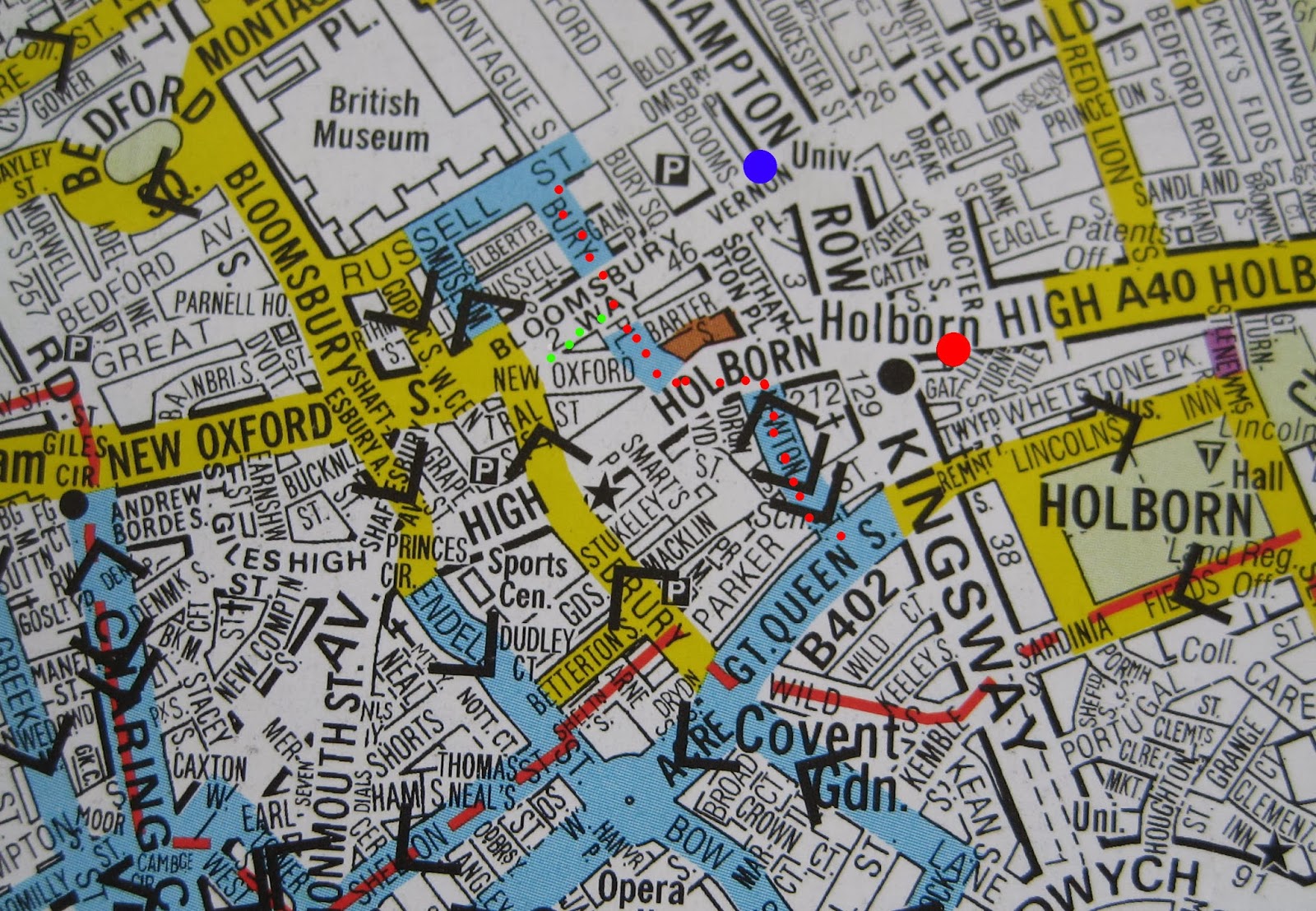
That post was prompted by the death, under a lorry, of Alan Neave on 15 July, in High Holborn, near the junction with Kingsway, at the place marked by the red dot on the map.


I linked that death, as did others, with the issue that cyclists from east London travelling towards the West End cannot follow Theobalds Road into Vernon Place, Bloomsbury Way and New Oxford Street on a direct route, as can the buses, but are are forced with cars round a mad multi-lane one-way system consisting of Drake Street, Procter Street, High Holborn, and St Giles High Street, that looks like this:


In the weeks leading up to Alan Neave's death, the police had been actively ticketing cyclists attempting to use the Vernon Place and Bloomsbury Way bus lane. The borough of Camden and Transport for London had always maintained that cyclists could not use this bus lane, as it is not wide enough for buses and cyclists to share.

I called, in July, on these authorities, and, in particular, on the Mayor's Cycling Commissioner, Andrew Gilligan, to take emergency action to create, through some sort of temporary infrastructure, not unlike that put in place for the Olympic lanes, a safe route for cyclists through this area, which has some of the highest cycle flows seen anywhere in London. They, and he, chose not to do this. Gilligan has persistently claimed, in response to such calls, that the number of cyclists being killed in London does not constitute an emergency, and that hurried action ("panic measures" as he terms it) would be counterproductive.

On 7 November Francis Golding, distinguished architect and former head of the Royal Fine Arts Commission, was killed by a left-turning coach at the junction of Southampton Place and Vernon Row, part of the same one-way system. So I need to add a blue dot to my map to mark his death:


Maybe if emergency measures to allow cyclists more priority and protection through this road system had been put in place after the death of Alan Neave, Golding would still be alive today. Maybe not. The incidents were different, only having a common factor in involvement of a large vehicle. But I just don't think arrangements for cyclists in this area are sane.

I also pointed out in my earlier post how there is a confounding problem, that the cycle route that I helped to devise, with Camden Cyclists, in the 1990s, via Great Russell Street, Bury Place, a short contraflow segregated track in High Holborn, then Newton Street, and Great Queen Street (shown with small orange dots on the map), which was designed to separate some cycle journeys from the Holborn one-way system, had been blocked by long-term building works with the provision of no alternative. Here is the blockage, looking towards the southern part of Bury Place from Bloomsbury Way:


I pointed out that it would have been really easy for Camden to provide an alternative here to maintain the cycle route. The signals cyclists need are still in place. They just needed to remove a section of railing, insert a dropped kerb, put in some markings and do a temporary traffic order. There is still a decent space for both pedestrians and cyclists to get through, with sensible behaviour, outside the building hoardings.

Then this week, a new comment appears on that earlier blogpost, from Tim Brooke:
Thanks for the article, David. 
Interestingly, I was given a £50 FPN [Fixed Penalty Notice] this morning on that very spot on Bury Place that your photograph shows (and where the long-term building works are still occupying pride of place), having cycled on the short stretch of pavement connecting Bury Place to Bloomsbury Way. Police hiding round side of Kier hoarding.
So, not only have we had police fining cyclists for trying to avoid the one-way system by using the bus lane in Bloomsbury Way, we've had them fining cyclists for trying to avoid it by using the disrupted cycle route in Bury Place. It's as if the police, Camden and TfL between them are deliberately laying a huge trap for cyclists in Holborn, trying to force them to their deaths, pushing them through a road system with a terrible safety record.

It is illegal, and it should be, for cyclists to cycle on the pavement.

But it should also be illegal for a local authority to allow a cycle route to be blocked without providing an equally safe temporary alternative.

Camden are supposedly a cycle-frienldy council, and have in the recent past done exemplary work in creating an alternative route for cyclists while an established route is closed for works, at Royal College Street:


But not at Bury Place.

I have learned, in conversations with Camden Cyclists' committee, that cyclists will soon be allowed to use the Bloomsbury Way westbound bus lane. But the lane will be segregated off with wands in the road (things like thin and flexible bollards), and it will still be too narrow for cyclists to overtake buses, or vice versa, and cyclists will be banned from overtaking buses by straying through the wands into the opposing lane. The Camden officer responsible for this scheme is reported as saying that if cyclists are seen doing this, cyclists will be banned from the bus lane again.

So it seems like cyclists are dying on the major roads in central London, and the response of the authorities, rather than providing rationally-designed, safe and practical infrastructure that cyclists can use without breaking the law, is consistently to blame cyclists for the problems and criminalise them at every possible opportunity for merely trying to use the road system in the best and safest way they can find.

Frankly, I'm sick of it. So are lots of other people.

It doesn't help that the first thing that it seems to enter Boris Johnson's head whenever there is another cycling death is some new, counter-evidential argument to attempt to transfer blame for the road danger that is killing them on to cyclists themselves. In November, after the deaths of six cyclists in two weeks, including Francis Golding, his response was to blather some rubbish about headphones. Quite sickening.

This, Mr Gilligan, this whole accumulation of deaths, injuries, insults, and institutional incompetence, is why cyclists and others are lying down in roads to protest. We know you have some good ideas, but there's a huge back-story here, a lot of it is associated with your boss, and we're not seeing the changes we need yet.

Here's Vernon Place looking east, with the contraflow bus lane that cyclists will soon by allowed to use, but not overtake buses in.


So, interpreting Camden and TfL's current position on this, it seems they are saying there's room for three eastbound lanes of traffic, but not room for making a westbound lane wide enough to be sensibly shared by buses and cyclists. These are unbelievably wrong priorities. This problem could be fixed by repainting the road markings with only two eastbound lanes and moving the traffic lights. It doesn't seem too complicated. Is the real agenda here that maintaining the capacity of the gyratory system is a higher priority than cyclists' safety?

Obviously, if Camden do what they say they will, and add these wands to the bus lane at its existing width, cyclists will overtake stopped buses by going over the solid white line, if there is nothing coming towards them in the opposing lane. Why shouldn't they? But I think that these wands will themselves be an extra hazard.

Andrew Gilligan has spoken elsewhere of segregating combined bus and cycle lanes (not necessarily contraflow ones) off from the rest of the traffic with wands. I find this concept hard to fathom. If the lane is not wide enough to combine cyclists and buses in, in parallel, with a good margin for overtaking, then enclosing the whole thing with wands is surely going to create more problems. If it is wide enough, then the wands are in the wrong place. They should be between the cycle flow and the motor flow, in other words, between separate bus and bike lanes. Or alternatively there should be no separation, but the cyclists must be allowed to undertake at the bus-stops with bus stop bypasses. Cycle flows have a totally different dynamic to bus movements. They are about the same average speed, but mix very badly, because of the stop-start character of buses. We have huge numbers of buses in London, and substantial numbers of cyclists (in certain places). Neither of these are going to change quickly. We have to sort this problem out.

I'll look at some further aspects of the practicality of TfL's bike plans for central London, which were announced this week, in another post. For now, it seems that in Holborn they are still intent in trapping cyclists in a weird cat-and-mouse game. If the police actually enforce the "no overtaking" rule (which is hard to imagine), cyclists will not have a practical route, and they will have to use the deadly one-way system again. Trying to prevent cyclists and buses from passing each another is idiotic.

Fortunately, there are other people with better ideas. I draw your attention to the Clerkenwell Boulevard proposal by Andrea Casalotti. I think this deserves some serious consideration. He has considered the east-west corridor from Old Street roundabout to Bury Place, the most cycled route in London, with conditions, that are, as he says, currently "scandalously disrespectful to people who cycle". He proposes making it a bus and  cycle (and pedestrian) only corridor, with continuous separation of cyclists from buses with a single bi-directional track. The removal of turns by other vehicles on to and off the route means that some traffic lights could be removed (though I'm not sure so many could be removed as the eight he claims), speeding both bus and cycle journeys. They would also be speeded, of course, by being separated from one another, and having the cars, lorries, vans and taxis removed from the corridor. This traffic would be displaced to the inner ring road: Euston Road, Pentonville Road and City Road.

Conditions on "Clerkenwell Boulevard": "Scandalously disrespectful to  people who cycle"
It's a radical proposal which would attract huge opposition from taxi drivers and commercial vehicle operators, without doubt. I also think it would need to be part of a wider and more complicated package of proposals. You wouldn't just get the displacement to the ring road, as Andrea claims, you would get displacement to many small roads unless they were all closed as well; particularly, the whole route of the Seven Stations Link, or LCN 0, needs to be closed to through-traffic. But such a radical proposal should force our decision-makers to think about who and what these streets are actually for. Are they there for the benefit of the taxi trade and commercial vehicle operators (there actually are not many private cars here at the moment) so that they have short (but rarely quick or efficient) journeys, or could we use them better, for a more beautiful, pleasant, and more civilised city?

We are not proposing removing motor vehicle access to any destination, but some motor routes would become longer. However, experience in the Netherlands and elsewhere shows that simplifying networks and reducing the number of possible motor routes and open intersections can actually make journeys faster for motor vehicles. Certainly any claim that we have the perfect solution in Central London at the moment would be generally laughed out-of-court. We are constantly told that road space in London is a limited resource, so why do we persist in using it so inefficiently? These roads are not working well now for anybody, and cyclists and pedestrians are coming off the worst. In too many cases they are being killed. More widely, there is a denial of travel choices. Contrary to what our Cycling Commissioner thinks, we do have an emergency, in so many ways. Let's have a radical rethink.

Sunday, 16 September 2012

The London Assembly and Safety in Numbers

Last Tuesday's meeting of the London Assembly's Transport Committee, which included its second session examining cycling safety, was quite fascinating. The previous session had allowed a considerable number of people to have their say, including representitives of the LCC, CTC, British Cycling, and the Cycling Embassy of Great Britain (including me). In this second session the speaking guests were restricted to a few "experts": Dr Rachel Aldred, Director of the Sustainable Mobilities Research Group at the University of East London; Karen Dee, Director of Policy at the Freight Transport Association; Ben Plowden, Director of Planning for Surface Transport at TfL; Steffen Rasmussen, Head of Traffic Design, Municipality of Copenhagen; and Roelof Wittink, Director of the Dutch Cycling Embassy. 

To have had these two last mentioned addressing the Aseembly Members was I think particularly remarkable. For people like me have been saying to London local government for decades that we need to get some experts from those European countries where very high cycling rates have been achieved to explain to us what is actually needed (if not to put them actually in charge of making the necessary changes, which would be even better). This was the first time, to my knowledge, that something like this has actually happened: that any level of UK Government has sought advice on cycling from experts from the continent. This is a very welcome and long overdue development.

The exchanges can be heard on a (very long) webcast available on this page*. Another blogger has already commented on the contribution to the debate of Richard Tracey, Conservative AM. I'm not going to give a full account of the session here, but I've transcribed, in a very approximate style, missing a lot out, but keeping, I hope, a fair essence of what was said, a few points that I felt were highly significant from around the 1 hour 50 minutes mark to the 2 hours 10 minutes mark.

In this section of the debate, Assembly Members were asking the experts about trends in cycling levels and cycling safety in London and elsewhere, and about the concepts of "Critical Mass" and "Safety in Numbers". Ben Plowden, questioned at length on the London statistics, had held to the the view that safety for cyclists in London was getting better over time, taking into account the increasing number of cyclists, with the particularly large number of deaths last year (16) being possibly only a statistical "blip".
Darren Johnson AM, to Roelhoff Wittink: 
In the Netherlands there's been a growth in cycling, but there hasn't been a comparable growth in casualties as there has been in London. Could you say something about that? 
Wittink: 
Cycling grew in the 70s and 80s because of our policies, and safety increased along with it. It has to do with the level of cycling but also with the measures that you take. 
Johnson: 
Do you put it down to a critical mass of cyclists on the road? 
Wittink:
That's a very important  explanation, but, also, if you move people from driving to cycling, you have fewer people causing the troubles for cyclists on the roads. Segregation where you have more than 30km/h is very important. We also disconnect the main routes for cyclists from the main routes for cars, so you have less intersections where you have both high volumes of cyclists and high volumes of cars. I had a look at some your roundabouts, some kilometres from here. The roundabouts we have in the Netherlands slow drivers down but your roundabouts allow drivers still to have a speed of 40km an hour – that's really impossible for cyclists. 
[Steffen Rasmussen is asked to comment] 
Rasmussen: 
There might be something about a critical mass of cyclists, we need more reasearch on the issue of critical mass, I don't know of any research specific to Europe. Infrastructure is extremely important, and we have a lot of work still to do in the City of Copenhagen. 
[Comments are invited from others, and Racheal Aldred speaks] 
Aldred: 
You expect trends in deaths to get better year on year because health care gets better, but when you compare modes, you see it's becoming safer year on year for those in cars, but for cyclists the improvement is much less. I think it's important to compare casualty rates for different modes of travel. The casualty rates for London per kilometre is 30 times greater for cyclists than for car drivers. That's a very big disparity. Comparable figures from the Netherlands (from SWOV) gives you a figure of 4 to 1. It's around 25 to 1 for the UK as a whole. There's an issue there, as we are trying to get people to switch from cars to cycling. In the Netherlands last year there were 4 right-hook deaths in the whole of the country, with their much higher cycling rate. They are doing something much better.  
I want to say something about "Safety in Numbers". This idea has been much discussed. A paper by Jacobsen in 2003 was the original use of the term "Safety in Numbers". He used five data sets, but three of them are cross-sectional, so there is a methodological issue; you can't tell whether you are getting the number of cyclists from safety or the safety from the number of cyclists, because it's at the same time. He used two other data sets that are longitudinal that give you a better insight into that. One of them was from the Netherlands, where he found as you got more cyclists, you did indeed get safer cycling, if you look at at a time series. Interestingly, the other data set was from the UK. He found but data for the UK was very different. It was all over the place; it wasn't showing a consitent improvement in safety related to the number of cyclists. I could talk about this at much greater length than I think you want to hear. There are many mechanisms likely to be going on. I don't think you can say more cyclists always leads to safer cycling. There are different mechanisms going on. It depends on the culture, the infrastructure, the legal context. 
Johnson: 
Could it be that the cycling rate is still too small in London to make a difference, we haven't reached that critical mass where the risk becomes acceptable? 
Aldred: 
What is an acceptable risk level is decided socially. Do we say that at 1%, 2% 5% cycling it gets acceptably safe? It's confounded because as you get more cycling you get more pressure for better cycling conditions, so that will feed into safety. There's a lot of things going on. 
Ben Plowden: 
I've been cycling in London for many years. You used to see hardly any other cyclists on the road, but it's very different now. I think you can get a "virtuous circle" where you get more cyclists, and improved behaviour by road users, leading to a "tipping point" where things change significantly. Now I see in some places 40 cyclists at every cycle of the lights. That must be having an effect on people's perception. 
Aldred: 
I think it is worth noting that Jacobsen's original idea of "Safety in Numbers" was in terms of presence on the roads, not in terms of a log-term cultural shift. In Grays Inn Road, when you've got 40 cyclists around you during rush-hour, it might be relatively pleasant, but late at night, when there are no other cyclists on the road and the traffic is flowing freely, it's a very different experience. You need continuity and consistency.

So, to sum up, it seems that the Director of Planning responsible for cycling in London, and perhaps the Green Assembly Member, expect cycling to automatically become safer as more people do it. On the other hand, those who have studied the subject in detail, and have real experience, know that cycling has to be made safe though the provision of infrastructure that separates cyclists physically from dangerous and intimidating motor traffic.

Personally, having studied the Netherlands, I think there is such a thing as a "critical mass" of cyclists. But it is something quite different to what all these people are thinking of. It is a phenomenon that occurs far further down the line of cycle growth than the regime they are considering. It's not at 2% modal share, or 5%, or 10%. And it's not a physical, "presence on the road" thing, it's the political phenomenon that Rachael Aldred alluded to. It's the "Dutch Effect": what happens when you have, probably, more than 51% of the entire population cycling regularly: a point that was passed in the Netherlands long ago (it is possible participation has never been below this level in the last century).

When you are in this happy situation, absolutely anything is possible for cycling. No expense is too great, no rearrangement of the urban or rural fabric too extreme to be worth doing for the comfort and convenience of cyclists, because virtually everybody wants it, there is little controversy about it, it is accepted, rather like massive state funding of health, railways, and roads for cars are accepted and non-controversial in the UK. I think that until we reach that happy state, politicians who wish for more cycling are going to have to be very pro-active and visionary. It will be vain for them to hope for a magical "tipping point" at some far lower level of cycling uptake, where it will all become easy and semi-automatic. It won't be like that. It will always be a struggle.

As a  post-script to this discussion, I quote from a recent post on the CTC blog written by Roger Geffen, the CTC's Campaigns and Policy Director. He writes about a report on cycling safety in various European countries by the European Traffic Safety Council (ETSC):

ETSC rightly recognises though that you cannot measure cycle safety simply by looking at casualty numbers. Comparisons should be based on the risk of a casualty per mile cycled (or per trip, or per hour – but at any rate, it should be relative to some measure of cycle use). Otherwise you fall into the trap of claiming that Dudley and St Helens are far safer for cycling than Cambridge(!), or, even more absurdly, that Britain is far safer than the Netherlands (as Road Safety Minister Mike Penning claimed in Parliament), simply because places with low cycle use obviously have fewer cyclist casualties. That doesn't mean they are "safer" - indeed, CTC's "Safety in numbers" evidence shows the exact opposite. 
ETSC then shows that Britain is one of only 3 EU countries to measure cycle use at the national level on an annual basis – the others being (you guessed it!) Denmark and the Netherlands. Two others, Sweden and Norway, also measure it reasonably frequently. ETSC compares cycle use and cycle safety in these five countries and, once again, finds clear evidence of the “safety in numbers” effect: cycling is safest in the places with highest cycle use. 
CTC has documented this relationship in the past, based both on a comparison of EU-wide data from a wider range of dates, and of figures from within Britain. However, until now our only source of comparable data on local cycle use within Britain was the national census, which only comes out every 10 years and covers cycle commuting only. It was good enough to show the “safety in numbers” relationship exists, but not to compare how local authorities are actually performing. 
Unsurprisingly, ETSC’s report shows that Britain is performing worst of the 5 countries in their comparison, in terms of both cycle use and cyclists’ safety. But hey, at least we are measuring this!
Here's my question: I've pointed out before how the Director of the Dutch state road safety organisation, SWOV, has said that the simple interpretation of "Safety in Numbers" – that simply having more cyclists automatically gives you safer cycling – is wrong. You have read the exchanges above. You may even have read this essay on the As Easy As Riding A Bike blog on the subject. And you may have read Freewheeler's biting satire Minutes of the Crapborough Cycling Campaign:

Also in Holland they have safety in numbers. Sam said if we could just get more people cycling in Britain then everyone would become as safe as in Holland.

Sam then showed a very interesting diagram showing how safety in numbers works in Holland. Here we see a typical Dutch street scene where a lorry driver pauses before turning. Dutch lorry drivers are used to being surrounded by lots of cyclists, which is why they take extra care at junctions.

My question is:

Is Roger Geffen of the CTC the only person in UK cycle campaigning who still believes in the simplistic nonsense of "Safety in Numbers"?

*Unfortunately the GLA website uses a Windows Media format for its videos that doesn't normally play correctly on Macs (it may be silent). The solution I have found is the free, open-source program VLC, which does play these videos correctly on the Mac.

Friday, 13 July 2012

In which I "dangerise" cycling again

On Thursday I attended the session of the London Assembly Transport Committee on cycle safety. Some of the things I and another Cycling Embassy of Great Britain member, Tim Lennon, said in the debate have been reported here. I won't give a general account of the debate, in which representatives of London Cycling Campaign, British Cycling, CTC and Sustrans all said some very good things which I hope will find their way into the committee's ultimate report, and influence the Mayor and Transport for London. But I will mention the opinions of one Richmond councillor, their "Cycling Champion", no less, Conservative Katherine Harborne, and I will put here, in more detail, the response that I gave to her in the debate, and this will inevitably lead me into a discussion, again, of the danger of cycling in the UK.

I broach this subject again not because I wish to dwell on bad things, but because I believe, and have believed for a long time, that realism on this subject is critical to generating the environment of honest debate that must be the necessary foundation for a real political movement to restore cycling to the major component of our transport system that it once was, and needs to become again, if we are to deal with the environmental challenges of the very near future, of which the greatest is probably global warming.

I don't need to quote what Katherine Harborne said in the debate because she issued a press release in response to the Transport committee's consultation beforehand which said very similar things. I have linked there to Richmond Cycling Campaign's website, and it is interesting to read there of the other correspondence that RCC have had with her. Anyway, her press release says:

Katharine Harborne is the Cycling Czar for the London Borough of Richmond, where she is also a councillor. 
“We have no family car and never have,” she says. “Cycling gives freedom to me and my family – and keeps me fit. My teenage son is working to get on the Olympic cycling programme. 
“But we are still some way from getting cycling accepted – and more people on their bikes. In fact research from British Cycling found that nearly a million women would like to start riding a bike, but many are put off by safety concerns. 
“Despite millions of pounds being spent making our roads from 2009-2011 less dangerous, safety fears have in fact increased by half in that period. 
“A 2011 report reveals that almost half [48%] of occasional cyclists think safety is a big issue and yet less than a quarter [23%] of regular cyclists think it is. 
“So if we want to encourage more people to cycle maybe we should stop going on about how dangerous it is because, frankly, it isn’t and we’re just putting people off. 
“Making London more cycle-friendly isn’t just about cycling superhighways or giving tipper trucks and skip lorries a lot of respect at junctions – 24% of people who commute in London could cycle, but don’t. 
“Many don’t because they would get to work sweaty and have nowhere to shower or get changed. So why not encourage employers to provide more shower facilities or encourage businesses that are better equipped to Share A Shower – allowing cyclists from other firms to use their facilities?”

Lets forget about the funny business at the end of proposing that lack of shower facilities is a reason why our children, parents and neighbours don't cycle on London's roads. Does anyone think that every Dutch or Danish person who takes a 2 km bike trip at 15 km/h in their normal clothes on their sit-up-and-beg bike has a shower at the end of it?

Let's think about the meat of this whole approach, which is, and has been, shared by many others, including many prominent voices in prominent cycling organisations:
“So if we want to encourage more people to cycle maybe we should stop going on about how dangerous it is because, frankly, it isn’t and we’re just putting people off. 
Other politicians who have told us in recent times that "Cycling is not dangerous" are transport ministers Norman Baker and Mike Penning, as I reported in a previous post on a session of the Commons Transport Select Committee, at which they grievously misused statistics to try to suggest, incredibly, that the UK is doing a good job on cycle safety, better even than the Dutch. The link just quoted, to Jim Gleeson's statistics blog (Drawing) Rings Around The World, gives the truth of the matter, that cycling in the Netherlands is more than twice as safe per km travelled than cycling in the UK as measured from the official KSI statistics (Killed and Seriously Injured) issued by the two governments. But there is far more to it than this, as Jim Gleeson's subsequent post showed.

For cycling is so widespread across all age-groups in the Netherlands that a very significant number of the KSIs in that country categorised as cycling casualties are one-person incidents: basically, as I mentioned once before on this blog, Dutch cycling conditions are so safe that an awful lot of elderly Dutch people just drop dead on their bikes, or have crashes causing injury that involve no other vehicle, and these are in the statistics. We really need to look, as Jim Gleeson does, at the rates, per km travelled, of death and serious injury of cyclists who are in collision with a motor vehicle to properly assess the safety records of the two countries, in regards how it should influence decision-making on street engineering and the segregation of bikes and cars.

When we do this, the results are astounding. There are 508 KSIs involving motor vehicles per billion km cycled in the UK, compared with 61 in the Netherlands, a ratio of 8.3.

Cycling, in regards interactions with motor vehicles, is really 8.3 times safer in the Netherlands.

Their record is not just better, it is fantastically better. And fantastically better with a far wider demographic cycling, including large numbers of old, frail people who are far more likely to be killed or injured as a result of a given impact with a motor vehicle, or the ground, than the young, fit people who make up most of the British cycling demographic. And, one also might note, these are just the people, along with children, who could not be expected to mitigate danger in a purely vehicular cycling environment (that is, space shared with fast motor traffic) by cycling fast and assertively in Cyclecraft-recommended manner. So the Dutch cycling safety space is clearly a different world to that of the UK.

Apart from comparing cycle safety between different countries, which represents a contrast that will not actually be felt by British people unless they actually try to cycle in those countries and here as well, we can also compare safety of different transport modes within the UK, describing a contrast that they can feel, and react to, on a daily basis, in making their decisions on transport mode.

In the Department for Transport's Annual Report on road casualties for Great Britain 2009 (the last year for which full details are available) we discover (Table 1g) that the rate of cycle casualties (KSI) in that year was 880 per billion vehicle miles. In Table 1i we find that the rate of car user casualties (KSI) was 45 per billion vehicle miles. 880/45=19.55. Note that these are figures per billion vehicle miles, not person miles. Because average car occupancy is greater than 1, the rate per occupant is lowered, while for bikes the vehicle mile figure is the person mile figure. UK average car occupancy is 1.6. Therefore the danger ratio per person mile, bikes to cars, was in 2009 about 31.

It's about 30 times more dangerous per mile to cycle than to travel by car in the UK.

Now it is often held that the casualty rate per mile is not that important in comparing transport modes, because different modes have different uses. We expect, generally, to make longer journeys, covering therefore more miles, at least for the average person, by car or train or plane than by bike. Yet consider this. One of the main arguments you constantly hear advanced in cycle promotion is something along these lines:
Half of all car journeys in Outer London are less than two miles in length, equating to a journey of about 10 minutes by bike. 
(Cycling Revolution London, TfL, 2010)
So there's the suggestion that people in general should be perfectly happy and willing just to swap the car for the bike for all these many short journeys they do. That's telling people not to live their lives in a different way, travel less or do anything else differently, that's just telling them to go on doing exactly all the things that they are doing now, but to use a mode of transport that is 30 times more dangerous than the one they are using! Telling them just increase their risk of death or serious injury on the road, by their own choice, their own actions, by a not insignificant factor of 30!

I don't think that makes sense, frankly. I think that's treating people as idiots, as I said in the London Assembly debate. People are just not going to respond to this message. They are not going to cycle under current conditions unless they really want to cycle, or they really have to (e.g. for financial reasons), and if they really want to cycle, because they love cycling, and thus can put up with the risk, they will be doing it already. But if people with some power like Cllr Harborne stop telling people cycling is "safe", and instead do more to make it safer, then more people will give it a go, even though it will never, judging from the Dutch experience, be as safe as travelling in a car. (And the Dutch have really tried, big-time, to make cycling "safe", reducing the cycling to driving casualty ratio per km to 3.5.) Cllr Harborne, bear in mind, is she who was dismissive of the need for wider 20 mph zones in Richmond in a letter to Richmond Cycling Campaign least year.

If we are to ever make progress on this, I think the advocates of cycling need to stop treating the public like idiots who cannot correctly judge what is or is not an unacceptably dangerous activity for them to engage in. I think they can judge. I think those for whom cycling would be massively dangerous under current conditions generally make a correct judgement not to do it, and even for those who judge that it is not unacceptably dangerous, it's still far more dangerous than doing the same journey by car, and their doing it at all depends on their sense of enjoyment, judgement of convenience, and sometimes, a financial incentive. Only motorcycling is significantly more dangerous per mile than cycling (about 4 times). The danger of walking is comparable to that of cycling (Annual Report 2009 Chart 1e), but we expect journeys by foot to be shorter, and everybody walks, not a restricted demographic.

There is another argument that floats around this area, that is, that people gain in years of life from cycling, due to avoidance of heart disease and other illnesses associated with obesity, more, on average, than they loose due to death in crashes. So it's kind of healthy to cycle, even if it's dangerous. The British Medical Association have been arguing this since 1992, and the report they produced then, authored by Mayer Hillman, now out of print, but re-quoted in their 1997 document Road Transport and Health, held that:
Even in the current hostile traffic environment, the benefits gained from regular cycling [are] likely to outweigh the loss of life through cycling accidents for the population of regular cyclists. One calculation has shown the ratio to be around 20:1.
I suspect there is a lot of uncertainty here, implied in the phrase "one calculation", as there would be a lot of factors to take into account. Would, for example, more cycling mean that people walked less? In any case, this has always struck me as a rather weak promotional argument. This is, in the first place, because it involves people thinking about remote imponderables in their lives. It involves them needing to agree to make an exchange of a very clear, tangible threat in the present, of getting knocked off a bike on the road, for a promised benefit in the far future which they may well not accept as being very real. They might argue "Well if I don't die of that, I'll probably die of something else soon after", or, more rationally, they might argue that they can, and prefer to, get exactly the same health benefit from another choice of exercise or strenuous activity, whether that be running, swimming, going to the gym, or gardening, without the risk or injury or death in traffic that comes with cycling. So I don't think trying to frighten people into taking up cycling with the threat of heart disease decades down the line gets as much traction as many would hope it might.

I think we actually can get more people cycling in three ways. We can make it:

  • Relatively safer
  • Relatively more convenient (or faster)
  • Relatively cheaper

The last of these is the only one we are really doing in the UK at the moment, and more by accident than design, with rising costs of fuel and public transport. I think this is the main factor that has been driving the modern increase in cycling in London. But if we get more people on bikes by this method, we get more deaths and injuries. As even Chris Peck of the CTC acknowledged at the Assembly debate, in the last couple of years, casualty increases have outstripped the increase in cycling, despite the CTC generally in the past having been rather fervent advocates of the "Safety in Numbers" theory. I don't think that's a great policy success. I want more people to cycle, for all the health and environmental and social benefits I think it would bring, but I don't want to go back to the 1930s situation, when we had plenty of cyclists on the streets (quite how many it is difficult to tell, as I have never seen any transport statistics for the pre-war period), and eleven were being killed every week in London, about 35 times the current death rate.

I don't think non-cyclists are much influenced by how dangerous people like me or Cllr Harborne say cycling is or isn't. They do what they feel is sensible for them. No political movement ever gained any traction by telling the vast majority of the population that their basic, gut feelings about what they should do are wrong. We shouldn't expect anything different in respect of cycling. And even if that rule were proved false in this case, and the masses responded to Cllr Harbone's message (and those of others  like her) and started cycling just because they are told they should, without other policy changes to make the roads safer for them, I don't think there would be any social or moral progress there, and it's not a thing with which I would want to be associated. I want more people to cycle because they really find it pleasurable, relaxing and safe, not because they are told they should, or are dragooned into it through lack of other affordable choice.

Tuesday, 7 February 2012

Inverted snobbery, "dangerising", and change at the CTC

The Times Cities fit for Cycling Campaign grows more impressive. You can still read all the stories relating to the campaign, without paying, via this link. I think it is absolutely admirable that The Times has removed their paywall for so much material, to conduct this campaign, and I hope they get some more subscriptions out of it. And do pledge your support, if you have not already done so.

There was some disapproval by cycling campaigners on Sunday of a graphic about "dressing to be seen" in specialised cycling clothes in bright colours. I think it is easy to get too worked up about this kind of thing. There have always been specialised cycling clothes, more or less since the invention of the bike. Making cycling practical in ordinary clothes is a great idea, and must be an objective, part of the Dutch-style mass culture of everyday cycling to be worked towards, and the article accompanying the graphic does make this point, but there is a danger of an "inverted snobbery" which says that you can't be part of a transport cycling revolution and still wear lycra. This would be silly. We have to face the fact that, as the UK environment is configured, many commuting cycling distances are going to be quite long, and some rides a bit hilly, and dressing for a 10 mile ride in such a way that you do not get overheated, and remain comfortable and unencumbered, is quite sensible, and there is nothing wrong with The Times featuring and advertising this garb.

The focus of The Times campaign remains bang-on, in my view, firmly on the subjects of lower speeds, safer road infrastructure, and how it should be paid for. Though some of the infrastructure they have suggested is on the whacky side, with futuristic cycle highways in tubes, how about their interactive graphic of suggested infrastructure at a roundabout? Here is thinking far ahead of that of Transport for London or other UK highway authorities, demonstrating continuity of networks, segregation on busy roads, cycle paths away from roads, and a cycle flyover – most of what you could want to "Go Dutch", in fact. The same graphic also shows the hazards resulting from the typical unsafe arrangement we have at the moment. Brilliant!

And they do keep banging on about the need for a dedicated fund to pay for cycling infrastructure. They have hit the nail totally on the head here, in my view.
Last year, funding for infrastructure in 12 Cycling City and Towns members was also stopped. Withdrawal of the £43 million came before final analysis could be made on whether the scheme was encouraging more cycling.
Critics argue that there is no central fund to build cycle schemes. Local authorities have access to a £560 million Local Sustainable Transport Fund until 2015, but early schemes appear to have prioritised improvements to bus and railway stations, smart-card ticketing and park-and-ride schemes, as much as cycling.
Mike Penning, the Roads Minister, said that 38 of 39 successful bids to the fund contain a cycling element. He was wary of calls for a new funding mechanism harnessing the Highways Agency budget. “Most cycling will be on local government roads so you are taking the budget out of national infrastructure into local government roads,” he said. “But like anything, if anybody has ideas they can be looked at.”
Penning isn't getting it yet. Until recently he seemed to think that cyclists were not allowed on the national roads infrastructure (trunk roads) at all. He is still not understanding the problem that there are not direct, efficient, and safe cycling alternatives, in general, to the big roads, and that this is a problem with the national infrastructure, which is his responsibility.

So The Times is plugging away at the real, core issues, and they have even got the AA to support almost blanket 20 mph in towns. Nobody seems to want to argue with this campaign! Nobody half sensible, anyway.

There has been the usual complaint from a few old-style cycling campaigners about The Times "dangerising" cycling. This is idiotic. The Times campaign is overwhelmingly a force for achieving the changes cyclists want. The Times did not dangerise cycling, just as I did not dangerise cycling when I wrote my piece Cycling is dangerous. The policies of successive governments dangerised cycling. A lot of people involved with cycling on a day to day basis seem to loose a basic grip on this danger issue, and I can see why. If you spend an hour or more a day in the saddle, on the streets of a major British city, and you (hopefully) do not come to any harm, you may easily start to believe that cycling in this environment is not dangerous.

This is an illusion borne of use, and there are a few ways to get back to reality. One is to spend some time cycling in an environment which is much safer. The best option is to go an a study tour with David Hembrow. If you do not have the time or money to do this, you can look at at some videos on YouTube. One of the best is this one from David's Hembrow's collaborator, Mark Wagenbuur: What defines Dutch cycling?


The point here is absolutely clear. This is a video of people doing daft things on bikes: things that they could only do in a really safe environment. You don't see British cyclists going along with umbrellas open, or cycling with dogs in tow, or people leaping on and off the back of their friend's bike, or people having conversations while riding side by side on city streets. Not often anyway. As Mark says, these are habits that only become normal in an environment which is really safe, where the constant anxiety arising from the need to share the road space with potentially lethal motor traffic is gone. Seeing how far were, generally, in the UK from the environment that allows these habits, gives you the measuring stick for how much underlying danger we are really coping with, despite the truth that UK cyclists are not being killed left, right, and centre.

The CTC, largest cycling organisation in the UK, have traditionally been prone to the "Don't dangerise cycling" tack, disliking ghost bikes and anything else of a publicity or campaigning nature that they feel might frighten people (as if they haven't noticed that what really frightens people is being passed with inches to spare by huge lorries). Blogger Cycalogical recently labelled this practice danger denial.

This brings me on to the fact that CTC have a new Chief Executive. This is a big change in the UK cycling world, as the last Chief Executive, Kevin Mayne, was in post for 14 years. Kevin Mayne was without doubt a hard worker for the interests of UK cycling, as he saw them, and without doubt a significant influence on the policies of CTC over a long period. In 2003 he told me that he didn't think that segregated cycle tracks on roads were a good idea. His argument was that you could never have them everywhere, and, because of that, if you introduced them anywhere, you would put cyclists elsewhere, on the normal roads, more at risk. He thought that creating tracks would attract cyclists to them (which I agree with), and that this would lessen the density of cyclists on other roads, which would make those roads more dangerous for the cyclists who chose not to use the tracks, in part, because they would get more harried and disrespected by motorists who thought they should not be on the roads.

Like many of the CTC's policy positions down the decades, unfortunately, this was just an argument for "no change". If you can never start to build a segregated cycle network, for fear of those consequences, then you are just stuck with the road network as we have it, possibly with the addition of a few bits of different-coloured paint, Boris-style. You remain in the situation of having only a tiny minority of people cycling, and with cycling in a politically very weak position. The very persecution of cyclists on the roads of the UK that Mayne worried about happened already, as things were, because of that political weakness. Inaction on the infrastructure issue was a prescription to keep that weakness permanent. Andreas Rohl, the bike chief of Copenhagen, drums the point home, in perhaps the most important words in all The Times's coverage:
From A to B there has to be quality before you can expect people to get on a bike. If you want to make cycling mainstream you have to separate bikes from cars and buses. It’s essential.
Ironically, Kevin is going on to a job with the European Cyclists' Federation, based in Brussels. I wonder if daily experience of that city, which does have a developing segregated cycle network, will cause him to modify his opinions. Anyway, I wish him well there. I wonder if the new CTC Chief Executive, Gordon Seabright, will be able to take advantage of the fair wind of The Times campaign to re-position his organisation as a more positive participant in debate about good cycling infrastructure and how to achieve it. My feeling is that if he did, a great many of his membership would back him.