This is bad. It is not what should happen in a healthy democracy. It is symptomatic of the continuing slide in prestige and status of local government in the UK under the coalition government. It reflects the slashed budgets, Eric Pickles' contrarian idea of 'localism' (basically, he decides what decisions councils should be able to take, and that includes none that challenge his car-centric libertarian agenda), and it reflects power further drained away from elected councillors by outsourcing, including, in the London Borough of Barnet, virtually all services (including those that should be under direct democratic control, like planning) in the far-right 'easy council' model, and the setting-up of undemocratic quasi-public bodies to take over what used to be local authority functions, such as, outside London, the Local Enterprise Partnerships, which are doing their bit to skew Britain's transport system further towards cars.
All this brings me to think of the wider failure of constitutional reform of the coalition government of the last five years, their greatest failure in my view. I've not heard recently any contrition or apology from the Liberal Democrats about this, which, considering what their policy position was in 2010, and historically long before that, I find surprising. The coalition failed to reform the electoral system, failed to reform the House of Lords, and failed to rejuvenate local or regional government in England, in fact, further squashed them. The Lib Dem's leverage and mandate for constitutional reform was totally squandered on a foolish referendum on a 'first-past-the-post lite' system that no-one who wanted real constitution reform wanted.
 |
| A Twitter exchange |
We know the Tories did not want constitutional reform, that's part of what being a Tory means. In fact they wanted to make our current House of Commons less representative by making it smaller (which would have potentially reduced even further the proportionality of the representation) but failed in this because the Lib Dems blocked it in retaliation for the failure of House of Lords reform. So the constitutional project ended in stalemate again, and we have another General Election on the same broken system.
Yesterday we had the party leaders all over a small number of marginal seats. It is obviously wrong that these seats and these restricted electorates get this attention, and that a few voters in a few swing seats hold the keys to the next government. I can understand why many people feel it is not worth voting; it hardly is for most of them. Such people have a respectable point, which can't be legitimately dismissed by pious preaching about their 'civic duty' and how 'people fought and died for the right to vote' (in First Past the Post).
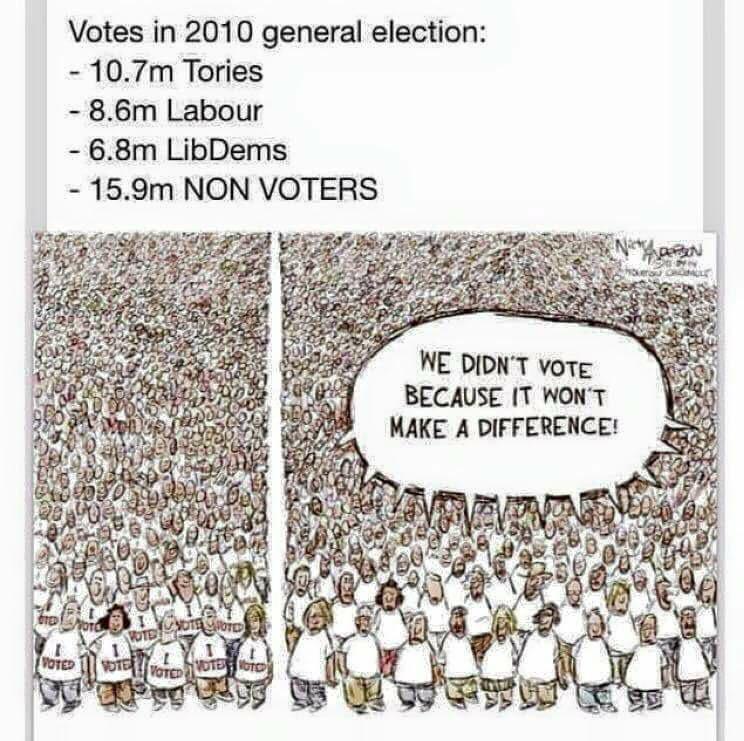 |
| This kind of preaching has little effect, because abstainers have a good point: they really can't make much difference. |
I used to think that tactical voting was a good idea under certain circumstances, but I have changed my mind. Tactical voting is a short term, negative tactic which people use to try to avoid getting the MP or government they definitely don't want in a bad, unrepresentative system where a party voted for by a minority can wield absolute power. But in the long term, tactical voting has always failed us. It delivers no genuine change because it makes the support for minority parties, which do wish to see the system changed, appear smaller than it justly should be. It always returns to power the big parties who wish to keep the elected dictatorship going. First Past the Post is a fiendishly clever system because, short of a violent revolution, there seems no way it can be changed. The parties, lobbies and viewpoints that is suits always win, and they won't change the system they depend on for their continued power.
We can protest and lobby and campaign against this, which I advocate, burt we can also act today by not playing along with the system and not voting tactically, but voting according to conscience. For there is no such thing as a 'wasted vote'. Though your vote for a party thought to have no chance of winning in your constituency may not count electorally, it will be counted by someone. Every vote for a party advocating fundamental constitutional reform, or a new type of economic system, or a human transport system, makes those reforms more likely, in a way that voting for the big parties does not. it increases the moral political weight of that minor party or individual and makes appear more iniquitous the inevitably unrepresentative result. It makes people think about these issues more, and, at the very least, it heartens some brave soul fighting on a principled platform for a party that cannot win; it tells them that they have not been wasting their time, and it may at least save their deposit. It encourages others who think similarly to try next time and to keep working between elections for what they believe in. So don't vote tactically, it's bad for your soul, and it's bad for the soul of the nation. The practice is itself part of the broken system.

