Wednesday, 19 August 2015

Taking the lane: a personal history

This post will not be the one that you thought it would be from the title. The title was suggested to me by a tweet from @AlternativeDfT whose inspiration I hereby acknowledge. Here is is:
THIS is what real "taking the lane" looks like, not some temporary mirage dependent on a driver's temperament. Taken for good!
He's referring to this picture of the very first cyclists to use the East-West Cycle Superhighway currently under construction on the Thames Embankment in London.

Picture by @beagleldn
I was originally going write a kind of review post called  Reflections on reaching 500,000, marking the half million page views of this blog, but we have gone a bit beyond that now. I have not had time to comment on many of the recent developments on cycling in London, but I thought I would try to summarise the state of play now as I see it, how far we have come, how we got there, and where we are going: a big task, necessitating an unusually long post. The account will be, of necessity, quite personal. The quote from @AlternativeDfT contains, of course, an ironic reference to the technique of 'vehicular cycling' as taught in various manuals, but that won't actually concern me here. The picture of the East-West Superhighway in action at last, combined with @AlternativeDfT's concept of Taking the lane – for good rather summarises all I have been trying to achieve in over 20 years of cycle campaigning in London, hence the title. This blogpost is a kind of summary of the whole blog so far, over five years.

Camden experiments and the early London Cycle Network
My main campaigning objective, as you will probably know if you have read earlier posts, has always been to get London to build a world-class network of segregated and largely-car free cycle infrastructure that will enable mass utility cycling. I became convinced that this was the correct direction in which to go in the late 1990s, mostly through discussions with Paul Gannon in the Camden Cycling Campaign, a branch of London Cycling Campaign.

Our successes in CCC in that period were the construction of the Royal College Street segregated cycle track (the first one), and the east-west cycle track through Bloomsbury, as I have described before. These were early examples of taking the lane, in the sense of my (@AlternativeDfT's) title. We got Camden council to remove lanes dedicated to motor traffic on the road, and just give them to cyclists. This was a big step forward from previous London Cycle Network concepts of painting lanes on the road that drivers could still physically drive on and park in, or confusingly painting cycle symbols on largely unadjusted bits of pavement, which was, and tragically, still remains, one of the government's (the Department for Transport's) main recommendations to local authorities for cycle infrastructure.

The original Royal College Street cycle track in Camden, photographed soon after it was built in 2000
I authored a piece in the LCC magazine, London Cyclist, with Paul Gannon, published in the October 2002 edition (you can read it here), in which we went through the whole argument about the need for high-quality segregated cycle routes to change the reality and perception of safety of cycling in London and readjust the demographic balance of cyclists to make it more like that found in the Netherlands and Scandinavian countries in order to make high levels of utility cycling (which I would define as a modal share of all trips above 10%) a practical possibility. We used graphs, figures and international comparisons, and we showed pictures of good and bad segregated cycling schemes in London, pointing out the errors that cause failure of some schemes. We also discussed the need for more and better training of cyclists, that would need to take into account the skills required for using a proper cycle network in a city of mass cycling (not just teach cyclists how to defend themselves against drivers on the roads), and the need for changes to the UK legal framework to balance it more in favour of the rights of vulnerable road users. But we were rather clear that the most productive thing campaigners could do at that moment was to campaign for more high-quality segregated cycle tracks on the roads. The key to the problem was taking the lane.

This was all pretty revolutionary stuff at the time; though not novel – other authors, notably academics like John Parkin, had written similar things before, but it was unusual find these ideas advocated in grass-roots cycle campaigning at that time, I don't think any other article had every been published on similar lines in London Cyclist (which had been published since the 1980s), and such view were very widely attacked by other campaigners. Nevertheless, it was all an extension of other developments that had already been occurring: some moves, from as early as the1980s, to establish a London Cycle Network that would, as David Hembrow would now say, unravel cycle journeys from busy motor routes in London. We can see some of these early attempts in a classic film now on YouTube: GLC Cycling for London from 1984 shows examples of cycle crossings of main roads, no-entries with exceptions for bikes and other early attempts to allow cyclists to thread a path through relatively traffic-free minor roads that was not possible for motor vehicles. Interestingly, many of these facilities still exist today, virtually unaltered, including the so-calle Ambassadors Route, which is shown. It has long ceased to be known by that name, but still runs from Albert Gate in Hyde Park to Chelsea Bridge.


These early network attempts were pretty limited because they tended to run out of ideas in the many places in London where main routes could not be avoided, particularly on and approaching crossings of the Thames and other barriers, they did not deal with major junctions very much nor physically reallocate any space on crucial main roads, they were built to low capacity standards, and they were sparse, soon exhausting the practical possibilities for running useful cycle routes entirely on the network of back-streets. Nevertheless, by the early 2000s, despite the slowdown in building them caused by the abolition of the Greater London Council (which produced the film), but because of the persistence of local campaigners, like us in CCC, trying to improve standards and ambition from the various borough councils that took over responsibility for the cycle network from the GLC, they had certainly made an impact. Cycling in London was on the rise, reversing the downward trend of the post-war period up to the 1980s, and in the same issue of London Cyclist that I already mentioned, October 2002, in which Paul's and my article appeared, we find this letter to the editor, which I urge you to read in full.


Well, perhaps it's a bit overstated, but I find this quite moving, coming as it does in the same issue in which Paul and I laid out the rationale of the segregated tracks we had been developing, and which Mike Aitken had already discovered and been so pleased by, and to me it's an important piece of evidence as well. It coincides with my view that the beginnings of a cycle network that had been developed in London by 2002 were actually effective in promoting journeys by bike, particularly in central London – even poor cycle facilities do have some positive effect – and it opposes the view that I have often heard stated, particularly by Roger Geffen, policy officer for CTC, that the moderm upsurge in cycling in London was independent of any provision, and particularly occurred without the provision of segregated space. I hold it did not. Segregated space and almost car-free space as part of the network was developed from the 1980s onwards, mostly by allowing cycling in the parks, on bits of embankment and towpaths, by providing cycle-specific connections which allowed these spaces to be utilised and accessed from the road network, and by means of minor road routes facilitated by the types of means shown in the GLA video and referred to in the letter.

This, remember, was the period before the congestion charge, and a period when Inner London was still depopulating, and an increase in cycling could not be attributed to increasing population density. Counts of cycles on screen lines provide the most accurate figures for cycling, and the data shows that cycling into central London was on a clear upward trend from the mid 1990s, and into inner London, increasing from 2002. The early, poor London Cycle Network did actually, to an extent, work, and our work in adding into it the first substantial, properly segregated on-road routes in Camden (which got extended a bit into Islington as well, but sadly not Westminster) enhanced it considerably, though only very locally, so you would be lucky to find yourself, like Mike Aitken, in the position where the new routes helped your commute.


I went into, in my earlier article, why the Bloomsbury route never achieved its potential, as it was compromised and mis-constructed into a space half the desired size. Basically, in this period, few politicians, and perhaps even fewer cycle campaigners, believed there was actually any demand for cycle routes like this. There was a belief that they would not be used much, and certainly they would not fill up. Paul and I were not surprised, but virtually everyone else was, that the Bloomsbury route was full to capacity from the day it opened, and remains so today.

We fondly hoped that such immediate success, and particularly with a route in quite an 'iconic' location, known to many Londoners, by the University of London and Dillons (now Waterstones) University Bookshop, the concept would rapidly spread, and other boroughs would build similar routes. But things are never quite as simple or as easy as this. Lack of borough resources no doubt played a part, in the era before the GLA and TfL were established, and lack of coordination between the boroughs and relevant leadership within them, but certainly a factor was the continued division amongst cyclists, within the LCC and CTC, and local groups, as to the in principle desirability of segregating cyclists from motor traffic. To say this today will sound strange to many, but the poor quality of information available at that time, in this largely pre-internet age, and climate of misinformation, spread by the likes of the American author John Forester, and his UK equivalent John Franklin, about the nature and results of segregated cycling systems across the world, which was widely manifested in what Paul Gannon has described as a counter-evidential 'campaigners' groupthink' within cycling organisations, where you wouldn't really be accepted socially unless you toed a certain philosophical line – the integrationist, pro vehicular cycling line according to the gospel of Frankin and Forester – resulted in it being very difficult for those cyclists (probably always a quiet majority), who felt instinctively that what the wide public really needed and wanted was to be able to cycle in a motor-free environment, to express that view wihout being shouted down, demeaned, or told they were ignorant of all the 'facts' and 'research'.

A period of stasis and ineffective campaigning
So history moved on. Tony Blair gave London a government again in 2000, and Ken Livingstone, previously leader of the Greater London Council, which had begun the London cycle Network in the 1980s, became Mayor. But Livingstone, a non-cyclist and bus enthusiast, never understood cycling, and his re-warmed cycling programme, called LCN+, soon ran into the sand, not being not based on the type of understanding we had been trying to promote in Camden for the need for demographically inclusive cycle facilities, nor backed by the political will to tackle the difficult places, the big, unavoidable roads and junctions, ther Niagaras and vortexes, in Mike Aitken's terms, that remained huge barriers everywhere, in places like Elephant and Castle, Swiss Cottage, Kings Cross, Bank and Bow. The concept in LCN+ was still one of basically trying to connect up backstreets, but, as I said, the easy possibilities for this had really been exhausted already in the first LCN building phase. Far more significant were other things that happened in this period: the introduction of the Central London congestion charge in 2003 caused a massive transfer of private car journeys directly to the bike, as the graph above shows. Ken's enthusiastic extension of the bus lanes (shared with cyclists) no doubt helped a bit for cycle commuters travelling at peak hours when the lanes were in operation and free from parked cars (though junctions remained dangerous). The 7 July 2005 bombings of the tube and bus network also seemed to cause some people to start cycling as a permanent lifestyle change, and the changing demographics of London, with an inflight to the inner city, reversing decades of exodus, probably enhanced the trend.

It was clear by the end of Ken's period in office, 2008, that a change of direction was needed if any cycle growth momentum was to be sustained, and the new Mayor, Boris Johnson, who was a cyclist, proposed the Cycle Superhighway project to replace an abandoned LCN+: a 'network' or twelve radial routes into central London from the suburbs, mostly on major roads controlled by the Mayor's transport organisation, TfL, not by the boroughs. I put the word 'network' in quotes, as it was not a network, the routes failing to link up in the centre. Moreover, the whole conception of the routes was, as I commented at the time, 'calamitously inadequate to the task', with little segregation, routes largely using busy bus lanes, and parked on much of the time, and lethal junctions. (Literally lethal junctions, as people soon started to get killed on Superhighway 2). Unfortunately the LCC went through a period, at this time, of ineffectual campaigning and weak leadership, with a chief executive, Koy Thomson, who believed in not criticising the authorities too much for fear of being excluded from influence and negotiations, and having no desire to take the membership on to the streets and protest, or otherwise be seen to be 'too militant'. 

The defective design of the Cycle Superhighway at Bow that resulted in three deaths

There was also the issue in the background that LCC, and even more so CTC, had never grappled with the segregation issue. They did not really know what they wanted as organisations, in terms of policy for accommodating cyclists in the transport network, at a very fundamental level, so couldn't argue for any coherent alternative to mis-concepts like the first generation cycle superhighways. There was a fear of confronting the division that existed, which resulted in a kind of paralysis. Also, there was the concept of not 'dangerising' cycling, which was highly prevalent, and generally corresponded with an anti-segregation stance. We couldn't campaign for safe facilities because we couldn't talk about the danger that existed, for fear of putting off new cyclists, which was believed to be counterproductive, since it was felt that there was 'safety in numbers' rather than in properly-designed infrastructure. These beliefs came very directly out of the Franklin-Forester 'religion'. I've taken on this belief-system in this blog several times, and a nice recent article by As EasyAs Riding A Bike does a good job (again) of demolishing this nonsense. But at one stage in Koy Thomson's LCC, campaigners were actually told not 'to use the D word' in their public pronouncements!

Enlightenment
But times they were a-changin'. The dark ages of the lack of information about how segregated cycling actually worked in the Netherlands, Denmark and so on were being swept away by blogs like and A View From the Cycle Path, Copenhagenize and others you can see in the sidebar of this blog. Home-grown London blogs like Crap Cycling and Walking in Waltham Forest, Cyclists in the City and iBikeLondon proved a significant force to mobilise a new movement, and the Cycling Embassy of Great Britain was formed to spread information about good and effective cycle engineering practice in the UK, and campaign for its implementation nationally. A new, dynamic CEO of LCC, Ashok Sinha, decided that the organisation needed to organise big, clearly directed campaigns, involving mass protests on the streets, as well as lobbying all the levers of power. The Tour de Danger, breaking the taboo on 'the D word', around all the worst junctions in London, was one of the first of these mass protest rides, organised initially by bloggers, and then endorsed by LCC, who did organise the string of protests at Blackfriars, covered in early posts on this blog. Also, significantly 2011, Sinha decided to consult the LCC members, the ordinary cyclists of London, directly, on what they actually wanted the organisation to campaign for in the run-up to the mayoral election of 2012. I proposed that they should be asked whether they wanted to campaign for segregated cycle routes like the Camden ones, for more taking the lane. As I expected, they massively concurred.

The Big Ride organised by LCC to promote its Love London, Go Dutch demands before the May 2012 mayoral election
This campaign was styled under the slogan Love London, Go Dutch,  and a set of demands was put together and promoted in 2012 in a manner that  made it very clear to the candidates for mayor that London's cyclists were a substantial, committed and united lobby who were demanding space to be taken from motor vehicles on main roads and physically reallocated to cycling, primarily for the benefit of the vast number of people who could cycle, but refused to do so under existing conditions. So successful was the campaign that all the mainstream candidates signed up to the demands, though I was sceptical about the true commitment of Boris Johnson to the programme. After his re-election (very marginal, in which the votes of cyclists could have made difference), things moved slowly, and there was talk of a new programme and a new person to take on a job as the Mayor's Cycling Commissioner, but little apparent action through the remainder of 2012. In October of that year I met the journalist Andrew Gilligan at a conference on Love London, Go Dutch organised by LCC and the Dutch Embassy with participation from TfL and the DfT. He asked my opinions and I emphasised to him the need for high-profile, effective segregated cycle tracks on London's main roads. I think he was already convinced of the case for this. When asked what was the one scheme that could make the biggest difference, I said the most obvious and easiest 'big win' was a segregated route along the north side of the Thames, on the Embankment. I may not have been the first to suggest this to him, but I can thus possibly claim some parentage to the East-West Superhighway.

Three months later, in January 2013 it transpired that Gilligan was the Mayor's Cycling Commissioner. In March he produced The Mayor's Vision for Cycling in London document that made promises pleasingly close to the Love, London, Go Dutch campaign demands. Critically, the Cycle Superhighways were to be upgraded and re-planned to the standards demanded, with large-scale segregation, and a grid of routes in central London was to be created to connect them up. The healine scheme was to be the route on the Embankment that I had suggested, styled Crossrail for the Bike  extended east and west from Barking to 'the western suburbs'. So clearly the Camden-pioneered programme of Taking the lane had been re-started after a decade and a half of delay.

At its October 2013 AGM, LCC further solidified its policy on physical provision for bikes, mostly through the efforts of its dynamic new Board member and Chair of its Policy Forum, sociologist of transport Rachel Aldred. The elected Policy Forum had been established at the initiative of Ashok Sinha a year earlier, to sort out the thorny issues I have dwelt upon above, but it had been initially chaired by Hackney anti-segregationist Oliver Schick, so had made no progress. Influenced by the Dutch standards being promoted by the Cycling Embassy of Great Britain, the Policy Forum now proposed to the Campaign that the bar for segregation to be demanded on cycle routes was to be set at 2,000 vehicles per day and 20mph. The AGM accepted this policy proposal, along with another from me on Uniformity of Provision, designed to put an end to two-tier network thinking and official discrimination that traditionally operated through providing for different notional 'types' of cyclists differently, so setting-up unacceptable choices between safety and convenience.

Proper standards and gradualist change
The new standards LCC adopted in 2013 meant that without speeds of 20 or lower plus very low motor vehicle volumes (generally only attainable on roads closed to through motor traffic), the campaign would henceforth not except as adequate route implementations those which were not physically segregated by some means or another. This was, at last, the clear and definitive endorsement of the policy I had been seeking since before 2000. The long internal arguments were over (in LCC, if not in the national organisations CTC and Cyclenation), and we could campaign unequivocally for what we needed for inclusive mass cycling. One novel means of segregation was being experimented with in Camden, where the Royal College Street track was rebuilt in 2013 with lightweight segregation on both sides of the road, to allow a capacity increase of at least 33%. This was another significant bit of taking the lane. Hard to recall now, but before 2000, Royal College Street was a three-lane one-way motor racetrack. In 2000 we took one lane from the cars, and in 2013 we took another. It is now one lane for cars, still one-way, but transformed out of all recognition from 15 years ago: a testament to, and a proof of the effectiveness of, visionary, but gradualist, campaigning.

The Royal College Street light segregation rebuild in 2013
LCC launched a further big campaign for the 2014 local elections in London entitled Space for Cycling. This was based on the polices adopted in 2013, and the idea spread to other parts of the country, with CTC and Cyclenation endorsing a national campaign along the same lines. So now the cycle lobby nationally was asking protected space on main roads and through major junctions, another landmark whose significance will be appreciated only a few people who have been involved with this over a long period. To those who became involved only more recently, it will just seem reasonable and expected. Back in London, it was satisfying to the the designs produced in September 2014 for the East-West Superhighway (as Crossrail for the Bike was subsequently renamed) and North-South Superhighway as being pretty much as ambitions as I would have liked them to be. We were to get, at long last, after all the protests, segregated cycling on Blackfriars bridge, a huge amount of motor traffic space was to be removed in the Blackfriars area to be given to the intersection of the two flagship segregated routes ('shockingly different' was how Cyclists in the City described the visualisation of this), and a high-capacity segregated route was to be driven right through that horrible gyratory Parliament Square and past the Houses of Parliament themselves. If we had believed in Camden in 2000 that our Bloomsbury route was a high-profile one, that would achieve a step-change in thinking as to what was possible for cycling on the streets of London, then this would be ten times more so.

I've already reviewed the problems and hold-ups and inevitable dissapointments that have accompanied the first two years from the publication of the Vision, and I don't need to go through that again at the moment. A huge battle for public opinion in the consultation on the E-W and N-S Superhighways was fought and won. Even in the week of writing this, on 18 August 2015, it has been announced that the London Taxi Drivers Association is trying to stop completion of these routes through the courts, though construction is well underway, and part of the E-W route is already being used by cyclists, as we saw in the picture at the top of this essay. This challenge will, I predict, fail, but it emphasises the battle that we still face in taking the lane, and probably always will.

Under construction
What do we have happening in London now? I can't cover it all, but we have construction of the East-West and North-South Superhighways, with the parts already consulted on due to be completed in Spring 2016. We haven't had plans for the full originally-promised Crossrail route from the 'western suburbs' (wherever they might be) to Barking, and I sense backsliding on this, on which we need to be very vigilant as the 2016 Mayoral elections approach. We have construction also ongoing of a pretty good looking Cycle Superhighway 5 between Oval and Belgravia, via a segregated two-way track on Vauxhall Bridge, which is already open. This should make an end of the Vauxhall Gyratory nightmare once and for all, and another landmark here is the first genuinely purpose-built, high quality piece of space reallocation on a Thames bridge. Though CS5 is intended to go to New Cross, however, we have not yet seem detailed plans for the rest of it: furthermore, the City of Westminster have not clarified how it will run north of Vauxhall Bridge, so these are more issues on which to be vigilant.

Current construction work on CS5 at Oval (photo by @cyclistsinthecity)
Some upgraded segregated sections of Superhighway 2 to Bow have just opened. I haven't experienced the route myself, but here is as early account. This route still clearly has major gaps and dangers that TfL has not presented satisfactory proposals on. But progress is being made on this notorious route; the cycle space is gradually being physically taken from motor vehicles.

New segregated section of CS2 with separated traffic light phases for motors and bikes, photo by@AViewofLondon
Separately from the Superhighways programme, as part of the Central London Grid (first proposed by LCC), Camden has been extending the segregated route on Royal College Street down Pancras Road, using stepped cycle tracks similar to those employed on Old Shoreham Road in Brighton. This work is also ongoing. Camden has plans also to create segregated tracks in both directions on Delancey Street, which will link the northern end of Royal College Street westwards towards Primrose Hill and Regents Park – a much needed part of the network jigsaw that I first proposed a long time ago, but TfL buses seem perversely to be creating problems with this plan.

New Pancras Road stepped cycle tracks, picture by Camden Cyclists
Camden, still the leading borough for cycle tracks, has plans for more stepped tracks on Gower Street (also in fact an indirect result of a suggestion I made, though the solution they are working on for Gower Street and Tottenham Court Road is not as good as the one I advocated, which would not have involved undoing the one-way system for cars). Work on designing signalisation to separate the cycle flows from motor flows on the five signalised junctions on Gower Street (similar to what has been done on CS2, above) is, I hear, ongoing. Further down the pipeline is work to create a proper cycle route on that busiest of central London cycle corridors – Bloomsbury Way, Theobalds Road and Clerkenwell Road – a concept that has been dubbed the Clerkenwell Boulevard. The boulevard concept is as yet only an idea from campaigners, originating with Andrea Casalotti, but it is being seriously investigated by Camden Council. It is a critically-needed part of the Central London Cycle Grid, linking the ends of the various Superhighways and other routes and creating a second east-west axis after the Embankment Superhighway. The boulevard would need to be implemented by Camden and Islington councils with TfL co-operation.

Consultant John Dales presents possible plans for a segregated Clerkenwell Boulevard at a Camden Cyclists meeting
And there is more in Camden. Finally the Bloomsbury route (or Seven Stations Link, the name we gave the route when we invented it in Camden Cycling Campaign in 2000) is to be upgraded to the capacity it so desperately needs. The plans are for the current two-way track on the north side of the road to become the eastbound track, with a new westbound track on the south side, and a whole motor lane removed from most of the route with one-way arrangements for motor vehicles that will minimise through-traffic and conflicts at the junctions, as described in detail here. So, another object lesson in how progress can be achieved: as at Royal College Street, a two-way track on one side of the road can, when the demand has been undeniably demonstrated, be easily upgraded by adding another track on the other side and making the original one-way, removing another motor traffic lane or a parking lane. Just as we predicted that the Bloomsbury route would be at capacity as soon as it was built, which it was, so I predict that the East-West and North-South Superhighways will be at at capacity as soon as they are built. And I think we can see how that will need to be resolved by the next Mayor.


Campaign video to show the need for upgrade of the Tavistock Place Cycle Tracks from Camden Cyclists on Vimeo.

Out in the north-west suburbs, where I live, we have seen no promising developments as yet. We await the advent of Cycle Superhighway 11, to run largely on the A41 from the West End to Brent Cross. We have not seen any plans for this so far, but it has to be of comparable standard to the Superhighways being built elsewhere in London. It must be at the very least a fully segregated two-way track on one side of the road (I favour the east side) achieved by removing one whole lane of motor traffic on the southbound side of the road. Nothing short of this will do, and I'll be watching this very closely. All we have seen so far has been some consultation by the City of Westminster on their proposal for painted cycle lanes on Avenue Road, between Swiss Cottage and Regent's Park. This will not do, and I strongly hope it will not do for Andrew Gilligan as well.

Looking forward with realism
I've made all the foregoing sound like a great success story, from my point of view, but I remain cautious. We are still a world from the comprehensive 'go anywhere' all-abilities cycle network we need in London to turn it into a world-class cycling city. I've already had the disappointment of expecting the manifest good of the cycle tracks implemented in Camden in the early 2000s to be rapidly understood and replicated all over London, only to find the project stalls for a decade and a half due to many other factors. I have ceased to believe there is any automatic route to progress, and that everyone else in the capital will suddenly see the light and start demanding this infrastructure in their neighbourhoods in a way that politicians find impossible to resist. The forces opposed to us remain very strong, and we are only a very small distance towards our goal. Progress after the current flurry of building, corresponding to the end of Boris Johnson's mayoralty, could yet stall with his successor, and we could be left in limbo for another decade. I now believe that every meter of new segregated space for cycling will continue to have to be fought over tooth-and-nail for the forseeable future.

I do believe that the current generation of segregated cycle routes, once completed, being much higher profile than those which we achieved in Camden 15 years ago, will make it obvious to far more people in London and the UK more generally that this is a means of achieving more pleasant and more efficient streets for everyone – cyclists, public transport users, pedestrians, business owners and motorists – whose results are superior to those produced by any other means: by that I mean, superior to the results achieved by mere implementation of lower speed limits, or superficial redesigns, such as Shared Space schemes. Another point is that, whenever we get a success in implementing a segregated cycling scheme, in my experience some foolish person always pops up to say "You did not ask for the right thing, you should have got elimination of all motor traffic on this road instead". Now it should be noted that usually this person never successfully campaigned for his preferred solution anywhere, nor discovered the real political and practical difficulties inherent in his idea, but has an unrealistic concept of the political process of negotiation over the use of street space, and no concept of a network of where the motor vehicles need to go.

I have always believed in putting forward ambitious, game-chaging concepts that will inspire people to see how our streets can be used in new, better and more efficient ways, and this was why I supported or proposed Royal College Street, the Bloomsbury Route, the Embankment route and so on. I have continually, in this blog, told campaigners not to 'fight over scraps' or make demands which are too small to make a difference or inspire anyone; this has been a guiding principle of mine. But I am also a realist, and no fundamentalist ecological anti-motor campaigner. I don't think cars, vans, lorries and buses will ever be eliminated from London, not in the lifetime of anyone now living, at least, I don't think they will be eliminated even from central London, and I don't really think they should be, either. They have many uses. They have become essential to our system of living. We can get a better balance incorporating them, but we cannot eliminate them. There will continue to need to be a practical working network of roads for motor vehicles, allowing access to all properties, throughout London, for all the future that I can foresee. Our cycle network proposals need to take this into account and allow it to be. All the schemes and proposals that I have mentioned and supported allow this. 

Going back to those early days in Camden Cycling Campaign in the 1990s, one of the main arguments that Paul Gannon was advancing at that time, which didn't seem to have occurrent to anyone in UK cycle campaigning before, was that segregated cycle tracks, with continuing motorised use of the rest of the road, are really the only way to square the need for workable dedicated cycle space with the need for taxis, buses and delivery vehicles to continue to be able to operate on necessary through-routes. The argument for cycle tracks, as opposed to fully closing roads to motor vehicles, has aways been an utterly pragmatic one. However ambitious the plans have seemed, the intentions have been limited and pragmatic. I've never set out to solve all the problems inherent in the use of motor vehicles with proposals for cycle infrastructure, and I've not set out to redesign the entire urban transport jigsaw. I've not set out to change the world, only to achieve the limited objective of getting more people enjoying the experience of riding bikes. I've set out to import the best bits of the cycling systems of places that seem to do it well, like the Netherlands and Denmark, but I've not claimed that they offer all the solutions to transport or environmental problems.

What we need to be asking for next
So, where now for the campaign? We've established clear principles for what we would like to see. We've largely ended the internal arguments within the cycling world that blighted the earlier years of my history here. We have a programme ongoing from the Mayor for the upgrade of the Cycle Superhighways, and from some boroughs for the construction of some other routes, to fairly good standards. We have new junction designs being tried out that aim to eliminate turning conflicts between bikes and motor vehicles by separating flows in time that cannot be separated in space. We have some sensible design standards for the new cycle facilities in London, and some good people in place in TfL. We are starting to learn from the Dutch experience, from the nation so far ahead of the rest of the world on these concepts, but we have many elements that are obstinate to learning, There are many in the GLA and Transport for London, and many in more in the boroughs, who are in positions of power and do not believe in the cycling agenda at all. To get building started on the East-West and North-South Superhighways was a huge battle for the progressive elements in the GLA and TfL. We will need to convince the next Mayor, elected in May 2016, to continue, improve and extend the programme, to spend more on cycling, and spend it efficiently and productively. We need an extensive and intensive network, and we need the quality, simulataneously, to achieve our objective of 'mass cycling'. We need to make the next Mayor understand that, want that, and be committed to that.

But we also have huge problems in the division of responsibility in London government. We have a Mayor with very limited powers over roads (though he controls the funding of changes on them) and we have 32 boroughs of diverse political and philosophical complexions that control most of the network. We have odd bodies like the Royal Parks, the Crown Estate Paving Commission, the Canal and River Trust, and the Corporation of London, that control bits of territory – roads, paths and open spaces – all over the place, having the arbitrary and democratically unaccountable power to scupper the Mayor's cycling schemes. The Mayor very nerarly had to use his ultimate power, through the Secrtetary of State for Communities, to remove control from one of the boroughs over a section of road on the East-West Superhighway, in order to get that route agreed, and the Royal Parks continue to stand in the way of a sensible solution to the Superhighway in the Buckingham Palace area, and also threaten CS11, which will need to use a (closed) Outer Circle of Regent's Park. 

TfL needs more powers over roads in order to implement a complete cycle network, without a doubt, but this is not within the Mayor's power to grant. It will require lobbying of the government to achive this, and at the moment it looks unlikely, with the continuing lack of leadership and stick-in-the-mud attitude to cycling from both the Department for Transport and the Department for Communities and local Government. Maybe we can somehow get the London MPs cross-party to propose extra powers for the Mayor and TfL, but this looks a long shot.

Having established the principles, I believe the campaign needs next to become one on the scale of the vision. Even without new powers for TfL, that body has in its power, if the next Mayor so wishes, to implement the type of solutions we are seeing on the latest Superhighways, or on Pancras Road, Gower Street etc, on every road it controls in London. We need to demand an end to main roads in London that do not provide practical separated space for cycling usable by all; Space for Cycling should not be restricted to a few arteries, it needs to become the standard, through a massive programme of progressive upgrading of the whole TfL-controlled network, that will, of course, need to deal with the remainder of the dangerous junctions as well. At they same time, the next mayor will need to cajole the boroughs into implementing similar solutions on all of their main roads and junctions, providing the necessary funding for them to do so. It's a tall order, but I have said we need to be ambitious, and this is what I think we need to be asking for in 2016: a programme of installation of cycle tracks on all TfL-controlled roads, plus strategic borough roads as well. In this context, the feeble and inefficient Quietways programme, re-cooking the old LCN concept, can probably be allowed to wither and die by the next Mayor.

The TfL route network, in red, shows the very minimum coverage that we need to start to achieve a segregated cycle network on London's main roads; eventually we will need segregation on all the white roads (borough A roads) as well.
Of course we need more than this; we need local rat-runs cutting, we need lots of traffic taken out of town centres and out of residential areas, we need better routes through parks, and the rest of it, but the demand for the tracks on all the main roads is a simple, comprehensible and saleable one, achievable, I believe in the medium term (say less than 10 years), and it would bring far more benefits and raise cycling levels faster than any other possible change. And it is not a fantasy, it's what they have in Copenhagen, I've seen it, and it works. Of course, if we demand it, we won't actually get cycle tracks on all  the main roads, but getting the next Mayor to be working towards that objective would get us an awfully long way.

Does campaigning work?
I've laid a lot of stress here on what actually happened in the campaigns over cycling in London over the last two decades, as I saw, and I've often been accused of over-esimating the impacts of campaigns, by some in the cycling world who seem to want to regard us as powerless pawns in the face of some vast, faceless bureaucratic government machine that does what it wants, serves its own interests and does not listen to special-interest voluntary group very much – well, not in this field anyway. In this narrative, something called 'culture' or 'tradition' determines what sort of society and infrastructure we get, this traps us in certain patterns of behaviour, and there isn't a heck of a lot we can do about it. Well, this is a matter of personal temperament and attitude, clearly, and there is certainly something in the 'bureaucratic barriers' narrative. I have often railed against these myself. But I give this account as I experienced things, and my experience was very clear. Before 1998 and the start of the Camden experiments, no cycling campaign group in London asked clearly for Dutch-style segregated cycle tracks on roads. Camden Cycling Campaign decided to do so, as a policy, going far out of line with what the rest of the UK cycling world was up to at that time. We asked for them, and, strangely enough, after a determined campaign, we got them. Of course they weren't done exactly right and we got less than we demanded, but we got enough to work and demonstrate a principle, and now those pieces of infrastructure form a basis that is being extended in all directions, as well as having the original parts upgraded.

By exact parallel, it was only when London Cycling Campaign took on the historic divisions over the segregation issue, put the issue to votes, and formulated clear policy on the matter (which some strongly disagreed with, and continue to do), and launched an energetic campaign, mobilising the membership and a wider part of the public in favour of this new vision, that, lo and behold, an initially very sceptical mayor bowed to the pressure and started to build what we wanted. I should not neglect to mention the influence of other, allied but separate campaigning groups in all this, particularly the 'pop-up campaign' Londoners on Bikes, which worked to take the Go Dutch message to politicians in the 2012 London elections, CyclingWorks, which did a tremendous job mobilising big employers in central London to come out in support of the 2014 Superhighway plans, and Stop Killing Cyclists, which continues to organise protests in the wake of deaths. I've also mentioned the national organisations CTC and CycleNation coming round to a similar agenda, the Cycling Embassy of Great Britain, founded to promote that agenda nationally. In addition there has been significant support from the mainstream press, particularly the Evening Standard, which has adopted a very pro-cycling tone in recent years and been a strong supporter or the new Superhighways, and The Times, with its Cities fit For cycling campaign. 

During the period I have covered social media became very significant in enabling the rapid organisation of protests, drawing in people who would not have been part of paid-up organisations. All these movements and opinion-formers, including the blogs and other social media, have supported each other in enabling the changes we are now seeing, but that the people at the centre, the existing and organised cyclists in London, decided exactly what they wanted to see, and decided to act on it, has, in my view, been decisive. The challenge now is to broaden the base of support massively; we need to get not only existing cyclists, but parents, teachers, academics, religious leaders, trade unions, mother' unions, old peoples' organisations, neighbourhood groups, amenity groups, disabled groups, and so on, on our side. CyclingWorks did a tremendous job getting businesses on our side, and that's a model that needs to be extended and followed up in other ways, particularly as the infrastructure starts to extend further out into the suburbs, where the views of employers become less important, but those of other groups more so.

In many ways our democratic process is broken, and broken into many pieces in London, with so many bodies having authority, and the ability to block change in certain areas. Some of this we cannot overcome now, but we can sometimes use this fragmentation to our advantage. There are always lots of people to whom we can appeal, who potentially have influence. If the councillors won't co-operate, one can try appealing to local MPs. If they are not interested, the London Assembly Members might well be, or even MEPs. It is possible to contact the Cycling Commissioner, and though Boris himself can be difficult to get hold of, he has various deputy mayors and assistants. There are usually potential points of pressure, and if you only have the Green Assembly Members on your side, you probably wont get very far, though they may make some noise. On the other hand, a broader alliance involving politicians and officials in different bodies and from different political or practical backgrounds might well provide the critical mass to move things forward.

"The argument your city is not like #Amsterdam is invalid. Neither was Amsterdam." Change takes work. 
Conclusion: some campaigning principles

  • Ask for big enough changes to make an obvious difference to the environment for everyone. Try to find out what best practice is, ask for that, and keep asking for it at all stages of the lobbying and negotiation process. What you get will probably be compromised, but if the starting point was good enough, the final result will be good enough to make a difference. Don't be under-ambitious or think "We'll never be given that". Note, for example, how the solution for the intersection of the East-West and North-South Superhighways at Blackfriars that the Mayor went for actually turned out to be more ambitions than any campaigner had asked for. The things you are compromised down to in the end are capable of improvement later, when the climate of opinion has improved, as with the widening Camden cycle tracks.
  • You have to take account how all the other transport modes and legitimate business and residential activities on the road are going to operate. There is no point crusading for a solution which is going to be widely unacceptable. You have to develop the ability to distinguish between the visionary, which is eminently practical and can prove popular once a certain conservatism has been overcome, and extreme, impractical and fundamentally unpopular solutions that will be perceived as anti-car, anti-choice, anti-business, or anti-pleasure.
  • Once you have a valid, practical and saleable solution, all objections should be analysed, questioned and shown to be weak or groundless. The variety of these is never-ending, and more will always be invented, from golf balls to bombs, but these can be shown up as mere irrational resistance to change, and most people have the good sense to be able to see this. The public can be trusted perhaps more than you think. Don't dismiss any population, anywhere, however it may appear from the outside, as being 'irredeemably wedded to the car'. Scratch the surface, and you find the most car-oriented people generally would like to be able to cycle their children to school, and they'd like their granny to be able to cycle to the shops like she used to, if they can see a feasible way of doing it.
  • Officials tend to want to keep doing the same things they have always done. Though nothing is actually telling them they cannot do what you are asking, they will invent reasons why it can't be done. Appeal to politicians at all levels and in all parties to make the officials work for them, as they are supposed to do, and not dictate their own agenda.
You may need to wait many years for it to finally pay off. But hopefully, one day, you'll be able to say, like Mike Aitken of Brighton, in his 2002 letter to London Cyclist:
Then in a blinding epiphany I realised: I had designed this route! This was the London Cycle Network in action, which I and thousands of LCC members had argued for over two decades.... 
I loved every one of them (even the dispatch riders). Sobbing by a blue cycle post in Mayfair, it was like Mandela walking free all over again.

Sunday, 28 June 2015

Time to Stop the Killing

Tomorrow, Monday, sees a vigil and die-in at Bank junction in London at 5:30pm to mark the deaths of Ling Tao, killed there on 22 June by a tipper truck, and Clifton James, killed the night before on Forward Drive, Harrow by a car. There has already been a large protest at Bank organised by London Cycling Campaign on Wednesday morning. Whether or not you went to that one, I urge you, whatever your usual mode of transport, if you are interested in making London a more civilised city thast tries harder to protect its people from the dangers of the roads, to attend the vigil and die-in tomorrow.

I've attended this year two similar events in London organised by the group Stop Killing Cyclists. This group has developed, under the leadership of the admirable Donnachadh McCarthy, into a powerful and well-organised 'conscience' for road safety in London, operating in the capital in a complimentary manner to the London Cycling Campaign, separate from it and with different methods, but similar goals. Where we used to get ghost bikes placed by a few anonymous souls at the site of a cycling fatality, and little else, we now get a significant demonstration with speeches from the relatives of bereaved and from campaigners, and then a protest that involves people lying in the road with bicycles for several minutes. We now have this very time there is a cycling fatality in London. It is systematic, and London's authorities now know it will happen every time, and that the movement is likely to grow until these unnecessary deaths stop.

I did not attend the event that marked the death of Esther Hartsilver in Southwark on 6 June, so I'll not discuss that one here, but I will write about the previous two Stop Killing Cyclists events, both of which I attended, commemorating Michael Mason and Moira Gemmill, as they illustrate starkly and respectively the twin issues the UK must address to make cycling (and walking) safe: road justice and infrastructure.

Michael Mason was given fatal injuries on 25 February 2014 by a driver on Regent Street who simply ran him over from behind. He was a cyclist with half a century of experience doing everything right, and he was just struck down on a busy central London street by a driver who just claims she 'didn't see him' and can't explain why. The police believe they have insufficient evidence to prove a charge of causing death by careless driving, and so no action has been taken against the driver at all. No case has been sent to the Crown Prosecution Service.

It would be had to imagine a clearer case of failure of road justice. The Metropolitan Police's response to a complaint over their failure to prosecute shows their mentality: rather than taking an objective view, they themselves construct a one-sided 'case for the defence', seeking to try to invent inadequate and incoherent reasons why the driver 'did not see' Michael Mason, whose visibility was was obvious to witnesses, rather than putting the case before a jury to decide. They say (my comments in italics):
  • Mr MASON (Deceased) was wearing dark clothing, the collision having taken place during hours of darkness. (Irrelevant. He had bright lights)
  • An independent witness at the scene (Neil TREVITHICK) stated that with the sea of brake lights, flashing lights and movement it would be difficult for a driver to pick out anything. (What? 'Sea of lights and movement'? This is what a busy shopping street is always like in the early evening. This is what road users have to cope with all the time. Drivers have to have adequate sight and responses and control of their vehicle and their speed must allow them to react to everything occurring on the road. This is a pathetic attempt to abrogate responsibility from the driver. It might be something that a non-expert accidental witness might come up with, but it has no place as a justification in a police report.)
  • CCTV traced corroborated how busy the area in general was, with both motorists and pedestrians. (Same comment as above)
  • All witnesses traced could not describe in any detail the lead up to the collision. (Irrelevant. As they were not involved in the collision, this is no surprise.)
  • Mr MASON was not wearing a cycle helmet, the cause of death being head injury (A helmet may or may not have saved his life, but this is irrelevant to deciding whether the driver was culpable for the collision that killed him.)
Of  course a jury may have taken the same view as the police, but at least a trial would have tested this view. The view will probably now be tested by a private prosecution of the driver by the relatives of Michael Mason, that is being funded by the Cyclists Defence Fund, to which I urge readers to donate. If this is allowed to stand without further legal or political challenge, the position seems to be that any good and responsible cyclist cycling in every way within the law can just expect to be be killed by a driver running them over from behind, there need be no rational explanation of the incident, and the driver may just walk away from such a killing with no legal procedure following and a blameless record.  The implications are quite horrific for all who cycle on our roads.

Stop Killing Cyclists vigil for Michael Mason in Regent Street on 13 March
The vigil in Regent Street on 13 March saw Michael's daughter give a moving tribute to her father and an account of the desperate situation for the family that the police's unfair and unbalanced treatment of the case has created. There were also speeches from Donnachadh McCarthy and Nicola Branch of Stop Killing Cyclists, Cynthia Barlow of RoadPeace, Caroline Russell of the Green Party and Roger Geffen of CTC. Following this the police facilitated the protesters to lay themselves and their bikes down in the street for two minutes. Here is part of Donnachadh's speech:


Sadly police incompetence in this case continued beyond this point. An announcement that had been made that the the case was in fact going to be referred to the Director of Public Prosecutions, which was seen as most likely a response to the protest and publicity, was then reversed, without apology, and with a further effect on the family that can only be imagined.

The vigil and die-in held on 20 April for Moira Gemmill was even more impressive. Moira,  an acclaimed museum designer distinguished for work at the Museum of London, the Victoria and Albert Museum and the Royal Collection was the fifth cyclist to be killed riding in London in 2015, the fifth to be killed by an HGV, the fourth by a construction lorry, and the fourth woman. There was an additional big issue in this case, though, apart from the usual one of the danger of lorries and their drivers' blind-spots and the apparent statistical extra vulnerability of female cyclists. The Millbank and Lambeth Bridge roundabout, where the crash occurred, is known as an especially dangerous junction.

Crashmap.co.uk for Millbank and Lambeth Bridge junction, crashes 2005–2113. 'Too many incidents to display'
If you have ever tried cycling round this roundabout you will know why it is one of the most dangerous in London. It has heavy traffic volumes and is a terrible design that encourages speed and aggression. It was identified as a junction requiring urgent work by Transport for London in 2012. It was also a focus of a conference in October of that year nearby at Church House in Westminster entitled the Love London Go Dutch Cycle Conference, sponsored by the Kingdom of the Netherlands and involving the London Cycling Campaign, Dutch consultancy firm Royal HashkoningDHV, Transport for London and others, and attended by then Under Secretary of State for Transport Norman Baker.

There was a working party consisting of campaigners and Dutch and British roads experts sent on the morning of the conference to examine the Millbank roundabout and come up with better designs. The better design proposed was a Dutch-style roundabout with a priority cycle track and parallel zebra crossings. There was discussion on this in the afternoon. I remember the bafflement of the Dutch representatives who couldn't quite understand the objection to their tried-and-testyed standard Dutch design from elements of the local contingent that it would not be able to cope with the number of vehicles that the roundabout currently does. They understood that to create a safe cycling environment and an attractive city for walking you have to reduce traffic to reasonable levels with designs not calculated to maximise motor throughput! They couldn't, at a fundamental level, understand why people would actually wish to have in the historic centre of a city and close to a world heritage site a motorway's worth of polluting, noisy, aggressive, fast and dangerous cars and HGVs.

Transport for London subsequently went away on worked on designs for the roundabout, and came back with something one-one much liked. It was a classic two-track provision compromise with shared pavements for "less-confident cyclists" and on-road cycle "awareness-raising" markers for the others, with raised tables under zebra crossings at the entrances and exits. It was roundly condemned by LCC and the Cycling Embassy of Great Britain (but not by CTC, who seem to think "tightening-up corner geometries" was all that was required).

TfL's 2012 design for Millbank roundabout

It appears Westminster council had their own reasons for opposing TfL's proposed changes, though what their argument was never publicly made clear. TfL announced finally that they would not processed with the proposed changers, and would not do anything else to the roundabout in the short term, but that they would trial a Dutch-style roundabout at the Transport Research Laboratory in Berkshire. The trial roundabout was indeed built in Berkshire in 2013, but no results from this trial have yet been published. Following the publication of The Mayor's Vision for Cycling in London in March 2013, Andrew Gilligan, the Boris Johnson's Cycling commissioner, often publicly suggested that temporary emergency changes could be made to known danger-spots for cycling on the road network, but no such action was ever taken, anywhere in London. There was clearly a lack of political support for this common-sense view.

The memorial for Moira Gemmill at Millbank roundabout
I can't report on the speeches that were made at the vigil and die-in for Moira Gemmill on 20 April, as the demo was so huge I could not get within (amplified) earshot of them. During the die-in the entire junction became a human and bike interlaced carpet, the low spring sun shone, and the tulips in the centre of the roundabout went a deep shade of crimson. There was a special quaity of silence, and this brief tweet with accompanying picture I made seemed to strike a popular chord, as it had 126 retweets and 47 favourites.
Sea of cyclists on the Millbank roundabout commemorating Moira Gemmill during the die-in on 20 April. Maybe Westminster or TfL thought that "Dutch-style roundabout" meant planting lovely red tulips on it.
 Hints are about now that Millbank roundabout may finally get a re-working as part of the Mayor's 'Better Junctions' programme, but that cannot now happen before 2016, and in the meantime it remains as deadly as ever.

Another junction that is well known as dangerous is the complex Bank intersection in the heart of the City of London. Bank junction has been admitted by the local authority, the City Corporation, to have "One of the poorest road safety records in the City, particularly in relation to injuries to pedestrians and cyclists" and they further, shockingly, state  "The junction does not work well for any mode of transport" Their head-scratching has been going on over this since at least October 2011, with seemingly no end in sight. The City have an extraordinarily leisurely project timetable in which
Our next task will be to build a computer traffic model to assess what is likely to happen if traffic is prevented from crossing the junction for example in certain directions or times of day. Information from pedestrian and cycling movements will also help to develop solutions. This is likely to be a big piece of work and will take some time to complete but it is very important to have credible options for alterations to the junction. We hope to have this work completed by early 2016.
So that's just building this model by early 2016. No actual building of anything on the ground. The latest from the Corporation suggests they will not have finished building whatever new design they eventually come up with before 2020 or even 2021!

Mark Treasure asked in July 2014:
Rather than just building a hugely complex model from scratch to find out what happens when a junction is closed to motor traffic, couldn’t the City just do it, on a trial basis? If the result is genuine chaos, then the trial can quickly be abandoned. 
There are good reasons for thinking a trial of this kind – closing roads at Bank temporarily – would not result in chaos. The main one is that the area is ringed by major arterial roads, composed of London Wall to the north, Aldgate and Tower Gateway to the east, and Upper Thames Street to the south.
All are designed to carry large volumes of motor traffic, and all lie very close to Bank itself. These are the roads that should be carrying through traffic; the area around Bank should, realistically, only be carrying private motor traffic that is accessing the area. Certainly, the Bank junction should not be carrying through motor traffic in an east-west direction, as there are two major roads to the north and south – just a few hundred metres away – that were built for this purpose. 
So – why not just try this? Try it now, rather than spending eighteen difficult months building a model from scratch. You’ll get results that correspond to the real world, and much more quickly!
One can draw a sharp contrast between the London approach and that of New York under Transportation Commissioner Janette Sadik-Khan, with her mantra "Do bold experiments that are cheap to try out". While New York is certainly not yet any kind of cyclists' or pedestrians' paradise, the radical changes achieved in locations like Time Square and Broadway with quick and temporary infrastructure used to experiment with concepts that can later be made permanent represent a possibility that seems anathema to the lumbering structures of London government.

While these structures, the boroughs, the City Corporation, TfL, and the Department for Transport, continue to quibble, delay, and argue about what should be done to known dangerous junctions, the dead bodies metaphorically pile up. Ying Tao, a 26 year-old management consultant was crushed at Bank last week, the eighth cyclist to be killed in London this year, the seventh by an HGV, the sixth by a construction lorry, and the sixth woman. About 12 hours earlier 60 year-old Clifton James became the second male cyclist to be killed in London this year, dying from head injuries caused by a car on Forward Drive, Harrow, a bad suburban rat-run on which traffic regularly exceeds the 30mph limit, furnished with two confusing mini-roundabout junctions on which drivers often fail to give way to cyclists. This death is quite local to me, and in fact I have written about the corridor on which Mr James was killed before, pointing out the uselessness of painting "awareness-raising" cycle symbols  on rat-run urban roads. It's funny how these places that the cycle campaigners and bloggers keep writing about as dangerous but which don't get changed are the places where we see the deaths.

I've written also before (2011) about King's Cross, where the same type of cycle fatality has been repeated in the same place, likewise (2013) the Holborn gyratory. While we have seen tinkering, we still have seen not seen substantive changes that remove the specific dangers in these locations. It is all getting quite tedious.

I was speaking to a friend yesterday who is a professional scientist and a cyclist, but not involved in cycle campaigning. He asked me, "Why can't we analyse the incidents in which cyclists die, and put in place measures that prevent the repeated occurrences of the same kind of incident? There is a body of information out there, there must be inquests on every death, why isn't this used more systematically?" Why indeed. I've written long ago about how our system of inquests in the coroners' courts is treated as a mere ceremony of legal closure typically achieving little in road death and other cases. More enlightened societies, like Sweden, have a 'Vision Zero' concept where they do attempt to carry out an investigation, analysis and remedial process systematically for every crash, with the ultimate aim of reducing road deaths to zero.

In the UK it seems priorities lie elsewhere. The best way to challenge this is to make a big fuss on the streets after every death until priorities do change. The stark language of the "Stop the Killing" movement takes its cue from the successful Dutch 'Stop the Child Murder' campaign of the 1970s. I believe we will eventually succeed with this in the UK as well, but we are far behind. The more people we get to events like tomorrow's vigil, the more publicity we generate, the harder time we  give the politicians and civil sevants responsible for the current mess, the sooner we will approach our own Vision Zero and also make London and other British towns and cities safe, pleasant and attractive place to cycle and to walk.

There is a more detailed history of the Millbank roundabout saga by Alex Ingram here.

Thursday, 7 May 2015

A good tactic?

So it's General Election day, and I hear on the BBC news that there are thousands of local council seats in other parts of the country (not London) up for election today as well, plus the posts of six mayors. Who knew? I didn't. There has been zero publicity in the national media, certainly the BBC, of the local elections. They have been totally eclipsed by the General Election.

This is bad. It is not what should happen in a healthy democracy. It is symptomatic of the continuing slide in prestige and status of local government in the UK under the coalition government. It reflects the slashed budgets, Eric Pickles' contrarian idea of 'localism' (basically, he decides what decisions councils should be able to take, and that includes none that challenge his car-centric libertarian agenda), and it reflects power further drained away from elected councillors by outsourcing, including, in the London Borough of Barnet, virtually all services (including those that should be under direct democratic control, like planning) in the far-right 'easy council' model, and the setting-up of undemocratic quasi-public bodies to take over what used to be local authority functions, such as, outside London, the Local Enterprise Partnerships, which are doing their bit to skew Britain's transport system further towards cars.

All this brings me to think of the wider failure of constitutional reform of the coalition government of the last five years, their greatest failure in my view. I've not heard recently any contrition or apology  from the Liberal Democrats about this, which, considering what their policy position was in 2010, and historically long before that, I find surprising. The coalition failed to reform the electoral system, failed to reform the House of Lords, and failed to rejuvenate local or regional government in England, in fact, further squashed them. The Lib Dem's  leverage and mandate for constitutional  reform was totally squandered on a foolish referendum on a 'first-past-the-post lite' system that no-one who wanted real constitution reform wanted.

A Twitter exchange
We know the Tories did not want constitutional reform, that's part of what being a Tory means. In fact they wanted to make our current House of Commons less representative by making it smaller (which would have potentially reduced even further the proportionality of the representation) but failed in this because the Lib Dems blocked it in retaliation for the failure of House of Lords reform. So the constitutional project ended in stalemate again, and we have another General Election on the same broken system.

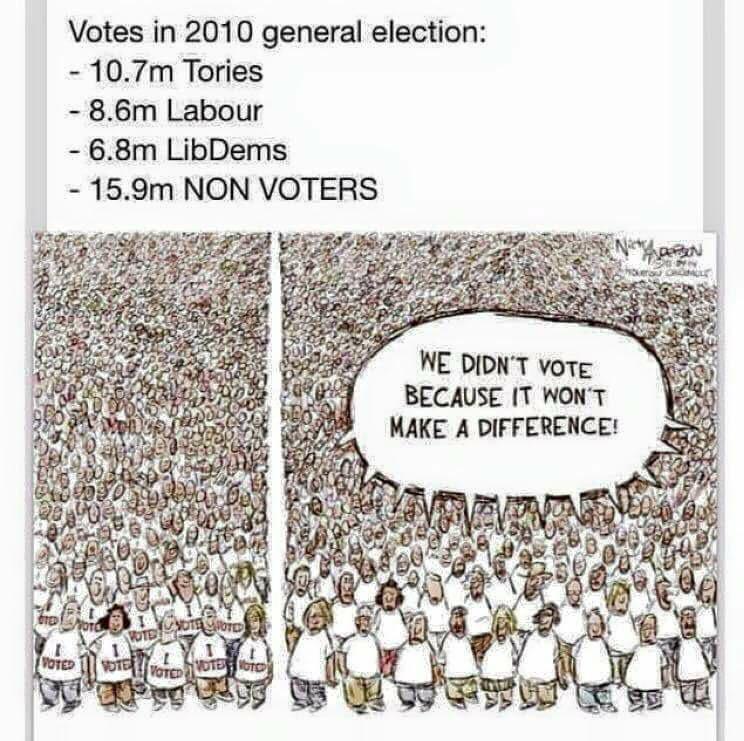
Yesterday we had the party leaders all over a small number of marginal seats. It is obviously wrong that these seats and these restricted electorates get this attention, and that a few voters in a few swing seats hold the keys to the next government. I can understand why many people feel it is not worth voting; it hardly is for most of them. Such people have a respectable point, which can't be legitimately dismissed by pious preaching about their 'civic duty' and how 'people fought and died for the right to vote' (in First Past the Post).

Media preview
This kind of preaching has little effect, because abstainers have a good point: they really can't make much difference.
I used to think that tactical voting was a good idea under certain circumstances, but I have changed my mind. Tactical voting is a short term, negative tactic which people use to try to avoid getting the MP or government they definitely don't want in a bad, unrepresentative system where a party voted for by a minority can wield absolute power. But in the long term, tactical voting has always failed us. It delivers no genuine change because it makes the support for minority parties, which do wish to see the system changed, appear smaller than it justly should be. It always returns to power the big parties who wish to keep the elected dictatorship going. First Past the Post is a fiendishly clever system because, short of a violent revolution, there seems no way it can be changed. The parties, lobbies and viewpoints that is suits always win, and they won't change the system they depend on for their continued power.

We can protest and lobby and campaign against this, which I advocate, burt we can also act today by not playing along with the system and not voting tactically, but voting according to conscience. For there is no such thing as a 'wasted vote'. Though your vote for a party thought to have no chance of winning in your constituency may not count electorally, it will be counted by someone. Every vote for a party advocating fundamental constitutional reform, or a new type of economic system, or a human transport system,  makes those reforms more likely, in a way that voting for the big parties does not. it increases the moral political weight of that minor party or individual and makes appear more iniquitous the inevitably unrepresentative result. It makes people think about these issues more, and, at the very least, it heartens some brave soul fighting on a principled platform for a party that cannot win; it tells them that they have not been wasting their time, and it may at least save their deposit. It encourages others who think similarly to try next time and to keep working between elections for what they believe in. So don't vote tactically, it's bad for your soul, and it's bad for the soul of the nation. The practice is itself part of the broken system.

Saturday, 17 January 2015

Why people advocating personal solutions to social problems annoys me

This post was triggered, as are many posts, by a Twitter exchange. This started because the City of London Twitter account announced:
We've teamed up with #taxis & .@CleanAirLondon to help #Londoners avoid air pollution bit.ly/1E7lxJZ .@TheLTDA pic.twitter.com/Mx4ATzvjOV
They were promoting an app where you can "choose from the user groups below to receive advice tailored for you on polluted days". So the Licensed Taxi Drivers Association was advising us on us how we can attempt to avoid the pollution that they are in large part responsible for. Great. A bit like Henry VIII advising his wives to steer clear of men with axes.

In reply to this, Schrödinger's Cat tweeted:
.@cityoflondon Is that advice simply "Leave London"? @CleanAirLondon @TheLTDA
Now the story gets more curious, because Clean Air London is a respected pressure group campaigning for air pollution to be cleaned up in London. They replied to my re-tweet of Schrödinger's tweet,
@VoleOSpeed You can reduce exposure without leaving London. @HealthyAirUK video
They linked to this video, from Healthy Air, another anti-pollution campaign:


This over-long video presents essentially two contentious ideas. The first is that those cycling and walking receive less pollution than those in cars. This is contentious because, although the concentrations of some pollutants have been measured to be higher in cars than around the heads of those walking and cycling on the same roads, it does not take into account the rate of absorption due to exercise and respiration, nor the time spent exposed to the pollution. Now, there's nothing wrong with advising people to cycle or walk (except that such advice is likely to be ineffective until the environment is changed to make that behaviour easier), but let's not advance scientifically-shaky arguments for it.

The second contentious idea is that those walking and cycling can reduce their pollution exposure by chosing 'quieter routes'. This is problematic in many ways. For one thing, there's nothing in general to stop motorists from very sensibly heeding the same advice, and chosing the quieter routes to drive on themselves, so making those routes anything but quiet and tending to level-up air pollution everywhere (a process that the sat-nav devices are expediting). For another, the advice is impractical, whether we talk about walkers or cyclists. They need to go to where the things are that they need to get to, which tend to be on main roads. Also, the main roads usually are the direct, shorter routes, the socially safer ones, and the easiest routes to find and navigate without spending a lot of time in research.

An actual example: yesterday, I nededed to wheel my partner, who is in a wheelchair, from the National Hospital for Neurology and Neurosurgery, Queen Square, London WC1, to King's Cross Station. We had decided to create less pollution by walking and taking the tube than by taking a cab. We could have walked between those points on a slightly quieter and ldess polluted route than the one I chose, which was via Russell square, Tavistock Place and Euston Road, some of the most polluted roads in London, but in fact we needed to go via shopping streets as we needed also a bank, and we desired an eating-place as well. She, being low down in the chair, would have received the worst of the pollution.

In general if you try to navigate in any town avoiding the main roads, you soon find that you are taking much longer routes, you are taking complex, time-consuming detours (which might lead to you even absorbing more pollution as you are in lower levels for longer), you are probably going up and down more hills (which also may lead to more absorbtion), as main routes tend to be the flattest ones in hilly areas, and you require more planning to take in the facilities you actually need to get to.

The truth is that everybody has a limited amount of time. Main roads are the main roads because they go through. Minor roads don't, you get lots of kinks in your route trying to use them, or you find yourself trying to navigate obscure paths, through housing estates or other obstructions, and in places where the space is tight and infrastructure poor. Many back streets have narrow pavements in a bad state of repair or with strange gradients or changes of surface, or are full of street furniture obstructions that make them impossible to get a wheelchair along. I have tried to use, for example, Stephenson Way NW1, as an alternative to a section of Euston Road, and found it is quite impossible with a wheelchair, for these reasons. You can only have a reasonable level of confidence that you are going to encounter reasonable, pedestrain and disabled-friendly infrastructure, with good junctions, pedestrian signals, smooth surfaces, proper dropped kerbs, and enough space, by sticking to big roads, where the pollution is.

But what I really object to is not being told all this nonsense about 'quiet routes' in itself. I can put up with it if I am told it by institutionally hypocritical governmental organisations, or people who are part of the problem, like the Licensed Taxi Drivers' Association. What I really object to is being told it by organisations that claim to be there to campaign for better conditions: for actual solutions to the problem of pollution. Because, I don't understand why they are doing this. It's like they are undermining their own work. They are causing a distraction from the big, real social problem, that they are supposedly there to address, and its real, collective, structural, permanent solutions, by towing, or in any way supporting or publicising, this 'personal solution' line. It's just very convenient for the organisations on the 'other side', like the chronically conservative, anti-democratic mediaeval excrescence that is the Corporation of the City of London, or the polluters themselves, the taxis, that campaigners collaborate with this kind of thing.

It's parallel to the cycling case where, for so long, cycle campaigners have got wrapped up in the idea, and the systems, of trying to train people to cycle in motor-dominated conditions, as a personal solution to the big social problem, that, basically, cycling can't flourish unless it is given workable motor traffic-free space. This is a similar distraction, playing along with the 'solution' advocated by those who want to keep the environmental, infrastructural status quo. It absorbs so much energy that should be spent campaigning for the actual change in conditions that is needed.

In another area in which I am interested, the quality of the night sky and the issue of light pollution, it is like campaigners for darker skies telling people they should get dark skies by driving to dark places (producing more pollution on the way, of course), rather than by getting better, more appropriate lighting solutions in their communities, in the places, and at the times, at which they are genuinely required, and not elsewhere.

It's also like rape justice campaigners saying a part of the solution is for women to be more careful and not get drunk, or put themselves in risky situations, or wear the 'wrong' clothes.

I am irritated by these people promoting personal solutions to social problems because they are wasting time and energy on these things, they are letting 'the authorities' and those otherwise in powerful positions 'off the hook', and in general, they are giving out patronising, unhelpful, poorly-thought-through advice to boot.

It's not a practical solution to try to avoid air pollution by cycling or walking on quiet routes. It's not a route to mass cycling to try to train everyone to ride on roads full of motor vehicles. It's not a solution to light pollution to tell anybody who wants to see the stars to drive to a place many miles away. It's not a solution to rape to advise women to avoid risky situations – which will – hey! lead to them avoiding quiet streets, which is where they are supposed to go to avoid the pollution, and not cycle, which seems to be regarded as an act of sexual provocation by many men, and avoid the places where they might be able to silently contemplate the stars.

For these personal 'solutions' to social problems just lead to a mass of patronising, contradictory advice and nonsense. They are not short-term solutions to 'tide us over' until the policies can be sorted out, they are part of the problem themselves; they form a part of the environment of ideas in which the real solutions are just put off. My take-home message: if something is wrong, campaign for the policies to fix it. Don't tell individuals to change their behaviour. Don't even start.


Wednesday, 31 December 2014

Letter to the BBC over 'I'm Sorry I Haven't A Clue'

Dear Sir,

I am writing to complain about a joke that was made in the I’m Sorry I Haven’t a Clue broadcast on Saturday 27 December, near the beginning, between 1’33 and 1’48” on the iPlayer recording. Part of Jack Dee’s introduction, this attack on ‘cyclists’, implying they do not know the Highway Code, was offensive, cheap and unpleasant humour to me, and to many others who I know.

I am sure you will claim that Clue is an ‘irreverent’ programme where attacks or jibes are meted out without fear or favour to all sorts of groups. Yes, the jokes following this ‘got at’ steam railway enthusiasts and UKIP supporters. But the joke against cyclists was unpleasant in a way that these, and similar jokes in the show, are not. They do not have the hostile majority-minority power-play implied that the joke against ‘cyclists’ did.

The background to this is that around 120 cyclists are killed on the roads of the UK every year and about 3,000 seriously injured (a figure that has been increasing in recent years). This is a bad record by international standards – cycling on the UK's roads is at least twice as dangerous as in some neighbouring European countries. According to statistics of police analysis of these incidents, in most cases the killed or seriously injured cyclist was not at fault and was cycling correctly and legally, and therefore most of these cyclist deaths and injuries are due to bad, illegal, and dangerous driving: that is, drivers wantonly ignoring the Highway Code. Yes, there are infringements of the Highway Code by all user-groups, but motorists have far more power to do damage than cyclists, who will in general only put themselves at risk by behaving badly on the roads. The issue is therefore the dangerous and irresponsible behaviour by those in control of powerful motor vehicles.

Unfortunately our society normalises many aspects of this behaviour, particularly the crime of speeding, and there is a mentality amongst many motorists that they have superior rights to the road compared to non-motorised users, and a culture of victimising cyclists with socially-widespread and acceptable inaccurate, prejudiced claims about their behaviour. It is right into this trap that the Clue joke about the Highway Code fell.

This kind of humour would be totally unacceptable when applied against religious or racial minorities, or other groups, such as the disabled. Cyclists have to put up with it as normality. It helps to sustain a set of attitudes in the public and official bodies that result in cases, such as the recent one of Michael Mason, a cyclist killed by a motorist on Regent Street (very close to Broadcasting house) where the driver who killed him has received absolutely no punishment despite effectively admitting full guilt and responsibility. The mythology of blaming and victimisation of cyclists excuses these deaths to our society and makes acceptable the fact that no-one is held responsible for road deaths in cases such as these, or  if they are, they typically receive derisory punishment.

I expect many BBC employees cycle to work on Portland Place and Regent Street, where Michael Mason, an experienced and expert cyclist, was killed, through no fault of his own. I wonder if any cycling BBC employees had the ‘Highway Code’ joke run past them before it was broadcast. I expect the answer is no, as if it had been, the scriptwriters would have realised their error. This was an offensive joke and should not have been broadcast. This was a favourite Radio 4 programme of mine, but I expect I will not be able to enjoy it in the same way again.

I hope these thoughts have explained to you why the BBC should apologise to the cycling community, and cycling organisations, for this error of judgement.

Yours,

David Arditti

Friday, 5 December 2014

Whatever happened to the Biking Borough money?

After Boris Johnson won the 2008 London mayoral election, he formulated a new cycling strategy which involved ditching Ken Livingstone's London Cycle Network Plus programme, which had run into the sand because of a lack of political will to tackle the main barriers to cycling in London like dangerous junctions, and was never predicated on high-quality infrastructure standards anyway, and replacing it with a combination of the first-generation Cycle Superhighway plans, to affect mainly Inner London, and a project called Biking Boroughs, which was for Outer London.

The initial Cycle superhighways (sponsored by Barclays) were merely strips of blue without any legal backing, mostly painted inside bus lanes on main roads, and often disappearing altogether where there were competing demands for road space. They did not treat major junctions in any safe or logical way, leaving them much as they had been, the blue lanes sometimes disappearing from an inside lane and reappearing in an outside one, leaving hapless cyclists to cut across multiple lanes of fast-moving motor traffic, if they dared. They were of course massively criticised, and at the time I commented, to the London Cycling Campaign:
The funding and the conception behind these routes is so calamitously inadequate to the task that they will be a total waste of time and money, and, worse, will attract inexperienced cyclists onto main road routes that have not been made any safer than they are now, with junctions that are still highly dangerous and unsuitable for all but the most skilled with-traffic cyclists.
Later came the much-publicised deaths on the 'calamitously inadequate' Cycle Superhighway 2, and following LCC's Go Dutch campaign and the appointment of Andrew Gilligan as Cycling Commissioner, we have a programme to rebuild the Superhighways to proper standards (or at least much better).

But let's go back to that other, less-publicised strand of Boris's first cycling strategy, the Biking Boroughs. This seemed to come out of an idea, propounded by Transport for London in its Analysis of Cycling Potential report of 2010 that:
The greatest unmet potential for growth can be found within outer London – 54 per cent of potentially cyclable trips – and only 5 per cent of the "total potential‟ in outer London is actually cycled, compared to 14 per cent of that for central London... and 9 per cent for inner London. The "total potential‟ is defined as the total number of trips currently cycled added to the number of potentially cyclable trips.
This was without doubt a true statement, given that so much of London's population lives and moves in the outer Boroughs, and given that cycling is so low there now, and yet one that gets us no further towards achievement of that potential without any definition of the standards that should pertain in the Outer London cycling environment, which were not hinted at by this study. Vagueness was thus built into the Biking Borough concept from the beginning.

The Biking Borough policy itself was very short-funded and gave little clue as to what it was actually trying to do in practice. I thought TfL might have tried to bury this embarrassment by now, but, surprisingly, a page on it still exists on the TfL website, saying this:
Thirteen outer London boroughs were given a share of £4m funding over three years to help raise the profile of cycling, improve facilities and highlight safety awareness locally.
All of these Biking Boroughs are funding initiatives to encourage more people to take up cycling, whether to work, or in their leisure time. The activities involved include:
  • Creating and improving cycle routes and access 
  • Educating people about cycle safely 
  • Making train stations more cycle friendly 
  • Building more cycle hubs
So a 'Borough' is an 'initiative': more confusion of thought and language. And to me, the term 'Biking' always suggested something to do with motorbikes. The first item, 'creating and improving cycle routes and access' sounds useful, but no-one actually could ever explain what a 'cycle hub' was, and Freewheeler's explanation is as good as any that I came across:
The answer is simple. A ‘bike hub’ is usually a shopping centre full of cars which contains no cycle parking. To access the ‘bike hub’ simply get on your bicycle and follow the signs that read ‘CAR PARK THIS WAY – PARKING FOR 600 CARS’. Remember to watch out for drivers of lorries, vans, 4X4s, Audis and BMWs, as these drivers find it particularly difficult to see cyclists.

If your local council is ‘Green’ you might find some cycle stands tucked away around the back of the car park block. These are rarely signed but it is always well worth looking for the waste containers. Remember that most bike stands are traditionally located in close proximity to rubbish.
But seriously, I am interested to learn from the TfL webpage linked above that:
A full report on all Biking Boroughs will be published in 2014 including results, case studies and lessons learned.
We are now almost at the end of 2014, and I have seen no sign of this report. It should be interesting.

I can, however, report on what happened in one borough that was awarded Biking Borough cash: Brent.

Brent was awarded £294,500 of Biking borough funding to be spent in 2011/12, 2012/13 and 2013/14. This was one of the largest awards to any borough. This followed the production of a TfL-funded report for the council on the state of cycling in the borough. Anybody could have told them for free that the state of cycling in the borough was 'dire' or 'virtually non-existent', but this is not how local government works. Every time there is a new project, and any funding to do anything at all, first of all, a large tranche of that funding has to be spent on a report from external consultants that tells you what everyone can see anyway.

The Brent Biking Borough report can be found on the Brent Cyclists website. I am not sure how much this cost to produce, but funding was provided by TfL of 'up to £25,000' for such a study, so it's a fair guess that the cost approached this. I first came across the wonderful world of cycling blogs, literally, when someone pointed me to Freewheeler's devastating critique of the Brent Biking Borough report, amongst the highlights of which were these paragraphs:

This MVA Consultancy report does a professional job of identifying the poor condition of cycling in Brent. However, it doesn’t diagnose it because it is incapable of understanding the reasons for it, and therefore its cures for the condition are rather like medical cures of the pre-modern era – a mixture of quackery and superstition. All the traditional cycling folk remedies are here – cycle training, signposting, promotional activities, recycling old bikes – and none of them will save the patient. 
.....
This report shows no understanding of the central importance of addressing subjective safety. Instead of safe and convenient cycling infrastructure what is really on the cards is developing relationships with parents to ‘encourage’ them to send their children to school on bicycles. 
It won’t work. Cycling will at present only increase to the extent that people can be persuaded to cycle in Outer London traffic. There are few signs that persuasion and minimalist new cycling infrastructure will ever be enough to encourage the surge in cycling which even the Mayor’s deeply unambitious target requires. Cycling in Brent appears every bit as doomed to stagnate as it does in the London Borough of Waltham Forest or in any other Outer London borough.

The report was launched at a 'Stakeholder Engagement Forum' on 3 March 2010 that I attended. I described this event in the April 2010 Brent and Harrow Cyclists Newsletter:

We heard a lot of interesting statistics collected by the consultants, though the gist of most of the important ones are things we already knew or could pretty much have guessed. Facts included here were that the proportion of people cycling to work varies from 0% in much of the north of the borough to over 6% in Kensal Rise, that 90% of Asian residents never cycle, compared with 74% of white residents, and that the highest levels of cycling are amongst middle-income earners. This last came as a surprise to the consultants, but not to us...

The stated objective for the “Biking Borough” is to achieve a 5% modal share of trips by bike (TfL’s statistics say that the modal share is currently 1%). The main problem with this forum, in our view, was a general underplaying, or a lack of understanding, of the role of the physical environment in determining cycling levels. There seemed to be a naive view amongst some, including the consultants, that raising the levels of cycling in Brent would primarily be a matter of promotion or publicity. A concept of a “Cycle Hub” was being discussed, but it was entirely unclear what this was supposed to be. Boris has apparently introduced this concept, but not defined it, and it is up to boroughs to interpret. It seems, however, as if it is not going to be primarily conceived as the provision of physical infrastructure.

Participants were asked if they thought the strategy should focus on trying to get more cycling from communities in Brent that already cycle quite a bit, or on trying to reach the communities that are highly reluctant to cycle, such as the Asians of north Brent. We do not think that making any such choice is desirable. We believe that the cycling environment needs to be improved radically across the whole borough, and that doing this would, pretty much automatically, raise cycling levels in all communities. The measures that need to be taken are well-known, it is a matter of political will and the commitment of funding. The main points we were keen to emphasise were the widely- perceived danger of cycling on Brent’s roads, which will not go away with a bit of promotion, and the lack of cycle permeability of the borough, with the major barriers of the North Circular Road and the railway lines preventing the creation of attractive and safe cycle routes. Until the major funding needed to address these is forthcoming, we do not see much prospect of Brent really becoming a “Biking Borough".
The money that Brent was allocated by TfL under the Biking Borough project was divided up as follows:

Project area
TfL Biking Borough funding to your borough
2011/12
2012/13
2013/14
Cycle Hub
£54,500
£50,500
£50,500
Cycling Communities
£10,000
£10,000
£10,000
Raising the Profile
£6,000
£2,000
£2,000
Other
£33,000
£33,000
£33,000
Total per year
£103,500
£95,500
£95,500

What the headings on the left really meant always remained a mystery to me. But I can tell you that the 'cycle hub' selected was in the south of the borough, in Kensal Green. SKM consultants were engaged for three years to find ways of spending this money around this area (which was already pretty much the highest-cycling area of Brent, owing to it being fairly affluent and only three miles from the West End, and having no major main-road barriers worse than Maida Vale and the Harrow Road, and already a reasonable functioning twisty backstreet London Cycle Network route from the West End (via Hamilton Terrace, Blomfield Avenue and Shirland Road)). They thus thought that in a borough with generally exceptionally cycle-hostile infrastructure, this area would be the easiest nut to crack.

What the 'cycle hub' actually amounted to in the end was the installation of cycle stands, mostly at Kensal Green, Kensal Rise and Queens Park Stations, and other places on the streets, and provision of numerous blue direction signs around Kensal Green, giving cycling mileages to various destinations. The roads were not improved in any way at all, except that there was contemporaneously, and seemingly incidentally, not funded out of the Biking Borough budget, a programme of installing cycle-unfriendly speed cushions and speed tables on residential roads in the area. Cycling remained firmly banned in Queens Park, under the control of the Corporation of London, and so there remained pretty much zero traffic-free space for cycling in the area, and no-where to take kids to teach therm to cycle.

Copious cycle signage supplied as part for the Biking borough Cycle Hub in Kensal Rise
There was an attempt by the consultants and the council to identify some permeability measures that could be implemented on minor roads in the area. They whittled it down to three possible schemes:
  1. Tidying up of an exiting messy road-closure in Hazel Road, near Kensal Green Station, and formally allowing cycle passage through it;
  2. Removing or modifying the barrier in the centre of Brondesbury Park (a road) between the two halves of Christchurch Avenue (two side roads) to allow cycling between these two roads, currently blocked along with the passage of all other traffic in an existing anti-rat-running scheme;
  3. Allowing contraflow cycling on Clifford Gardens, just north of Kensal Rise Station.
Tiny and profoundly unambitious, or 'realistic', if you will, as these schemes were, none of them were realised. The reasons are too tedious to go into at length.

Possible scheme 1:Road closure in Hazel Road, bikes formally banned, no dropped kerb at far end
I mentioned Number 1 in a previous post, The red tape that strangles cycling provision. The red tape strangled this tiny proposed change. Though the bit of digging and kerbstone-lying required would only have taken a couple of men half a day to do, it would, apparently, have been too expensive to change the traffic order. (Some of the professional opinions on that latter post were that it should not have been, and that Brent officers were interpreting procedure or the law wrongly, but I cannot adjudicate on that. I can just tell you it did not happen.)

Possible scheme 2: Christchurch Avenue barrier in Brondesbury Park: an easy-to-fix snag that eluded solution under the Biking Borough /Cycle Hub projects
Scheme number two produced another set of meetings and a consultant's report, which proposed a bad fudge that no-one liked, and again that scheme never made progress. The consultant's suggestion of widening the barrier to create a cycling refuge in the middle of Brondesbury Park would just have created more problems for cyclists on that road. The solution for that location was clearly, and still is, clearly, for the barrier in the middle of the main road to be moved to one of the side roads, and for a cycle gap to be made into it there, with maybe a combined cycle-pedestrian crossing of Brondesbury Park to aid cyclists in getting across from one side road to the other. But that would be a change to the traffic system, with changes to allowed movements in and out of the side roads. Though this change would not necessarily be 'anti-car', car movements here are restricted by the current setup, Brent officers believed they would not win any consultation of residents in the area on such a change, which they believed firmly could be painted as being 'anti-car'. So nothing has happened, despite children and staff at Malorees Primary School in Christchurch Avenue, a school which is doing its bit to encourage cycling, wanting a route across here. This should have been a classic 'easy win' for cycling, but it couldn't be achieved in the three years of Bikling borough funding, though it remains on the Brent Cyclists Space for Cycling 'Ward Asks' wish-list.

Possible scheme 3: Clifford Gardens
Scheme 3, the contraflow on Clifford Gardens, a side-road off Chamberlayne Road, planned to connect with an existing contraflow (one of the few in Brent) on Bathurst Gardens, got further than all the others. Though there were doubts amonsts some cyclists as to how well this might work, with parking on both sides of this narrow road, and a need, if it the scheme were implemenred, for cyclists to face down some fast rat-running traffic in the confined space, it was supportyed by Brent Cyclists, as really the last hope of getting anything concrete out of the Biking Borough project, and it was designed and went to consultation. The results of the consultation were 52% in favour, 48% against. Brent Council decided that this was too close a margin, and abandoned the project.

It's worth reminding ourselves now that in 2011, in a letter to Brent's then Head of Transport, Ben Plowden of TfL wrote:
Your funding bid has now been evaluated against the following criteria:
  • Demonstration of local political and stakeholder commitment to increasing levels of cycling;
  • Evidence that the measures proposed will achieve a step change in levels of cycling and offer good value for money;
  • Deliverability by March 2014.
I am pleased to confirm that a total of £294,500 has been awarded to your borough to fund proposals relating to the development of Cycle Hubs, Cycling Communities and Raising the Profile of Cycling locally as set out in Table 1 below. I would like to congratulate you on the scope and quality of your bid.
So even where a consultation was won, on the last-ditch attempt to push some change through using the Biking Borough cash, Brent Council turned back. So much for the 'local political commitment to increasing levels of cycling'. So much for the 'proposed changes'. So much for the 'step change in levels of cycling and good value for money'.

The £294,500 awarded to Brent disappeared into promotional activities (such as dubious victim-blaming things like "Exchanging Places"), some funding for training courses and Sky Rides, and production of a promotional booklet about cycling in Brent, which contained basic errors, like a map that showed a route that did not physically exist, and promoted the dubious ideas that cyclists were safest using cycle infrastructure where available and that they should always wear a helmet.

I can't say anything about the Biking Borough projects in the other twelve boroughs. But the way the Biking borough played out in Brent was a scandal. The £300,000 went down the drain, emptied into the pockets of consultants and the people who made the blue signs, so purposeless in the absence of meaningful subjectively-safe routes on the roads they signposted. Only the few thousands of pounds spent on the cycle stands could be said to have been possibly money well-spent.

A few stainless steel Sheffield racks are the only infrastructural legacy of the Brent Biking borough project
The £300,000 went down the drain because it was 'calamitously inadequate' to the task in hand, and nothing it could have been spent on would have caused substantial progress in raising Brent's cycling level from the existing 1% modal share to the Mayor's target of 5%. But it had to be spent, so it had to be wasted. After the money for the studies, money for leaflets, money to pay the lorries to come and do 'Exchanging Places', money for the events organisation and for the trainers was taken out, there was too little left, divided three ways between three tiny infrastructure schemes in a small (and anyway already relatively cycle-friendly) area of the borough, far from the disastrous cycling environment of the North Circular and the suburbs beyond, to even achieve those tiny schemes, given councillor-level indifference and officer-level timidity.

The Biking Borough project left Brent exactly as it had been before for cycling. Because it was such a small amount of money, I suppose no-one really cared about it. Boris's second term cycling strategy looks far better, because Andrew Gilligan has removed much of the fluff around 'cycle hubs' , 'cycling communities' and 'raising the profile', and directed a much larger investment into much clearer infrastructure objectives.

The three Outer London mini-Holland schemes in Walthamstow, Enfield and Kingston are each getting about a hundred times the Brent Biking Borough allocation. This is enough to matter, enough to make a difference, if spent wisely, and enough for people to care about getting wasted. On the other hand, some of the issues that bedevilled Brent's biking borough could come back to haunt the current mini-Holland and Quietway projects, and they should not be neglected. The Brent failure needs to be learned from, and I await this promised report into the overall effectiveness of the Biking Boroughs with much interest. Even if a sensible amount of money is provided to change an area of car-dominated Outer London, and even if it is not, this time, divided up into such small parts that nothing useful can actually be done with it, the same risks exist, of council double-speak, consultant opportunism, lack of engineering and administrative competence, timidity and foot-dragging, to waste it all again.

Four years after the Biking Borough study, and two years after its mini-Holland bid failed, Brent is conducting a survey to inform a new cycling strategy. There appears to be no limit to the amount of paper that can be pushed before we get the real infrastructural change in Brent that everyone interested in the subject can see we need. Since the end of Ken Livingstone's LCN+ project in 2008, not a single, tiny piece of cycling infrastructure has been built in the Biking Borough of Brent.