Mostly about cycling in the
"Biking Borough"of Brent
and elsewhere in London,
but also touching on
environment, politics,
philosophy, science,
society, music and art
Five years ago today the video below was issued by London Cycling Campaign as part of a consultation exercise with its members to find out what their preferred campaign might be for the 2012 London Mayoral election. In it, I argued that the key first step towards mass cycling is the provision of high-quality segregated cycle tracks on main roads. This overwhelming support this concept gained from the membership led directly to the Love London, Go Dutchcampaign, the commitments secured from Boris Johnson, his Mayor's Vision for Cycling, and the system of quality segregated cycle tracks we now see starting to be developed on the main roads of London, so conspicuously enabling all-abilites, 'eight to eighty' cycling in places where this had not be dreamed of before. So I am proud of this.
This is not to decry the proposers of the other three possible campaigns mooted in the video. They all make excellent points. But it was a matter of what was the best, most effective strategy for us to pursue at the stage we were at (and largely still are) in our development of a utility cycling system and culture in London.
In the video, the first proposed theme, that of getting larger numbers of children cycling to school, was an objective, not a mechanism. There was no contradiction or competition with my proposal there because the one was necessary for the other. A very large number of schools are only accessed on major roads that would need segregated cycle infrastructure in order to get kids and parents cycling to them. Other schools in other places would require different treatments of the roads around them. But putting a social result of good cycling infrastructure forward to be the campaign itself was not quite logical. And one might be struck by the fact that for a demonstrator background to that bit of video, a temporary 'artificial' situation was used, of the FreeCycle (then called SkyRide) ride round London where children do indeed come out cycling in large numbers because the roads are closed for a few hours. In contrast, the background to my segment was the real, permanent situation created by the Torrington Place cycle track in Bloomsbury (which was doubled in capacity last year).
The third proposal, for 'unwinding urban gyratories,' also contained a fallacy: the idea that merely making these major roads two-way would be of great benefit to cyclists and pedestrians, would actually transform them into pleasant places to be, without measures to also reduce the total motor traffic. I've dealt with that one here, and I think we've moved beyond this concept in policy terms now. I pointed out long ago how, where in it was tried in practice, for example in Piccadilly, the simple unwinding of gyratory systems proved to be no good for pedestrians or cyclists.
Then the final proposal, Love thy neighbourhood, for a campaign for area-wide traffic motor removal schemes through modal filtering, did of course advocate a policy that is essential to creating a truly people-friendly city. But it can never be the primary solution for cycling on the road grid that we already have, because we can't get rid of all the motor traffic arteries that most real cycle trips will need to use for part of the journey. A comprehensive application of Love thy neighbourhood principles would, at best, lead to a series of separate small districts in which cycling was an attractive option, cut off from one another by still-hostile main roads.
Then, proposing this as the first step from where we were, also, I hold, badly underestimated the huge political challenge of creating these calmed neighbourhoods in a political climate where most people cannot imagine everyday transport by bicycle and believe in general that having all possible routes for motor vehicles open is a good thing. The Quietway element of The Mayor's Vision hit precisely this snag. It turned out, as I expected, that it was actually poltically far easier to carve space for cycling out of main roads by physical segreagtion, than it was to create routes on minor roads by closing rat-runs. Those who depend on car transport typically only think their street should be quieted. The next one, and the next one... they should all be rat-runs to allow them to get places fast. This is a fundamental problem. We have seen that there is not yet political consensus on the general desirability and practicality of low-traffic residential areas in London.
We've seen that again and again, in Lambeth (Loughborough Road area), Camden (West Kentish Town), Hackney (London Fields) and so on, where progressive proposals from boroughs for area-wide traffic reduction in residential districts have been defeated by opponents. But, judging from consultation results, and also conversations I have with politicians, we do have consensus that main roads should allow protected space for cycling. We need the calmed neighbourhoods as well, of course, for many reasons beyond cycling, but it looks like being a while still before that argument can be generally won. Then again, a main point about the 2012 campaign was we were trying to influence the Mayor, and he controlled not the neighbourhood roads, but the major ones. So it made sense for the campaign to be calling for stuff that he could bring about directly.
The point about the main road treatments is they really do generate new users, they get people out of their cars and off the buses and tubes, and start to build up the mass of influence we need to get the other, more difficult changes through. That's why attempting to start with the other stuff wouldn't be very effective. That's why I stressed in the video: This is the first step to generating a real, mass cycling culture. The propaganda power of the cycle track carved in granite out of what was previously space ruled by motors is huge, and immediately comprehended by those who have never thought about this subject before, in a way that filtered permeability just isn't. In other words, as Paul Gannon said to me back in the last century: people cycling on separate tracks on busy roads make other people think I could could do that too to a far greater extent than any other engineering measure or piece of promotion does.
The proof of all this seems to me to be amply demonstrated by what we see on the roads of Central London today. Mind you, I never expected to see the scene that was videoed by Wayne David last Saturday at the Embankment, site of the East-West Cycle Superhighway, the route for which I first suggested to Andrew Gilligan, the future Mayor's Cycling Commissioner, in 2012.
Clearly this was not the normal usage of the Embankment even on a busy day for cycling. Bike Biz tried to get to the bottom of what it actually was: seemingly a semi-organised, semi-counter-cultural, semi-commercial youth street 'happening'. It attracted criticism, but I cannot but agree with one commentator on the BikBiz article, who wrote:
Looks like they've done a better job at getting young people on bikes than all of the government schemes put together...
They may have been preparing for the RideLondon FreeCycle this Saturday. This annual mass ride around closed streets in Central London has existed for many years under various names and sponsors. It was first suggested to the then Mayor, Ken Livingstone, by LCC. I've been somewhat negative about this event in the past: of the 2011 event, then called Sky Ride, I wrote:
In this event, a seven mile circuit of central London streets is given over exclusively to bikes for a few hours once a year, cyclists are dressed up like yellow canaries for no apparent reason except to unwillingly advertise Sky Sports, and a huge number of obstructive barriers is erected around The Mall to prevent anybody from conveniently walking anywhere, enforced by a huge number of paid-for-the-day officious event staff who shout orders at you and tell you what a good time you are having.
I saw it as rather tokenistic and an excuse for the Mayor not taking decisive action to make cycling an everyday option for Londoners:
To expect Sky Ride to encourage more people to cycle under everyday London traffic conditions is like expecting the experience of taking a cross-channel ferry to encourage people to swim the channel. It unrealistic, as the conditions are so profoundly different.
But from where I sit now, having seen the changes since then, I reckon I was a bit harsh. Perhaps these events, though demonstrating the suppressed demand, did contribute to generating the political pressure that brought our present infrastructure programme into being. And, strangely enough, I am quite looking forward to this weekend's event. It looks far better than ever before, with a route that does not use the same roads there and back, as in the past, but is a real loop round, with various interesting alternatives to explore, using in part the new East-West Superhighway, but closing a lot of other roads to motor traffic besides. And, of course, if you are lucky enough to come from an appropriate direction, you can use a Superhighway to get there.
Maybe I will see you there. Look out for the Vole!
As we draw to the end of this very unpleasant referendum campaign, it is worth, I think, recalling why we are where we are. It essentially goes back (as do so many things in modern Britain) to Mrs Thatcher. It was her volte-face on Europe that split the Conservative Party, the split that ultimately led this referendum to be called. After being strongly pro-European in the early part of her premiership, continuing the tradition of pervious Conservative leaders (including Edward Heath, who took the UK into the EEC, as it then was), including signing the Single European Act (the Luxembourg Treaty) in 1986, which gave the first real powers to the European parliament, she did a 180 degree turn on the subject for reasons best known to herself. Half the Conservative Party follwed her, and half continued allegiance to the older conservative pro-Europe line. The next leader, John Major, was bedevilled with this problem, and could not solve it, though he got the Maastricht Treaty, which created the modern EU, through. David Cameron's solution to this same, ongoing problem of the bitterly-divided Tory party was to call this referendum. The nation overall did not want it: it is important for our European friends to understand this.
The European Union was actually proposed by a British Conservative Prime minister in the first place: Winston Churchill. But it was always unclear whether he saw Britain as part of that future entity or not. Probably, he did not: he shared the romantic Victorian-Edwardian attachment to the dream of some future theoretical and impractical 're-union of the English-spaking peoples' (presumably including the USA, Canada, Australia and so on) that would then separate us from Europe. A similar transatlantic-gazing viewpoint is it the root of the views of many of the current Leavers: that we can somehow go on to exploit our cultural and economic attachments with those anglophone parts of the world more thoroughly if only we can leave the EU behind. Unfortunately, in the real world, as opposed to that of Rudyard Kipling's and Arthur Conan Doyle's fiction, we can't.
There are of course some on the radical left of UK politics campaigning for 'Leave'. Some of these are people for I have great respect. Baroness Jones (Jenny Jones, former Green London Assembly Member) is one of these. I attended her leaving party at City Hall before the May election to congratulate her ( and her colleague Darren Johnson) on all they had done for cycling in their time at City Hall. Nevertheless, I'd like to take her to task on her pro-Brexit position (which is at odds with the majority opinion in her party). This essentially amounts to: 'THe EU is broken and undemocratic. There's no chance we can fix it, so we should leave'.
I find this a very strange position for anyone of an internationalist disposition to take. So if the EU is 'broken', we leave, and what? We leave 300 million people in a 'broken' institution, and we give up any influence in trying to improve it or reform it? That can't be right. I can only imagine the rationale is that she (and others like her) hope that the EU will simply fall apart in reaction to Brexit. I have to say I find this a deeply improbable proposition. The UK leaving the EU will not have that much effect on the citizens of the rest of the Union, or on their politicians. The EU will be able to adapt and continue. The supposed fragility of the EU and its institutions has been consistently overplayed by our media. We've heard nothing about the Euro (ever) except 'It's on the brink of collapse'. Except that it hasn't collapsed. It's had a rocky time, but basically, this project, to place under a monetry union the economically diverse and divergent nations from Portugal to Austria and Finland to Crete , this incredibly improbable and ambitious project, has succeeded. It's not going back.
Similarly, if the UK leaves, there's going to be no shortage of new nations wanting to accede to the EU, and there's going to be no domino effect of old members wanting to leave. The EU is going to continue, grow, and strengthen as an entity, without us. We'll have to negotiate a new deal with the EU over trade and labour movement, and it's going to have to have many of the characteristics of the deal we have now. If we cease to pay into the European budget we're going to lose all influence over how the rules are set up, but we're basically going to have to continue to abide by those rules to trade. There's not going to be the free lunch the Brexiters want. We're going to have to accept freedom of movement if we want to be within the trading block on anything like reasonably advantageous terms. Or, maybe we'll be offered a deal whereby we pay to be out of the agreement on freedom of movement but within the trading area. In either case, we're not going to get what the Brexiters claim we might get. The EU has to defend itself, ultimately, in response to defection. It obviously can't offer an ex-member state a deal so advantageous that it might tempt others to secede. There has to be a punishment for leaving the club. That punishment will surely be felt in the purse of ever UK citizen in a Brexit world.
An anonymous cartoon gleaned off Twitter which crudely but effectively summarises the problem with the Brexit position
The world of science and the world of the arts both thrive on international co-operation, and their representative organisations are uniformly sending out the message that Brexit would be a scientific and cultural disaster: see for example the press release from the Royal Astronomical Society, or this piece by, extraordinarily, Jenny Jones's ex-GLA Green colleague, Darren Johnson and champion of cycling in Outer London (with whom I got drunk in a south London pub not long ago), now turned music journalist. The response of the Brexiters, that the EU is 'not a magic money tree' really doesn't cut it. It completely misunderstands what the experts in these fields are saying, what they know. As the RAS puts it:
Participation in trans-national programmes... has more impact than those carried out by single countries, even if they are funded at the same level. The coordination of projects across the European continent prevents duplication of effort, and allows scientists to more effectively share resources.
Much the same goes for the arts, for which freedom of movement is hugely important. And anyway, the Brexiters aren't saying the money we would save from EU membership would be spent on science and the arts. They seem to have committed that money to building more hospitals. Or something. But we won't have the money for hospitals if our science base, on which our high-tech industries depend, collapses.
In fact the Leavers have no coherent economic plan, and little understanding of why the EU is there in the form that it is in the first place. It was a response to a Europe almost destroyed by a century of war between major powers (if you date that century back to the Franco Prussian War of the 1870). The EU has made the Europe that generated those wars an unimaginably remote history to all who are young today.
The 'democracy' arguments trotted out by the Bexit side make no sense. None of them seem to have noticed that the UK is still dominated by a monarchy and a hereditary aristocracy and that two-thirds of our law-making parliament is unelected. The European Parliament, elected by proportional representation, is the most democratic layer of government England (outside London, which has the GLA) has got. The Council of Ministers consists of people appointed by the Westminster government and its equivalents in the other member states. There is a huge range of public bodies in the UK that wield great influence over citizens' lives that are far less democratic. I don't hear the Brexiters in general talking about removing the undemocratic influence of mediaeval bodies within the UK like the Corporation of London, the Royal Parks Agency or the Verderers of the New Forest.
Of course the EU is deeply imperfect in its democratic structures. But it is misrepresented as some sort of monster developing in its own way beyond the control of the citizens of its constituent states. Most of the nonsense claims of the Brexit side in this respect are simply knocked out by the observation that our government and parliament have had a veto over every significant change in the powers and operation of the EU over its history since we joined. We have agreed to it all: our Prime Ministers, cabinets and parliaments from Heath to Cameron have agreed to it all. We could have stopped anything we didn't want, and in fact we did stop lots of things. Other provisions, like the Shengen agreement on open borders, and monetary union, we opted-out of, for better or worse. The veto we had over treaty changes, plus the influence that being one of the biggest economies and biggest contributors made us, ensured that the UK influence in the development of the EU was always huge. We created the EU, with others. For us to leave it now would be like a person abandoning a house they had built, and into which they had sunk all our resources, with no realistic prospect of finding another remotely as comfortable or accommodating.
The EU is not a superstate, and is not heading to be one. There's a simple economic reason it can't be one. It's central administration takes only about 0.5% of the member nations' GDP. Its bureaucracy is on the scale of that of an English county council. I've seen it. I've been to Brussels to talk to the Transport Committee Chair of the European Parliament about cycling (who was then an English MEP). Such a small organisation with that level of funding can never take control of Europe in the manner of the Federal Government of the United States. It would take a massive change of policy on behalf of all the governments of the member states, acting unanimously, to start heading it in that direction. That ain't going to happen. And as for Ever closer union, that famous phrase, what doea it mean? I think it is correctly interpreted not as a vision of a superstate; I think it means rather an ever-closer spiritual and cultural union, an evolution towards a state of cooperation between the European peoples that makes conflict between them ever less conceivable. I believe this is what the founding fathers of the EU meant by that phrase. Then again, perhaps it doesn't mean anything at all.
I could go on and on on this subject, but I had better not. I haven't mentioned environmental legislation, worker's rights, so many other aspects of the story of why the EU is a worthwhile institution that has done the its peoples good. And I haven't touched on the how a UK vote to leave the EU will almost certainly herald the break up of the UK, through triggering another Scottish independence referendum, as Scotland will certainly vote to remain. Even more serious are the likely consequence for Northern Ireland and peace in the Island of Ireland, where the existing post Good Friday Agreement consensus, of devolved provincial government within a UK that is united with the Republic within the EU, will be broken. And, in case you are one of those worried by immigration (I'm not, like most people in London and other big cities who are used to everyone being immigrants from somewhere) I haven't touched on the fact also, that with less co-operation from EU member states and France in particular, we'll probably get more illegal immigration and asylum claims to deal with.
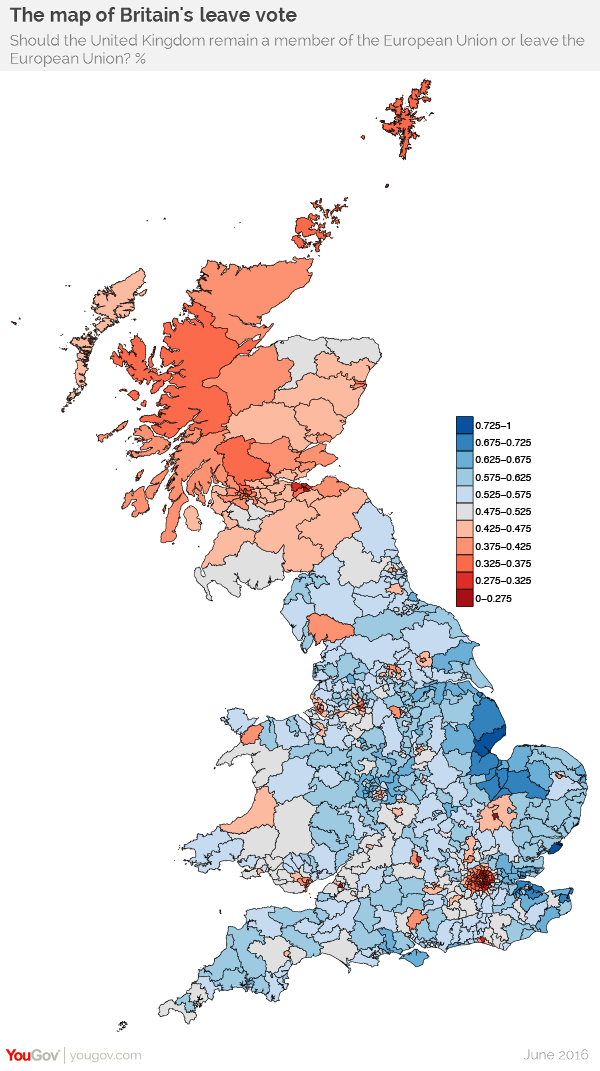
YouGov's map of voting intentions by local authority. Scotland will vote 'remain' and the UK cannot survive Brexit.
For cycling, the usual topic of this blog, the freedom of movement we have enjoyed since EU accession I am convinced has contributed to the cultural and information-exchange process that has allowed us to reach the point of importing some of the best pro-cycling policies Europe has produced into at least some British cities. For example, if we hant't had freedom of movement, would the Hembrows have settled down in Assen and provided us with the information and cross-cultural Dutch translation that we needed for the Go Dutch campaign in London? Such questions are unanswerable, and I need to get this blogpost out in time to make, I hope, one or two undecided voters to think in some new ways.
England was deeply part of cultural Europe until the reign of Henry VIII, the break with Rome, and the destruction of most English art by his henchman Thomas Cromwell. Our focus was more on remote territories for the next four centuries, but our attention was forced back to Europe by the wars of the twentieth century and the loss of our empire. The accession to the EEC was an important, defining event for those of my generation, too young to vote in the 1977 referendum called by Harold Wilson (whose Labour cabinet was divided over Europe), but brought up, post-decimalisation and post-metrication to think, at least to some extent, of ourselves as European citizens, with our maroon European passports. I am a product of the wider Europe, coming from a family on my father's side of wandering, Sephardic Jews, traders between the Christian and Moslem worlds, who had come from Spain at the time of the Inquisition, and spread across Europe, North Africa and the Near East, to Morocco, Italy, Greece, Turkey, Israel, France, arriving in my great grandfather's time in England in 1898; while on my mother's side I am a descendent of mid-european Catholics, inhabitants of a mountainous and fiercely independent region, the South Tyrol, fought over by Papal, Napoleonic, Hapsburg, and Italian armies for centuries, and still not really, comfortably settled into one of the states of modern Europe (though now forming a largely German-speaking Italian province with a high degree of autonomy from Rome).
I am one of those people whom Boris Johnson claims don't exit: who feel an 'underlying loyalty to the idea of Europe', that is, feels 'European'. I think there are a lot more of us. I think there may be enough of us to swing this divisive and dividing referendum against the old England post-Imperial delusionists on Thursday. We will see.
As we approach the Mayoral election tomorrow in London, and the end of Boris Johnson's eight years in office, so the builders race to finish his principal legacy to London before he finally vacates the chair. Not the bus that gets too hot, not the cable car that only has one regular passenger, not the quite pointless two-way conversion of a few streets around Piccadilly that were one-way, not, for God's sake, the preposterous, as yet unbuilt, Garden Bridge. No, his principal legacy is the four segregated Cycle Superhighways, and principally the East-West Superhighway (which it would appear now will be eventually designated CS3, continuous with the existing CS 3 to Beckton), and the North-South superhighway, which has been designated CS 6. These meet at the crossroads of Blackfriars Bridge north side. The system is not yet fully open, but it seems likely to be so within weeks or even days.
Cyclists waiting at the signals at the interchange between the two Superhighways at Blackfriars (via @London_Cycling)
This blog started with articles covering the cycle protests at Blackfriars towards the end of Johnson's first term in office, at which stage he had done little for cycling except paint meaningless and dangerous blue 'Superhighway' markings on some roads. The protests were against this lack of progress, the danger at major London junctions controlled by the mayor for cyclists (and pedestrians), the cycle deaths that had occurred at Blackfriars and elsewhere on account of poor or non-existent cycle infrastructure and terrible, antiquated motor-centric road designs, and against a scheduled rebuild of the Blackfriars junction that promised to make it no better for cyclists and pedestrians. Blackfriars was where all this started.
I reported on the cycle hustings, organised by The Times, in 2012, where Boris appeared to lose his temper with the cycle activists and insulted us with silly remarks about 'morally superior' cyclists and 'brown skinny legs'. I reported:
It appeared to me that Boris made no concessions to the campaigns of the last year at all. He did not admit that his Cycle Superhighways have been very poor and have not lived up to the initial promises he made for them. He did not agree that cycling casualties per mile are increasing. He several times referred to people who want a cycling infrastructure "ideal world" which is unachievable, implying that talk of giving cyclists proper, protected space on London's main roads, in other words, Going Dutch, is not really possible. Towards the end of the meeting he seemed to be implying that the cyclists in the room were all greeny unrealistic lefties, wanting to see the back of all motor traffic in London, saying, in a bizarre improvisation on words, that it was not possible to "Pasturise [or should that be Pasteurise] London".
Well, what we didn't know at that moment was that Boris had already agreed, by the time that meeting started, to sign the LCC's Love, London, Go Dutch pledge to build proper cycle infrastructure in London. The die was cast. Cycle lobbying had become a significant political force in London, which he had to realistically acknowledge. This may have been a cynical move for him at that moment, as I believed in 2012, it is hard to tell, but the evidence now is that he came to believe late, but sincerely, that Go Dutch was a good policy.
Fast forward to last Friday, and we had the second Times cycle hustings, this time badged as The future of London transport: a recognition (perhaps) of the way cycling has been moved, by campaigners and enlightened politicians, from a niche subject associated with sport and fitness to one that is regarded as having major economic and social significance in the likely future development of the city.
Ashok Sinha, CEO of London Cycling Campaign, introducing The Times cycle hustings last Friday
At this hustings, we had none of the Boris-style rancour. In fact it was almost bland, with all the mayoral candidates (with the exception of the UKIP one) having signed-up to the LCC's demands this time round (due to another fantastic effort by campaigners, not just in LCC, but in Londoners on Bikes and Stop Killing Cyclists) and a general agreement that cycling has become mainstream transport policy, that future growth in the capital is anticipated and to be catered for, and that the infrastructure developments started under Johnson must be continued. This, at least, was the general rhetoric of the meeting.
On the other hand, none of the candidates were themselves regular cyclists, with the exception of the Green candidate Sian Berry. Boris always had that going for him. He definitely knew what it was really like on the streets. There was a lack of real passion from the Labour and Conservative candidates, Sadiq Khan and Zac Goldsmith on the subject that may ring warning-bells. Formally they all seemed to be saying the right things: Khan talked about making London a by-word for cycling, 'On a par with Amsterdam, Copenhagen and Berlin'. (The inclusion of that last city will raise eyebrows for anyone who has a first-hand knowledge). Goldsmith promised to spend £100 million per year on cycling if elected. This would potentially keep the infrastructure building programme going at its current rate, though might not be enough to achieve LCC's demand of a tripling of the length of segregated Superhighways, plus a mini-Holland scheme in every borough that wanted it. Khan refused to be pinned down on money, while Berry promised 15% of the TfL budget, which would be almost four times as much as Goldsmith's commitment.
Johnson's margin of victory in 2012 was only 62,000 votes. With the polls close again, and with certainly at least 100,000 regular cyclists in the capital, and enough others interested enough in the subject to be willing to vote primarily on the basis of this issue, or be strongly swayed by it, and with the level of organisation of the cycle lobby, it is clear that candidates now have to court it, as has been noted even on BBC news.
Goldsmith should have been the easy winner of the cycle vote. He came with a track-record of supporting 'green' causes, unusually for a Conservative MP, and he was a one-time editor of The Ecologist magazine. And as a Conservative successor to Boris, sharing many similar views, he might have been expected to want to continue his legacy. But from the beginning of this campaign he has blundered and fumbled about this issue. At every opportunity he has seemed to want to talk up electric cars as being the future of personal transport in the city, almost as if he were in the pay of the manufacturers. He even suggested in an early interview that they might be allowed to use bus lanes, which would of course be disastrous for the many cyclists who still depend on bus lanes for some small measure of protection and priority where cycle lanes do not exist, should electric cars actually become popular. Later he became known for a quote in an LBC interview where he commented that if cycle highways did not work and were shown to increase pollution he would 'rip them up'. When this caused consternation, he claimed he was being 'hounded' by cycle campaigners.
He tried to clarify and distance himself from these earlier comments in the hustings last week, claiming he had been misrepresented, and that he had only been stating a common sense position that if any piece of transport infrastructure were shown not to be working, one should consider removing it. But I think that emotive, unforgettable phrase, 'rip them up' is going to be inscribed on the tombstone of his campaign to become Mayor of London. Of course I'd agree that if a cycle facility isn't working, and isn't attracting cyclists, and isn't facilitating their progress in a safe manner, it should be removed. But, heres the point: it should then be replaced with a better facility. Goldsmith doesn't say this second part. He has never said that. He also seems to not understand that a piece of cycle infrastructure cannot 'cause pollution'. It is the motorists who are doing that. Goldsmith has repeatedly adopted the rhetoric of the 'bikelash' anti-cycle lane campaigners: the bizarre idea that cycling schemes force motorists to pollute.
He may promise to spend money on cycling, but when it comes to all specific cycling issues, Goldsmith has been found wanting. He has repeatedly criticised the consultation process for the Superhighways and mini-Holland schemes, and repeated this criticism at the hustings. This criticism mirrors that of the 'bikelash' campaigners who want consultations re-run indefinitely to try to achieve a different result: consultations that typically have seen about two-thirds backing for the cycle schemes, after a huge response and a hugely expensive public engagement exercise. Goldsmith always comments that the Walthamstow and Enfield mini-Holland schemes have had poor consultation and been unpopular (not true), while, according to him, the scheme in his constituency, the Kingston mini-Holland, has been well-consulted and has been popular, and he states he 'hasn't received a single letter of protest about it'. But he doesn't seem to have noticed that the other mini-Holland schemes are far more ambitious, particularly the Walthamstow one, which has achieved a far greater change in a short time.
Part of the Enfield mini-holland scheme: Orford road, a town centre street transformed for walking and cycling
There is always going to be more resistance to more ambitious and more effective cycling and walking schemes. Goldsmith has shown he lacks the backbone to stand up to the short-term, short-sighted reactions of those who initially feel threatened. He has stated that he would waste TfL money and waste time by re-running the consultation on CS 11, decisively supported by a two-thirds majority. He has clearly allied himself with the opponents of effective cycling schemes. We've all noticed that. He was the last to sign up to Sign for Cycling of the major candidates. He waited for Khan to sign first. His attempt to re-establish his cycling credentials in an interview with the estimable Chris Boardman (that Boardman had to pretty much hound him to obtain) came too late. And still he comes out sounding wrong. In an interview for the Evening Standard today, Wednesday 4 May, headlined I'd be the greenest Mayor: pledege to clean up air with tax penalty on gas guzzlers, there's no mention of cycling in 25 paragraphs. With the East-West Superhighway likely to open tomorrow, election day, and under a headline on air pollution, he doesn't feel the need to mention cycling. He's not going to get many cyclists' votes.
His Labour rival, Sadiq Khan, has wisely avoided commenting on specific current cycle schemes, by and large, apart from one odd interview in which the expressed an idea that some of the new cycle tracks were too wide: a comment greeted with incredulity in a city famous the world over for having ridiculously narrow cycle lanes and tracks. But he has repeatedly emphasised, and did so again in the hustings, the need for more segregated cycle tracks. Goldsmith has not done this, preferring to talk about Quietways (which have failed) and min-Hollands. Khan's manifesto commitments to cycling are more complete and convincing than Goldsmith's, despite his refusal to be specific on the money he would spend. Khan's comment that he would not yet be happy with his close family members cycling in London doesn't say to me he is talking down the potential of cycling, it says to me he understands the real safety issues that still prevent most Londoners who would benefit from cycling from using it as a daily means of transport. As the son of a bus driver, associated with the bus lobby, he doesn't seem the best politician to continue Boris's cycling legacy. Nevertheless, he seems a far better bet than Goldsmith.
Anyone who takes up the mayor's chair and tries to promote cycling will experience a backlash from some of the old guard officials at Transport for London: we know that. There are people there who think they have now 'done' cycling, and with the opening of Boris's cycle tracks, they can get back to more serious business. The new mayor has to face them down and tell them, 'Sorry son, we've only just started on this'. We have to judge whom of the main candidates is most likely to do this. Cycling commentator Bill Chidley attended the meeting on CS11 that Goldsmith organised in St John's Wood, and commented:
My own impression... was that Zac is nice but dim, but entirely lacking in stomach. At one point, he said that he didn't believe in "imposing grandiose schemes on local communities" - which is exactly what the Mayor is mandated and obliged to do.
And an observer from Camden Cyclists commented on the meeting on how
He visibly shifted in response to sentiment in the room. [Most of the attendees were from the noisy minority of car-centric NW8 residents opposed to the Superhighway]
At least Boris wasn't afraid to appear unpopular in a meeting. He wasn't afraid of that at the 2012 cycle hustings, but we've also seen in a video of a TfL board meeting how he personally pushed the E-W Superhighway project along against prevarication from other Board members. Would Goldsmith do this? It looks very unlikely. London is at a crossroads, and it looks like a Mayor Goldsmith would turn in a different direction. The London 'cycling revolution' would be in severe danger with Goldsmith in charge.
The London Green Party has consistently been the most in touch with cycling issues over the past four years, with Green Assembly Members Jenny Jones and Darren Johnson consistently asking pertinent questions of the Mayor, compiling relevant papers and reports, and actually getting out on bikes on the roads in all parts of London to find out what cycling conditions are actually like there: not just in Westminster and the City, but in remote car-dominated suburbs too. I showed Jenny Jones round the appalling Neasden gyratory system on one occasion (which she said was the most depressing experience she had had on her cycling survey of London), and this (and this blog) influenced a valuable report on cycling in Outer London produced by the London Greens. Very recently I showed Green Assembly candidate Caroline Russell around the Brent Cross area and the A41 Hendon Way, where TfL seem to have abandoned plans for an outer section to CS 11, but where safe space for cycling is desperately needed.
Retiring Green Assembly Member Jenny Jones and Green Assembly candidate Caroline Russell studying the awful cycling environment around Brent Cross in Barnet with me this April (Photo by Jonathan Briggs)
The Greens have been engaged in the issue beyond other parties, pushing Boris every step of the way, though there has also been sterling work by Caroline Pidgeon, Liberal Democrat Assembly Member and mayoral candidate. I'm therefore going to be voting for Sian Berry for Mayor as my first preference. I'd like to vote for Pidgeon as well, but the system means that the second preference vote must go to the candidate who can stop the worst candidate, who is Goldsmith. So my second preference vote will be for Sadiq Khan. I recommend all those who give their first preference vote to Berry or Pidgeon to give second preference to Khan.
In the vote for London-wide assembly members, I recommend a vote for 'Green' for the reasons given above. The two Green Assembly members (who are both retiring) have been critical to ensuring London has progressed this far in creating a cycleable and walkable city, and their successors I am certain, from personal discussion, will carry on that work. The more of them that are elected under the proportional London-wide ballot the better.
The vote for Constituency Assembly members is a 'first past the post' system. For those in my constituency, Brent and Harrow, I recommend a vote for the sitting Labour Assembly Member, Navin Shah. He has also worked hard on behalf of walking and cycling, persistently asking the mayor awkward questions, particularly about Barnet's proposed ugly, car-centric Brent Cross Cricklewood development. At a recent meeting in which I personally questioned him, he affirmed his support for more segregated Superhighways and a mini-Holland in every borough, and said he believed CS 11 should go ahead as planned. For those in the Barnet and Camden constituency, I recommend a vote for Andrew Dismore, again the sitting Labour Assembly member, as he has also been helpful.
Things have moved on so far from when I first started campaigning, decades ago, when cycle schemes were so insignificant and below the public radar as never to be discussed even by senior councillors, and were hardly known to anyone except some sad campaigners and equally sad junior council officers, who were never promoted. We're in a different world today, with national-level politicians forced to answer on exactly what they will do for those wanting to travel on two wheels, and knowing that their answers will matter for their future. London is at a crossroads on its journey to become a people-friendly city. The opening of the Superhighway within hours of election day will be apt and rather symbolic. If you have votes in this election, please use them carefully to ensure that journey continues.
This post will not be the one that you thought it would be from the title. The title was suggested to me by a tweet from @AlternativeDfT whose inspiration I hereby acknowledge. Here is is:
THIS is what real "taking the lane" looks like, not some temporary mirage dependent on a driver's temperament. Taken for good!
He's referring to this picture of the very first cyclists to use the East-West Cycle Superhighway currently under construction on the Thames Embankment in London.
I was originally going write a kind of review post called Reflections on reaching 500,000, marking the half million page views of this blog, but we have gone a bit beyond that now. I have not had time to comment on many of the recent developments on cycling in London, but I thought I would try to summarise the state of play now as I see it, how far we have come, how we got there, and where we are going: a big task, necessitating an unusually long post. The account will be, of necessity, quite personal. The quote from @AlternativeDfT contains, of course, an ironic reference to the technique of 'vehicular cycling' as taught in various manuals, but that won't actually concern me here. The picture of the East-West Superhighway in action at last, combined with @AlternativeDfT's concept of Taking the lane – for good rather summarises all I have been trying to achieve in over 20 years of cycle campaigning in London, hence the title. This blogpost is a kind of summary of the whole blog so far, over five years.
Camden experiments and the early London Cycle Network
My main campaigning objective, as you will probably know if you have read earlier posts, has always been to get London to build a world-class network of segregated and largely-car free cycle infrastructure that will enable mass utility cycling. I became convinced that this was the correct direction in which to go in the late 1990s, mostly through discussions with Paul Gannon in the Camden Cycling Campaign, a branch of London Cycling Campaign.
Our successes in CCC in that period were the construction of the Royal College Street segregated cycle track (the first one), and the east-west cycle track through Bloomsbury, as I have described before. These were early examples of taking the lane, in the sense of my (@AlternativeDfT's) title. We got Camden council to remove lanes dedicated to motor traffic on the road, and just give them to cyclists. This was a big step forward from previous London Cycle Network concepts of painting lanes on the road that drivers could still physically drive on and park in, or confusingly painting cycle symbols on largely unadjusted bits of pavement, which was, and tragically, still remains, one of the government's (the Department for Transport's) main recommendations to local authorities for cycle infrastructure.
The original Royal College Street cycle track in Camden, photographed soon after it was built in 2000
I authored a piece in the LCC magazine, London Cyclist, with Paul Gannon,published in the October 2002 edition (you can read it here), in which we went through the whole argument about the need for high-quality segregated cycle routes to change the reality and perception of safety of cycling in London and readjust the demographic balance of cyclists to make it more like that found in the Netherlands and Scandinavian countries in order to make high levels of utility cycling (which I would define as a modal share of all trips above 10%) a practical possibility. We used graphs, figures and international comparisons, and we showed pictures of good and bad segregated cycling schemes in London, pointing out the errors that cause failure of some schemes. We also discussed the need for more and better training of cyclists, that would need to take into account the skills required for using a proper cycle network in a city of mass cycling (not just teach cyclists how to defend themselves against drivers on the roads), and the need for changes to the UK legal framework to balance it more in favour of the rights of vulnerable road users. But we were rather clear that the most productive thing campaigners could do at that moment was to campaign for more high-quality segregated cycle tracks on the roads. The key to the problem was taking the lane.
This was all pretty revolutionary stuff at the time; though not novel – other authors, notably academics like John Parkin, had written similar things before, but it was unusual find these ideas advocated in grass-roots cycle campaigning at that time, I don't think any other article had every been published on similar lines in London Cyclist (which had been published since the 1980s), and such view were very widely attacked by other campaigners. Nevertheless, it was all an extension of other developments that had already been occurring: some moves, from as early as the1980s, to establish a London Cycle Network that would, as David Hembrow would now say, unravel cycle journeys from busy motor routes in London. We can see some of these early attempts in a classic film now on YouTube: GLC Cycling for Londonfrom 1984 shows examples of cycle crossings of main roads, no-entries with exceptions for bikes and other early attempts to allow cyclists to thread a path through relatively traffic-free minor roads that was not possible for motor vehicles. Interestingly, many of these facilities still exist today, virtually unaltered, including the so-calle Ambassadors Route, which is shown. It has long ceased to be known by that name, but still runs from Albert Gate in Hyde Park to Chelsea Bridge.
These early network attempts were pretty limited because they tended to run out of ideas in the many places in London where main routes could not be avoided, particularly on and approaching crossings of the Thames and other barriers, they did not deal with major junctions very much nor physically reallocate any space on crucial main roads, they were built to low capacity standards, and they were sparse, soon exhausting the practical possibilities for running useful cycle routes entirely on the network of back-streets. Nevertheless, by the early 2000s, despite the slowdown in building them caused by the abolition of the Greater London Council (which produced the film), but because of the persistence of local campaigners, like us in CCC, trying to improve standards and ambition from the various borough councils that took over responsibility for the cycle network from the GLC, they had certainly made an impact. Cycling in London was on the rise, reversing the downward trend of the post-war period up to the 1980s, and in the same issue of London Cyclist that I already mentioned, October 2002, in which Paul's and my article appeared, we find this letter to the editor, which I urge you to read in full.
Well, perhaps it's a bit overstated, but I find this quite moving, coming as it does in the same issue in which Paul and I laid out the rationale of the segregated tracks we had been developing, and which Mike Aitken had already discovered and been so pleased by, and to me it's an important piece of evidence as well. It coincides with my view that the beginnings of a cycle network that had been developed in London by 2002 were actually effective in promoting journeys by bike, particularly in central London – even poor cycle facilities do have some positive effect – and it opposes the view that I have often heard stated, particularly by Roger Geffen, policy officer for CTC, that the moderm upsurge in cycling in London was independent of any provision, and particularly occurred without the provision of segregated space. I hold it did not. Segregated space and almost car-free space as part of the network was developed from the 1980s onwards, mostly by allowing cycling in the parks, on bits of embankment and towpaths, by providing cycle-specific connections which allowed these spaces to be utilised and accessed from the road network, and by means of minor road routes facilitated by the types of means shown in the GLA video and referred to in the letter.
This, remember, was the period before the congestion charge, and a period when Inner London was still depopulating, and an increase in cycling could not be attributed to increasing population density. Counts of cycles on screen lines provide the most accurate figures for cycling, and the data shows that cycling into central London was on a clear upward trend from the mid 1990s, and into inner London, increasing from 2002. The early, poor London Cycle Network did actually, to an extent, work, and our work in adding into it the first substantial, properly segregated on-road routes in Camden (which got extended a bit into Islington as well, but sadly not Westminster) enhanced it considerably, though only very locally, so you would be lucky to find yourself, like Mike Aitken, in the position where the new routes helped your commute.
I went into, in my earlier article, why the Bloomsbury route never achieved its potential, as it was compromised and mis-constructed into a space half the desired size. Basically, in this period, few politicians, and perhaps even fewer cycle campaigners, believed there was actually any demand for cycle routes like this. There was a belief that they would not be used much, and certainly they would not fill up. Paul and I were not surprised, but virtually everyone else was, that the Bloomsbury route was full to capacity from the day it opened, and remains so today.
We fondly hoped that such immediate success, and particularly with a route in quite an 'iconic' location, known to many Londoners, by the University of London and Dillons (now Waterstones) University Bookshop, the concept would rapidly spread, and other boroughs would build similar routes. But things are never quite as simple or as easy as this. Lack of borough resources no doubt played a part, in the era before the GLA and TfL were established, and lack of coordination between the boroughs and relevant leadership within them, but certainly a factor was the continued division amongst cyclists, within the LCC and CTC, and local groups, as to the in principle desirability of segregating cyclists from motor traffic. To say this today will sound strange to many, but the poor quality of information available at that time, in this largely pre-internet age, and climate of misinformation, spread by the likes of the American author John Forester, and his UK equivalent John Franklin, about the nature and results of segregated cycling systems across the world, which was widely manifested in what Paul Gannon has described as a counter-evidential 'campaigners' groupthink' within cycling organisations, where you wouldn't really be accepted socially unless you toed a certain philosophical line – the integrationist, pro vehicular cycling line according to the gospel of Frankin and Forester – resulted in it being very difficult for those cyclists (probably always a quiet majority), who felt instinctively that what the wide public really needed and wanted was to be able to cycle in a motor-free environment, to express that view wihout being shouted down, demeaned, or told they were ignorant of all the 'facts' and 'research'.
A period of stasis and ineffective campaigning
So history moved on. Tony Blair gave London a government again in 2000, and Ken Livingstone, previously leader of the Greater London Council, which had begun the London cycle Network in the 1980s, became Mayor. But Livingstone, a non-cyclist and bus enthusiast, never understood cycling, and his re-warmed cycling programme, called LCN+, soon ran into the sand, not being not based on the type of understanding we had been trying to promote in Camden for the need for demographically inclusive cycle facilities, nor backed by the political will to tackle the difficult places, the big, unavoidable roads and junctions, ther Niagaras and vortexes, in Mike Aitken's terms, that remained huge barriers everywhere, in places like Elephant and Castle, Swiss Cottage, Kings Cross, Bank and Bow. The concept in LCN+ was still one of basically trying to connect up backstreets, but, as I said, the easy possibilities for this had really been exhausted already in the first LCN building phase. Far more significant were other things that happened in this period: the introduction of the Central London congestion charge in 2003 caused a massive transfer of private car journeys directly to the bike, as the graph above shows. Ken's enthusiastic extension of the bus lanes (shared with cyclists) no doubt helped a bit for cycle commuters travelling at peak hours when the lanes were in operation and free from parked cars (though junctions remained dangerous). The 7 July 2005 bombings of the tube and bus network also seemed to cause some people to start cycling as a permanent lifestyle change, and the changing demographics of London, with an inflight to the inner city, reversing decades of exodus, probably enhanced the trend.
It was clear by the end of Ken's period in office, 2008, that a change of direction was needed if any cycle growth momentum was to be sustained, and the new Mayor, Boris Johnson, who was a cyclist, proposed the Cycle Superhighway project to replace an abandoned LCN+: a 'network' or twelve radial routes into central London from the suburbs, mostly on major roads controlled by the Mayor's transport organisation, TfL, not by the boroughs. I put the word 'network' in quotes, as it was not a network, the routes failing to link up in the centre. Moreover, the whole conception of the routes was, as I commented at the time, 'calamitously inadequate to the task', with little segregation, routes largely using busy bus lanes, and parked on much of the time, and lethal junctions. (Literally lethal junctions, as people soon started to get killed on Superhighway 2). Unfortunately the LCC went through a period, at this time, of ineffectual campaigning and weak leadership, with a chief executive, Koy Thomson, who believed in not criticising the authorities too much for fear of being excluded from influence and negotiations, and having no desire to take the membership on to the streets and protest, or otherwise be seen to be 'too militant'.
The defective design of the Cycle Superhighway at Bow that resulted in three deaths
There was also the issue in the background that LCC, and even more so CTC, had never grappled with the segregation issue. They did not really know what they wanted as organisations, in terms of policy for accommodating cyclists in the transport network, at a very fundamental level, so couldn't argue for any coherent alternative to mis-concepts like the first generation cycle superhighways. There was a fear of confronting the division that existed, which resulted in a kind of paralysis. Also, there was the concept of not 'dangerising' cycling, which was highly prevalent, and generally corresponded with an anti-segregation stance. We couldn't campaign for safe facilities because we couldn't talk about the danger that existed, for fear of putting off new cyclists, which was believed to be counterproductive, since it was felt that there was 'safety in numbers' rather than in properly-designed infrastructure. These beliefs came very directly out of the Franklin-Forester 'religion'. I've taken on this belief-system in this blog several times, and a nice recent article by As EasyAs Riding A Bike does a good job (again) of demolishing this nonsense. But at one stage in Koy Thomson's LCC, campaigners were actually told not 'to use the D word' in their public pronouncements!
Enlightenment
But times they were a-changin'. The dark ages of the lack of information about how segregated cycling actually worked in the Netherlands, Denmark and so on were being swept away by blogs like and A View From the Cycle Path, Copenhagenize and others you can see in the sidebar of this blog. Home-grown London blogs like Crap Cycling and Walking in Waltham Forest, Cyclists in the City and iBikeLondon proved a significant force to mobilise a new movement, and the Cycling Embassy of Great Britain was formed to spread information about good and effective cycle engineering practice in the UK, and campaign for its implementation nationally. A new, dynamic CEO of LCC, Ashok Sinha, decided that the organisation needed to organise big, clearly directed campaigns, involving mass protests on the streets, as well as lobbying all the levers of power. The Tour de Danger, breaking the taboo on 'the D word', around all the worst junctions in London, was one of the first of these mass protest rides, organised initially by bloggers, and then endorsed by LCC, who did organise the string of protests at Blackfriars, covered in early posts on this blog. Also, significantly 2011, Sinha decided to consult the LCC members, the ordinary cyclists of London, directly, on what they actually wanted the organisation to campaign for in the run-up to the mayoral election of 2012. I proposed that they should be asked whether they wanted to campaign for segregated cycle routes like the Camden ones, for more taking the lane. As I expected, they massively concurred.
The Big Ride organised by LCC to promote its Love London, Go Dutch demands before the May 2012 mayoral election
This campaign was styled under the slogan Love London, Go Dutch, and a set of demands was put together and promoted in 2012 in a manner that made it very clear to the candidates for mayor that London's cyclists were a substantial, committed and united lobby who were demanding space to be taken from motor vehicles on main roads and physically reallocated to cycling, primarily for the benefit of the vast number of people who could cycle, but refused to do so under existing conditions. So successful was the campaign that all the mainstream candidates signed up to the demands, though I was sceptical about the true commitment of Boris Johnson to the programme. After his re-election (very marginal, in which the votes of cyclists could have made difference), things moved slowly, and there was talk of a new programme and a new person to take on a job as the Mayor's Cycling Commissioner, but little apparent action through the remainder of 2012. In October of that year I met the journalist Andrew Gilligan at a conference on Love London, Go Dutch organised by LCC and the Dutch Embassy with participation from TfL and the DfT. He asked my opinions and I emphasised to him the need for high-profile, effective segregated cycle tracks on London's main roads. I think he was already convinced of the case for this. When asked what was the one scheme that could make the biggest difference, I said the most obvious and easiest 'big win' was a segregated route along the north side of the Thames, on the Embankment. I may not have been the first to suggest this to him, but I can thus possibly claim some parentage to the East-West Superhighway.
Three months later, in January 2013 it transpired that Gilligan was the Mayor's Cycling Commissioner. In March he produced The Mayor's Vision for Cycling in London document that made promises pleasingly close to the Love, London, Go Dutch campaign demands. Critically, the Cycle Superhighways were to be upgraded and re-planned to the standards demanded, with large-scale segregation, and a grid of routes in central London was to be created to connect them up. The healine scheme was to be the route on the Embankment that I had suggested, styled Crossrail for the Bike extended east and west from Barking to 'the western suburbs'. So clearly the Camden-pioneered programme of Taking the lane had been re-started after a decade and a half of delay.
At its October 2013 AGM, LCC further solidified its policy on physical provision for bikes, mostly through the efforts of its dynamic new Board member and Chair of its Policy Forum, sociologist of transport Rachel Aldred. The elected Policy Forum had been established at the initiative of Ashok Sinha a year earlier, to sort out the thorny issues I have dwelt upon above, but it had been initially chaired by Hackney anti-segregationist Oliver Schick, so had made no progress. Influenced by the Dutch standards being promoted by the Cycling Embassy of Great Britain, the Policy Forum now proposed to the Campaign that the bar for segregation to be demanded on cycle routes was to be set at 2,000 vehicles per day and 20mph. The AGM accepted this policy proposal, along with another from me on Uniformity of Provision, designed to put an end to two-tier network thinking and official discrimination that traditionally operated through providing for different notional 'types' of cyclists differently, so setting-up unacceptable choices between safety and convenience.
Proper standards and gradualist change
The new standards LCC adopted in 2013 meant that without speeds of 20 or lower plus very low motor vehicle volumes (generally only attainable on roads closed to through motor traffic), the campaign would henceforth not except as adequate route implementations those which were not physically segregated by some means or another. This was, at last, the clear and definitive endorsement of the policy I had been seeking since before 2000. The long internal arguments were over (in LCC, if not in the national organisations CTC and Cyclenation), and we could campaign unequivocally for what we needed for inclusive mass cycling. One novel means of segregation was being experimented with in Camden, where the Royal College Street track was rebuilt in 2013 with lightweight segregation on both sides of the road, to allow a capacity increase of at least 33%. This was another significant bit of taking the lane. Hard to recall now, but before 2000, Royal College Street was a three-lane one-way motor racetrack. In 2000 we took one lane from the cars, and in 2013 we took another. It is now one lane for cars, still one-way, but transformed out of all recognition from 15 years ago: a testament to, and a proof of the effectiveness of, visionary, but gradualist, campaigning.
The Royal College Street light segregation rebuild in 2013
LCC launched a further big campaign for the 2014 local elections in London entitled Space for Cycling. This was based on the polices adopted in 2013, and the idea spread to other parts of the country, with CTC and Cyclenation endorsing a national campaign along the same lines. So now the cycle lobby nationally was asking protected space on main roads and through major junctions, another landmark whose significance will be appreciated only a few people who have been involved with this over a long period. To those who became involved only more recently, it will just seem reasonable and expected. Back in London, it was satisfying to the the designs produced in September 2014 for the East-West Superhighway (as Crossrail for the Bike was subsequently renamed) and North-South Superhighway as being pretty much as ambitions as I would have liked them to be. We were to get, at long last, after all the protests, segregated cycling on Blackfriars bridge, a huge amount of motor traffic space was to be removed in the Blackfriars area to be given to the intersection of the two flagship segregated routes ('shockingly different' was how Cyclists in the City described the visualisation of this), and a high-capacity segregated route was to be driven right through that horrible gyratory Parliament Square and past the Houses of Parliament themselves. If we had believed in Camden in 2000 that our Bloomsbury route was a high-profile one, that would achieve a step-change in thinking as to what was possible for cycling on the streets of London, then this would be ten times more so.
I've already reviewed the problems and hold-ups and inevitable dissapointments that have accompanied the first two years from the publication of the Vision, and I don't need to go through that again at the moment. A huge battle for public opinion in the consultation on the E-W and N-S Superhighways was fought and won. Even in the week of writing this, on 18 August 2015, it has been announced that the London Taxi Drivers Association is trying to stop completion of these routes through the courts, though construction is well underway, and part of the E-W route is already being used by cyclists, as we saw in the picture at the top of this essay. This challenge will, I predict, fail, but it emphasises the battle that we still face in taking the lane, and probably always will.
Under construction
What do we have happening in London now? I can't cover it all, but we have construction of the East-West and North-South Superhighways, with the parts already consulted on due to be completed in Spring 2016. We haven't had plans for the full originally-promised Crossrail route from the 'western suburbs' (wherever they might be) to Barking, and I sense backsliding on this, on which we need to be very vigilant as the 2016 Mayoral elections approach. We have construction also ongoing of a pretty good looking Cycle Superhighway 5 between Oval and Belgravia, via a segregated two-way track on Vauxhall Bridge, which is already open. This should make an end of the Vauxhall Gyratory nightmare once and for all, and another landmark here is the first genuinely purpose-built, high quality piece of space reallocation on a Thames bridge. Though CS5 is intended to go to New Cross, however, we have not yet seem detailed plans for the rest of it: furthermore, the City of Westminster have not clarified how it will run north of Vauxhall Bridge, so these are more issues on which to be vigilant.
Current construction work on CS5 at Oval (photo by @cyclistsinthecity)
Some upgraded segregated sections of Superhighway 2 to Bow have just opened. I haven't experienced the route myself, but here is as early account. This route still clearly has major gaps and dangers that TfL has not presented satisfactory proposals on. But progress is being made on this notorious route; the cycle space is gradually being physically taken from motor vehicles.
New segregated section of CS2 with separated traffic light phases for motors and bikes, photo by@AViewofLondon
Separately from the Superhighways programme, as part of the Central London Grid (first proposed by LCC), Camden has been extending the segregated route on Royal College Street down Pancras Road, using stepped cycle tracks similar to those employed on Old Shoreham Road in Brighton. This work is also ongoing. Camden has plans also to create segregated tracks in both directions on Delancey Street, which will link the northern end of Royal College Street westwards towards Primrose Hill and Regents Park – a much needed part of the network jigsaw that I first proposed a long time ago, but TfL buses seem perversely to be creating problems with this plan.
New Pancras Road stepped cycle tracks, picture by Camden Cyclists
Camden, still the leading borough for cycle tracks, has plans for more stepped tracks on Gower Street (also in fact an indirect result of a suggestion I made, though the solution they are working on for Gower Street and Tottenham Court Road is not as good as the one I advocated, which would not have involved undoing the one-way system for cars). Work on designing signalisation to separate the cycle flows from motor flows on the five signalised junctions on Gower Street (similar to what has been done on CS2, above) is, I hear, ongoing. Further down the pipeline is work to create a proper cycle route on that busiest of central London cycle corridors – Bloomsbury Way, Theobalds Road and Clerkenwell Road – a concept that has been dubbed the Clerkenwell Boulevard. The boulevard concept is as yet only an idea from campaigners, originating with Andrea Casalotti, but it is being seriously investigated by Camden Council. It is a critically-needed part of the Central London Cycle Grid, linking the ends of the various Superhighways and other routes and creating a second east-west axis after the Embankment Superhighway. The boulevard would need to be implemented by Camden and Islington councils with TfL co-operation.
Consultant John Dales presents possible plans for a segregated Clerkenwell Boulevard at a Camden Cyclists meeting
And there is more in Camden. Finally the Bloomsbury route (or Seven Stations Link, the name we gave the route when we invented it in Camden Cycling Campaign in 2000) is to be upgraded to the capacity it so desperately needs. The plans are for the current two-way track on the north side of the road to become the eastbound track, with a new westbound track on the south side, and a whole motor lane removed from most of the route with one-way arrangements for motor vehicles that will minimise through-traffic and conflicts at the junctions, as described in detail here. So, another object lesson in how progress can be achieved: as at Royal College Street, a two-way track on one side of the road can, when the demand has been undeniably demonstrated, be easily upgraded by adding another track on the other side and making the original one-way, removing another motor traffic lane or a parking lane. Just as we predicted that the Bloomsbury route would be at capacity as soon as it was built, which it was, so I predict that the East-West and North-South Superhighways will be at at capacity as soon as they are built. And I think we can see how that will need to be resolved by the next Mayor.
Out in the north-west suburbs, where I live, we have seen no promising developments as yet. We await the advent of Cycle Superhighway 11, to run largely on the A41 from the West End to Brent Cross. We have not seen any plans for this so far, but it has to be of comparable standard to the Superhighways being built elsewhere in London. It must be at the very least a fully segregated two-way track on one side of the road (I favour the east side) achieved by removing one whole lane of motor traffic on the southbound side of the road. Nothing short of this will do, and I'll be watching this very closely. All we have seen so far has been some consultation by the City of Westminster on their proposal for painted cycle lanes on Avenue Road, between Swiss Cottage and Regent's Park. This will not do, and I strongly hope it will not do for Andrew Gilligan as well.
Looking forward with realism
I've made all the foregoing sound like a great success story, from my point of view, but I remain cautious. We are still a world from the comprehensive 'go anywhere' all-abilities cycle network we need in London to turn it into a world-class cycling city. I've already had the disappointment of expecting the manifest good of the cycle tracks implemented in Camden in the early 2000s to be rapidly understood and replicated all over London, only to find the project stalls for a decade and a half due to many other factors. I have ceased to believe there is any automatic route to progress, and that everyone else in the capital will suddenly see the light and start demanding this infrastructure in their neighbourhoods in a way that politicians find impossible to resist. The forces opposed to us remain very strong, and we are only a very small distance towards our goal. Progress after the current flurry of building, corresponding to the end of Boris Johnson's mayoralty, could yet stall with his successor, and we could be left in limbo for another decade. I now believe that every meter of new segregated space for cycling will continue to have to be fought over tooth-and-nail for the forseeable future.
I do believe that the current generation of segregated cycle routes, once completed, being much higher profile than those which we achieved in Camden 15 years ago, will make it obvious to far more people in London and the UK more generally that this is a means of achieving more pleasant and more efficient streets for everyone – cyclists, public transport users, pedestrians, business owners and motorists – whose results are superior to those produced by any other means: by that I mean, superior to the results achieved by mere implementation of lower speed limits, or superficial redesigns, such as Shared Space schemes. Another point is that, whenever we get a success in implementing a segregated cycling scheme, in my experience some foolish person always pops up to say "You did not ask for the right thing, you should have got elimination of all motor traffic on this road instead". Now it should be noted that usually this person never successfully campaigned for his preferred solution anywhere, nor discovered the real political and practical difficulties inherent in his idea, but has an unrealistic concept of the political process of negotiation over the use of street space, and no concept of a network of where the motor vehicles need to go.
I have always believed in putting forward ambitious, game-chaging concepts that will inspire people to see how our streets can be used in new, better and more efficient ways, and this was why I supported or proposed Royal College Street, the Bloomsbury Route, the Embankment route and so on. I have continually, in this blog, told campaigners not to 'fight over scraps' or make demands which are too small to make a difference or inspire anyone; this has been a guiding principle of mine. But I am also a realist, and no fundamentalist ecological anti-motor campaigner. I don't think cars, vans, lorries and buses will ever be eliminated from London, not in the lifetime of anyone now living, at least, I don't think they will be eliminated even from central London, and I don't really think they should be, either. They have many uses. They have become essential to our system of living. We can get a better balance incorporating them, but we cannot eliminate them. There will continue to need to be a practical working network of roads for motor vehicles, allowing access to all properties, throughout London, for all the future that I can foresee. Our cycle network proposals need to take this into account and allow it to be. All the schemes and proposals that I have mentioned and supported allow this.
Going back to those early days in Camden Cycling Campaign in the 1990s, one of the main arguments that Paul Gannon was advancing at that time, which didn't seem to have occurrent to anyone in UK cycle campaigning before, was that segregated cycle tracks, with continuing motorised use of the rest of the road, are really the only way to square the need for workable dedicated cycle space with the need for taxis, buses and delivery vehicles to continue to be able to operate on necessary through-routes. The argument for cycle tracks, as opposed to fully closing roads to motor vehicles, has aways been an utterly pragmatic one. However ambitious the plans have seemed, the intentions have been limited and pragmatic. I've never set out to solve all the problems inherent in the use of motor vehicles with proposals for cycle infrastructure, and I've not set out to redesign the entire urban transport jigsaw. I've not set out to change the world, only to achieve the limited objective of getting more people enjoying the experience of riding bikes. I've set out to import the best bits of the cycling systems of places that seem to do it well, like the Netherlands and Denmark, but I've not claimed that they offer all the solutions to transport or environmental problems.
What we need to be asking for next
So, where now for the campaign? We've established clear principles for what we would like to see. We've largely ended the internal arguments within the cycling world that blighted the earlier years of my history here. We have a programme ongoing from the Mayor for the upgrade of the Cycle Superhighways, and from some boroughs for the construction of some other routes, to fairly good standards. We have new junction designs being tried out that aim to eliminate turning conflicts between bikes and motor vehicles by separating flows in time that cannot be separated in space. We have some sensible design standards for the new cycle facilities in London, and some good people in place in TfL. We are starting to learn from the Dutch experience, from the nation so far ahead of the rest of the world on these concepts, but we have many elements that are obstinate to learning, There are many in the GLA and Transport for London, and many in more in the boroughs, who are in positions of power and do not believe in the cycling agenda at all. To get building started on the East-West and North-South Superhighways was a huge battle for the progressive elements in the GLA and TfL. We will need to convince the next Mayor, elected in May 2016, to continue, improve and extend the programme, to spend more on cycling, and spend it efficiently and productively. We need an extensive and intensive network, and we need the quality, simulataneously, to achieve our objective of 'mass cycling'. We need to make the next Mayor understand that, want that, and be committed to that.
But we also have huge problems in the division of responsibility in London government. We have a Mayor with very limited powers over roads (though he controls the funding of changes on them) and we have 32 boroughs of diverse political and philosophical complexions that control most of the network. We have odd bodies like the Royal Parks, the Crown Estate Paving Commission, the Canal and River Trust, and the Corporation of London, that control bits of territory – roads, paths and open spaces – all over the place, having the arbitrary and democratically unaccountable power to scupper the Mayor's cycling schemes. The Mayor very nerarly had to use his ultimate power, through the Secrtetary of State for Communities, to remove control from one of the boroughs over a section of road on the East-West Superhighway, in order to get that route agreed, and the Royal Parks continue to stand in the way of a sensible solution to the Superhighway in the Buckingham Palace area, and also threaten CS11, which will need to use a (closed) Outer Circle of Regent's Park.
TfL needs more powers over roads in order to implement a complete cycle network, without a doubt, but this is not within the Mayor's power to grant. It will require lobbying of the government to achive this, and at the moment it looks unlikely, with the continuing lack of leadership and stick-in-the-mud attitude to cycling from both the Department for Transport and the Department for Communities and local Government. Maybe we can somehow get the London MPs cross-party to propose extra powers for the Mayor and TfL, but this looks a long shot.
Having established the principles, I believe the campaign needs next to become one on the scale of the vision. Even without new powers for TfL, that body has in its power, if the next Mayor so wishes, to implement the type of solutions we are seeing on the latest Superhighways, or on Pancras Road, Gower Street etc, on every road it controls in London. We need to demand an end to main roads in London that do not provide practical separated space for cycling usable by all; Space for Cycling should not be restricted to a few arteries, it needs to become the standard, through a massive programme of progressive upgrading of the whole TfL-controlled network, that will, of course, need to deal with the remainder of the dangerous junctions as well. At they same time, the next mayor will need to cajole the boroughs into implementing similar solutions on all of their main roads and junctions, providing the necessary funding for them to do so. It's a tall order, but I have said we need to be ambitious, and this is what I think we need to be asking for in 2016: a programme of installation of cycle tracks on all TfL-controlled roads, plus strategic borough roads as well. In this context, the feeble and inefficient Quietways programme, re-cooking the old LCN concept, can probably be allowed to wither and die by the next Mayor.
The TfL route network, in red, shows the very minimum coverage that we need to start to achieve a segregated cycle network on London's main roads; eventually we will need segregation on all the white roads (borough A roads) as well.
Of course we need more than this; we need local rat-runs cutting, we need lots of traffic taken out of town centres and out of residential areas, we need better routes through parks, and the rest of it, but the demand for the tracks on all the main roads is a simple, comprehensible and saleable one, achievable, I believe in the medium term (say less than 10 years), and it would bring far more benefits and raise cycling levels faster than any other possible change. And it is not a fantasy, it's what they have in Copenhagen, I've seen it, and it works. Of course, if we demand it, we won't actually get cycle tracks on all the main roads, but getting the next Mayor to be working towards that objective would get us an awfully long way.
Does campaigning work?
I've laid a lot of stress here on what actually happened in the campaigns over cycling in London over the last two decades, as I saw, and I've often been accused of over-esimating the impacts of campaigns, by some in the cycling world who seem to want to regard us as powerless pawns in the face of some vast, faceless bureaucratic government machine that does what it wants, serves its own interests and does not listen to special-interest voluntary group very much – well, not in this field anyway. In this narrative, something called 'culture' or 'tradition' determines what sort of society and infrastructure we get, this traps us in certain patterns of behaviour, and there isn't a heck of a lot we can do about it. Well, this is a matter of personal temperament and attitude, clearly, and there is certainly something in the 'bureaucratic barriers' narrative. I have often railed against these myself. But I give this account as I experienced things, and my experience was very clear. Before 1998 and the start of the Camden experiments, no cycling campaign group in London asked clearly for Dutch-style segregated cycle tracks on roads. Camden Cycling Campaign decided to do so, as a policy, going far out of line with what the rest of the UK cycling world was up to at that time. We asked for them, and, strangely enough, after a determined campaign, we got them. Of course they weren't done exactly right and we got less than we demanded, but we got enough to work and demonstrate a principle, and now those pieces of infrastructure form a basis that is being extended in all directions, as well as having the original parts upgraded.
By exact parallel, it was only when London Cycling Campaign took on the historic divisions over the segregation issue, put the issue to votes, and formulated clear policy on the matter (which some strongly disagreed with, and continue to do), and launched an energetic campaign, mobilising the membership and a wider part of the public in favour of this new vision, that, lo and behold, an initially very sceptical mayor bowed to the pressure and started to build what we wanted. I should not neglect to mention the influence of other, allied but separate campaigning groups in all this, particularly the 'pop-up campaign' Londoners on Bikes, which worked to take the Go Dutch message to politicians in the 2012 London elections, CyclingWorks, which did a tremendous job mobilising big employers in central London to come out in support of the 2014 Superhighway plans, and Stop Killing Cyclists, which continues to organise protests in the wake of deaths. I've also mentioned the national organisations CTC and CycleNation coming round to a similar agenda, the Cycling Embassy of Great Britain, founded to promote that agenda nationally. In addition there has been significant support from the mainstream press, particularly the Evening Standard, which has adopted a very pro-cycling tone in recent years and been a strong supporter or the new Superhighways, and The Times, with its Cities fit For cycling campaign.
During the period I have covered social media became very significant in enabling the rapid organisation of protests, drawing in people who would not have been part of paid-up organisations. All these movements and opinion-formers, including the blogs and other social media, have supported each other in enabling the changes we are now seeing, but that the people at the centre, the existing and organised cyclists in London, decided exactly what they wanted to see, and decided to act on it, has, in my view, been decisive. The challenge now is to broaden the base of support massively; we need to get not only existing cyclists, but parents, teachers, academics, religious leaders, trade unions, mother' unions, old peoples' organisations, neighbourhood groups, amenity groups, disabled groups, and so on, on our side. CyclingWorks did a tremendous job getting businesses on our side, and that's a model that needs to be extended and followed up in other ways, particularly as the infrastructure starts to extend further out into the suburbs, where the views of employers become less important, but those of other groups more so.
In many ways our democratic process is broken, and broken into many pieces in London, with so many bodies having authority, and the ability to block change in certain areas. Some of this we cannot overcome now, but we can sometimes use this fragmentation to our advantage. There are always lots of people to whom we can appeal, who potentially have influence. If the councillors won't co-operate, one can try appealing to local MPs. If they are not interested, the London Assembly Members might well be, or even MEPs. It is possible to contact the Cycling Commissioner, and though Boris himself can be difficult to get hold of, he has various deputy mayors and assistants. There are usually potential points of pressure, and if you only have the Green Assembly Members on your side, you probably wont get very far, though they may make some noise. On the other hand, a broader alliance involving politicians and officials in different bodies and from different political or practical backgrounds might well provide the critical mass to move things forward.
"The argument your city is not like #Amsterdam is invalid. Neither was Amsterdam." Change takes work.
A relevant tweet from @TodUrbanWORKS, right-hand photo by Thomas Schlijper;note, in passing, how successful here was the conversion two-way to one-way flow for motor vehicles, while many in London currently advocate the reverse, rather than reallocating more space to sustainable modes.
Conclusion: some campaigning principles
Ask for big enough changes to make an obvious difference to the environment for everyone. Try to find out what best practice is, ask for that, and keep asking for it at all stages of the lobbying and negotiation process. What you get will probably be compromised, but if the starting point was good enough, the final result will be good enough to make a difference. Don't be under-ambitious or think "We'll never be given that". Note, for example, how the solution for the intersection of the East-West and North-South Superhighways at Blackfriars that the Mayor went for actually turned out to be more ambitions than any campaigner had asked for. The things you are compromised down to in the end are capable of improvement later, when the climate of opinion has improved, as with the widening Camden cycle tracks.
You have to take account how all the other transport modes and legitimate business and residential activities on the road are going to operate. There is no point crusading for a solution which is going to be widely unacceptable. You have to develop the ability to distinguish between the visionary, which is eminently practical and can prove popular once a certain conservatism has been overcome, and extreme, impractical and fundamentally unpopular solutions that will be perceived as anti-car, anti-choice, anti-business, or anti-pleasure.
Once you have a valid, practical and saleable solution, all objections should be analysed, questioned and shown to be weak or groundless. The variety of these is never-ending, and more will always be invented, from golf balls to bombs, but these can be shown up as mere irrational resistance to change, and most people have the good sense to be able to see this. The public can be trusted perhaps more than you think. Don't dismiss any population, anywhere, however it may appear from the outside, as being 'irredeemably wedded to the car'. Scratch the surface, and you find the most car-oriented people generally would like to be able to cycle their children to school, and they'd like their granny to be able to cycle to the shops like she used to, if they can see a feasible way of doing it.
Officials tend to want to keep doing the same things they have always done. Though nothing is actually telling them they cannot do what you are asking, they will invent reasons why it can't be done. Appeal to politicians at all levels and in all parties to make the officials work for them, as they are supposed to do, and not dictate their own agenda.
You may need to wait many years for it to finally pay off. But hopefully, one day, you'll be able to say, like Mike Aitken of Brighton, in his 2002 letter to London Cyclist:
Then in a blinding epiphany I realised: I had designed this route! This was the London Cycle Network in action, which I and thousands of LCC members had argued for over two decades....
I loved every one of them (even the dispatch riders). Sobbing by a blue cycle post in Mayfair, it was like Mandela walking free all over again.