Showing posts with label Europe. Show all posts

Tuesday, 5 July 2016

A nice walk

I went for a nice walk in Central London on Saturday. It was great to be in the sunshine and showers, slowly ambling past the architectural treasures and follies in the historic heart of our democracy at Westminster. The experience was rendered infinitely more pleasurable by the fact that the authorities had, for some reason, decided to ban all traffic in those streets for the day – even (shock, horror) bikes. So the air was clean and there was no threat of getting run over, even walking in the middle of the street.

It wasn't as quiet as you might have expected, however, as 30,000 other people had decided to do the same thing. And some of these people had trumpets and other noise-making gadgets (and I realised for the first time exactly why it was that, historically, the trumpet was always the primary instrument of the army).

This was clearly a family day out for many, and the huge crowd was good-natured and boisterous. Many of these walkers had created very clever posters lampooning the politicians who led the campaign for the UK to leave the EU. I think my favourite was the one paraded by some children referencing the Scooby Doo cartoons. With Gove, Johnson and Farage dressed as fake spooks, it stated You won't get away with it, we are the meddling kids.


Some of my acquaintances, even left-wing people, actually disapproved of this march. They called it 'anti-democratic'. 'We've had the referendum, we didn't like the result, but that's it, we've got to live with it, that's democracy' went the argument.

I beg to differ. I think we have a duty to continue to campaign, if we really believe that Brexit is so wrong, in particular to defend some people who may be rendered vulnerable by the result of the referendum. Majority votes have the potential to damage the weak if the question asked is a bad one. That's why generally why we don't use referendums, we use representative democracy through Parliament. Additionally we have a high duty to European peace and solidarity, if we truly believe that that is what the EU is ultimately about. If we believe the 52% got it badly wrong, it's our duty to go on saying so.

The constitutional position is fairly simple. The referendum was only advisory, and Members of Parliament, have, as I stated in my letter to my MP, the duty to take not just the referendum result, but all the circumstances, and all their best judgement about what is best for the nation, into consideration in coming to their decision as to whether to allow the UK to secede from the EU. It's totally legitimate for the Remain supporters to go on lobbying parliament to try to convince them that we should not leave the EU, for many and various reasons, after the vote has been counted, and even after we start to leave, if we do, to continue to lobby to reverse the process. This isn't anti-democratic. it's fully a correct part of the democratic process. If an MP was on the losing side of a vote in the House of Commons on a subject that he or she cared passionately about, no-one would be surprised if he or she continued to try to persuade fellow members of their point of view on the subject and to agitate for a further vote. Many important reforms have historically come about in this way: the principle was lost first time round but succeeded in the end. No-one would argue this is an undemocratic process in a legislature – why so if amongst members of the public after a referendum? I would expect the supporters of any cause who believed in it strongly, even the Leave camp, if events were going against them, to do the same. Ultimately, of course, the objective is not to make Parliament take an unpopular decision. It is for the populace to realise that they got it wrong first time round. Public sentiment and politicians' minds need to be turned at the same time.

But in the shorter term, before most people realise that Brexit is wrong, there's another relevant argument: 48% simply isn't a mandate for the scale of destructive change that will be brought about. As many have pointed out, it is normal in not only developed political systems, but in voluntary organisations, for change to the constitutional status quo to require a supermajority of 60%, or two-thirds, or majorities simultaneously in two levels of government (for example in all devolved authorities as well las the central one). Such a stipulation wasn't put in place in this referendum, though it was in the first Scottish and Welsh devolution referendums. Instead all we have is the discretion of MPs to call upon.

I'm not over-optimistic about the effect that a march of 30,000 people will have. The Stop the War protests were bigger, and they didn't stop the war. But protest is an essential element in the combination of levers the ongoing Remain campaign will need to use turn this around. There is an important difference with the Stop the War movement. The war was inherently self-limiting, as the people will not stand for an indefinite foreign military involvement. Marching may not stop a war, but may bias the politicians to pull out more quickly. Separation from the EU just goes on once triggered, and the period for campaigning about it is indefinite. The arguments by the Remain side will become ever more convincing with time as the problems with separation ravel up in ever-more tangled knots, growing more intractable as they are further examined. We are seeing this currently as the Conservative party debates who will be the next Prime Minister.

Now the EU emigrants in the UK and UK emigrants in other countries have become the political pawns in the Conservative leadership contest. 'Give everyone working here the right to remain' some say. 'No, we need to use them them as a bargaining chip against the other states where are own expats are' say others. So the lives of both their expatriates and ours are tossed about by these politicians in their own game.

The truth is it isn't possible for the UK government to give a guarantee about the EU nationals here because they can't be confident of getting a reciprocal deal from the EU. The truth is that the EU will not want to offer such a deal quickly, if at all, because the UK has to be seen to be punished for separating. The further truth is that some states in the EU probably would not be that averse to no deal being achieved, ever, and mass repatriations resulting, because in due course the expanding economies of the East European states might well need more of their workers back, and the Spanish and Provençale authorities may be quite happy to get rid of the burden of a large number of elderly British from their healthcare systems. Recall that every member state will have a veto on the final deal reached. The worst deal for Britain is the one that will take it. The UK is the biggest exporter of people in the EU: we have most to loose from negotiations on 'right to remain'.


It's not clear to me that the Bexit campaigners thought any of this through in advance. There is one huge, critical question that none of our pro-Leave politicians are asking, as French commentator P Y Gerbeaux (spelling?) commented right at the end of Radio 4's Westminster Hour this week (after recounting how many EU immigrants in the UK are now feeling scared and alienated): What hasppens if, down the road of the Article 50 process, all the UK negociators can get out of Brussels is a deal that is terrible for the UK? What happens if what the UK is offered is trading terms less favourable than those offered to Turkey, plus an insistence on full freedom of movement, plus fees? The UK then has only two rational course available: leave with no agreement, in which case we might get our 4.9 million mostly elderly nationals back pretty quickly, which will do wonders of our health and social care bills, or stay in the EU on current terms (if the other states unanimously still want us, which seems doubtful).

The likely real results of negotiations are seen in the actua example of Switzerland, which did have a binding referendum on limiting immigration, which the Swiss government has not been able to implement because it conflicts with trade agreements with the EU. The Swiss example shows how a favourable al la carte European relationship won't be possible. We'll either end up in a very subservient relationship, as Switzerland is now finding itself in, or with no more relationship with the EU than, say, Russia.

The fundamental problem with the concept of Brexit, is, and always has been, that it doesn't mean any one clear thing. That was the main difficulty with asking the populace to vote on it. The referendum asked a bad question. The EU is a continually evolving entity, shaped by it's member states and their government's policies. What Brexit means this year is different from what it might mean in the future. But there are several things we can say it definitely does mean. It means our government does not send any Commissioners to Brussels. It means our people do not elect members of the European Parliament. It means our ministers are not part of the EU Council of Ministers. It means our representatives are cut out of the decision-making of Europe. On the other hand, Brexit does not definitely mean control over our borders, and it does not mean definitely no contributions to the budgets of European institutions. Far from meaning 'taking back control', in most likely scenarios, Brexit amounts to a desperate loss of control.

How did this state of misunderstanding arise? It seems to go back to a kind of post-Imperial British feeling of entitlement and inflated self-importance. We're still a nuclear power after all. We may have the second most impressive lot of aircraft carriers in the world by 2023 and we're still at the top table of the UN in the Security Council. There's been this feeling all along that Europe needs us more than we need them; an arrogant conceit that we, the anglo-saxons, are still going to show those failing Eurocrats exactly how it all should be done.

So on Saturday protestors filled the pavements, carriageways and cycle tracks of London, clambering over the brand new granite kerbs of Cycle Superhighway 2 in Parliament Square to push for a different, more realistic course than the one the 52% chose. I will leave the EU debate and go back to discussing cycle infrastructure in my next post. Some divisions are bad, but kerbs are OK.

Wednesday, 29 June 2016

Letter to my MP Barry Gardiner on the EU and Parliament

To Barry Gardiner MP, Member of Parliament for Brent North

Dear Barry,

Allow me to congratulate you on your appointment as Shadow Energy and Climate Change Secretary.

What I am writing to you about however is not primarily this, but the EU referendum result and the role of Parliament. It is not disconnected, however, to your portfolio, as you well know that the role of the EU in trying to reach global agreement on limiting emissions and climate change has been critical, and this role threatens being diluted by the prospect of UK disengagement from the EU.

Fundamentally, my points are these:

  • The referendum result was marginal: too marginal to be a mandate for such far-reaching change that will affect generations to come. We know that young people voted primarily to ‘remain’, and they will have to cope with the long-term consequences of a British exit from the EU. The marginal result needs to be taken with consideration that the very young, but of age, i.e. 16 and 17 year olds, were not allowed to vote, and that long-term EU foreign nationals resident in the UK, working and paying taxes here, were not allowed to vote on this measure, hugely important to their futures. This obviously includes a huge number of residents of Brent North.
  • Your constituents, and Londoners more widely, voted by a large majority to ‘remain’.
  • The ‘Leave’ vote has already led to economic and financial instability, and more importantly, fear in many communities you represent, with an upsurge in racial harassment and racially-motivated crime across the country
  • The main planks of the 'Leave’ campaign were based on misleading information and false promises, already widely discredited and acknowledged as false by the leaders of the ‘Leave’ campaign, such as the promise that the UK could control migration from within the EU while retaining some kind of access to the Single Market, and the promise to send an extra £350 million on the Health Service
  • We know that many ‘Leave’ voters now regret their vote in the light of coming to understand the above
  • The referendum, in the light of the above, cannot be considered a reliable indication of the will of the British people, and its result is manifestly not in their long-term interest
  • The jobs of many of your constituents, particularly those working in the City and financial sector, are threatened by the prospect of the UK leaving the EU, and by the uncertainty that the referendum result has generated
  • The referendum was only advisory, and Parliament is not bound by the result. Parliament is sovereign and Members of Parliament must use their own best judgement to decide whether the UK should remain in or leave the EU – this is their duty
  • The present situation, with the leaders of the 'Leave’ campaign stating that they will negotiate a deal with the EU before formally beginning the Article 50 secession process laid down by the Treaty of Lisbon, and the leaders and officials of the EU stating clearly and unanimously that this is not possible, and that the UK must invoke Article 50 before negotiations commence, is a recipe for ongoing paralysis, vacuum of leadership, and economic and social instability
  • In any case, the type of deal that the leaders of the ‘Leave' campaign state is their goal is not possible, as all the leaders of the EU have said that there can be no access to the Single Market without full Free Movement of people – so, again, we face paralysis leading to long-term economic and social damage to the country
  • Parliament has it within its powers to solve this dreadful situation in the only way possible: by refusing to agree to the invoking of Article 50 and refusing to agree to the UK leaving the EU.

Therefore, I am calling on you to say that you will vote in any vote in Parliament to oppose any steps that may be taken to facilitate the UK leaving the European Union, and that you will work to persuade your colleagues to do the same.

Thank you very much.

Yours Sincerely,

Dr David Arditti

Edgware,
Middlesex

Tuesday, 21 June 2016

The Brexiters' dream is a post-Imperal delusion

As we draw to the end of this very unpleasant referendum campaign, it is worth, I think, recalling why we are where we are. It essentially goes back (as do so many things in modern Britain) to Mrs Thatcher. It was her volte-face on Europe that split the Conservative Party, the split that ultimately led this referendum to be called. After being strongly pro-European in the early part of her premiership, continuing the tradition of pervious Conservative leaders (including Edward Heath, who took the UK into the EEC, as it then was), including signing the Single European Act (the Luxembourg Treaty) in 1986, which gave the first real powers to the European parliament, she did a 180 degree turn on the subject for reasons best known to herself. Half the Conservative Party follwed her, and half continued allegiance to the older conservative pro-Europe line. The next leader, John Major, was bedevilled with this problem, and could not solve it, though he got the Maastricht Treaty, which created the modern EU, through. David Cameron's solution to this same, ongoing problem of the bitterly-divided Tory party was to call this referendum. The nation overall did not want it: it is important for our European friends to understand this.

The European Union was actually proposed by a British Conservative Prime minister in the first place: Winston Churchill. But it was always unclear whether he saw Britain as part of that future entity or not. Probably, he did not: he shared the romantic Victorian-Edwardian attachment to the dream of some future theoretical and impractical 're-union of the English-spaking peoples' (presumably including the USA, Canada, Australia and so on) that would then separate us from Europe. A similar transatlantic-gazing viewpoint is it the root of the views of many of the current Leavers: that we can somehow go on to exploit our cultural and economic attachments with those anglophone parts of the world more thoroughly if only we can leave the EU behind. Unfortunately, in the real world, as opposed to that of Rudyard Kipling's and Arthur Conan Doyle's fiction, we can't.

There are of course some on the radical left of UK politics campaigning for 'Leave'. Some of these are people for I have great respect. Baroness Jones (Jenny Jones, former Green London Assembly Member) is one of these. I attended her leaving party at City Hall before the May election to congratulate her ( and her colleague Darren Johnson) on all they had done for cycling in their time at City Hall. Nevertheless, I'd like to take her to task on her pro-Brexit position (which is at odds with the majority opinion in her party). This essentially amounts to: 'THe EU is broken and undemocratic. There's no chance we can fix it, so we should leave'.

I find this a very strange position for anyone of an internationalist disposition to take. So if the EU is 'broken', we leave, and what? We leave 300 million people in a 'broken' institution, and we give up any influence in trying to improve it or reform it? That can't be right. I can only imagine the rationale is that she (and others like her) hope that the EU will simply fall apart in reaction to Brexit. I have to say I find this a deeply improbable proposition. The UK leaving the EU will not have that much effect on the citizens of the rest of the Union, or on their politicians. The EU will be able to adapt and continue. The supposed fragility of the EU and its institutions has been consistently overplayed by our media. We've heard nothing about the Euro (ever) except 'It's on the brink of collapse'. Except that it hasn't collapsed. It's had a rocky time, but basically, this project, to place under a monetry union the economically diverse and divergent nations from Portugal to Austria and Finland to Crete , this incredibly improbable and ambitious project, has succeeded. It's not going back.

Similarly, if the UK leaves, there's going to be no shortage of new nations wanting to accede to the EU, and there's going to be no domino effect of old members wanting to leave. The EU is going to continue, grow, and strengthen as an entity, without us. We'll have to negotiate a new deal with the EU over trade and labour movement, and it's going to have to have many of the characteristics of the deal we have now. If we cease to pay into the European budget we're going to lose all influence over how the rules are set up, but we're basically going to have to continue to abide by those rules to trade. There's not going to be the free lunch the Brexiters want. We're going to have to accept freedom of movement if we want to be within the trading block on anything like reasonably advantageous terms. Or, maybe we'll be offered a deal whereby we pay to be out of the agreement on freedom of movement but within the trading area. In either case, we're not going to get what the Brexiters claim we might get. The EU has to defend itself, ultimately, in response to  defection. It obviously can't offer an ex-member state a deal so advantageous that it might tempt others to secede. There has to be a punishment for leaving the club. That punishment will surely be felt in the purse of ever UK citizen in a Brexit world.

An anonymous cartoon gleaned off Twitter which crudely but effectively summarises the problem with the Brexit position

The world of science and the world of the arts both thrive on international co-operation, and their representative organisations are uniformly sending out the message that Brexit would be a scientific and cultural disaster: see for example the press release from the Royal Astronomical Society, or this piece by, extraordinarily, Jenny Jones's ex-GLA Green colleague, Darren Johnson and champion of cycling in Outer London (with whom I got drunk in a south London pub not long ago), now turned music journalist. The response of the Brexiters, that the EU is 'not a magic money tree' really doesn't cut it. It completely misunderstands what the experts in these fields are saying, what they know. As the RAS puts it:
Participation in trans-national programmes... has more impact than those carried out by single countries, even if they are funded at the same level. The coordination of projects across the European continent prevents duplication of effort, and allows scientists to more effectively share resources.
Much the same goes for the arts, for which freedom of movement is hugely important. And anyway, the Brexiters aren't saying the money we would save from EU membership would be spent on science and the arts. They seem to have committed that money to building more hospitals. Or something. But we won't have the money for hospitals if our science base, on which our high-tech industries depend, collapses.

In fact the Leavers have no coherent economic plan, and little understanding of why the EU is there in the form that it is in the first place. It was a response to a Europe almost destroyed by a century of war between major powers (if you date that century back to the Franco Prussian War of the 1870). The EU has made the Europe that generated those wars an unimaginably remote history to all who are young today.

The 'democracy' arguments trotted out by the Bexit side make no sense. None of them seem to have noticed that the UK is still dominated by a monarchy and a hereditary aristocracy and that two-thirds of our law-making parliament is unelected. The European Parliament, elected by proportional representation, is the most democratic layer of government England (outside London, which has the GLA) has got. The Council of Ministers consists of people appointed by the Westminster government and its equivalents in the other member states. There is a huge range of public bodies in the UK that wield great influence over citizens' lives that are far less democratic. I don't hear the Brexiters in general talking about removing the undemocratic influence of mediaeval bodies within the UK like the Corporation of London, the Royal Parks Agency or the Verderers of the New Forest.

Of course the EU is deeply imperfect in its democratic structures. But it is misrepresented as some sort of monster developing in its own way beyond the control of the citizens of its constituent states. Most of the nonsense claims of the Brexit side in this respect are simply knocked out by the observation that our government and parliament have had a veto over every significant change in the powers and operation of the EU over its history since we joined. We have agreed to it all: our Prime Ministers, cabinets and parliaments from Heath to Cameron have agreed to it all. We could have stopped anything we didn't want, and in fact we did stop lots of things. Other provisions, like the Shengen agreement on open borders, and monetary union, we opted-out of, for better or worse. The veto we had over treaty changes, plus the influence that being one of the biggest economies and biggest contributors made us, ensured that the UK influence in the development of the EU was always huge. We created the EU, with others. For us to leave it now would be like a person abandoning a house they had built, and into which they had sunk all our resources, with no realistic prospect of finding another remotely as comfortable or accommodating.

The EU is not a superstate, and is not heading to be one. There's a simple economic reason it can't be one. It's central administration takes only about 0.5% of the member nations' GDP. Its bureaucracy is on the scale of that of an English county council. I've seen it. I've been to Brussels to talk to the Transport Committee Chair of the European Parliament about cycling (who was then an English MEP). Such a small organisation with that level of funding can never take control of Europe in the manner of the Federal Government of the United States. It would take a massive change of policy on behalf of all the governments of the member states, acting unanimously, to start heading it in that direction. That ain't going to happen. And as for Ever closer union, that famous phrase, what doea it mean? I think it is correctly interpreted not as a vision of a superstate; I think it means rather an ever-closer spiritual and cultural union, an evolution towards a state of cooperation between the European peoples that makes conflict between them ever less conceivable. I believe this is what the founding fathers of the EU meant by that phrase. Then again, perhaps it doesn't mean anything at all.

I could go on and on on this subject, but I had better not. I haven't mentioned environmental legislation, worker's rights, so many other aspects of the story of why the EU is a worthwhile institution that has done the its peoples good. And I haven't touched on the how a UK vote to leave the EU will almost certainly herald the break up of the UK, through triggering another Scottish independence referendum, as Scotland will certainly vote to remain. Even more serious are the likely consequence for Northern Ireland and peace in the Island of Ireland, where the existing post Good Friday Agreement consensus, of devolved provincial government within a UK that is united with the Republic within the EU, will be broken. And, in case you are one of those worried by immigration (I'm not, like most people in London and other big cities who are used to everyone being immigrants from somewhere) I haven't touched on the fact also, that with less co-operation from EU member states and France in particular, we'll probably get more illegal immigration and asylum claims to deal with.
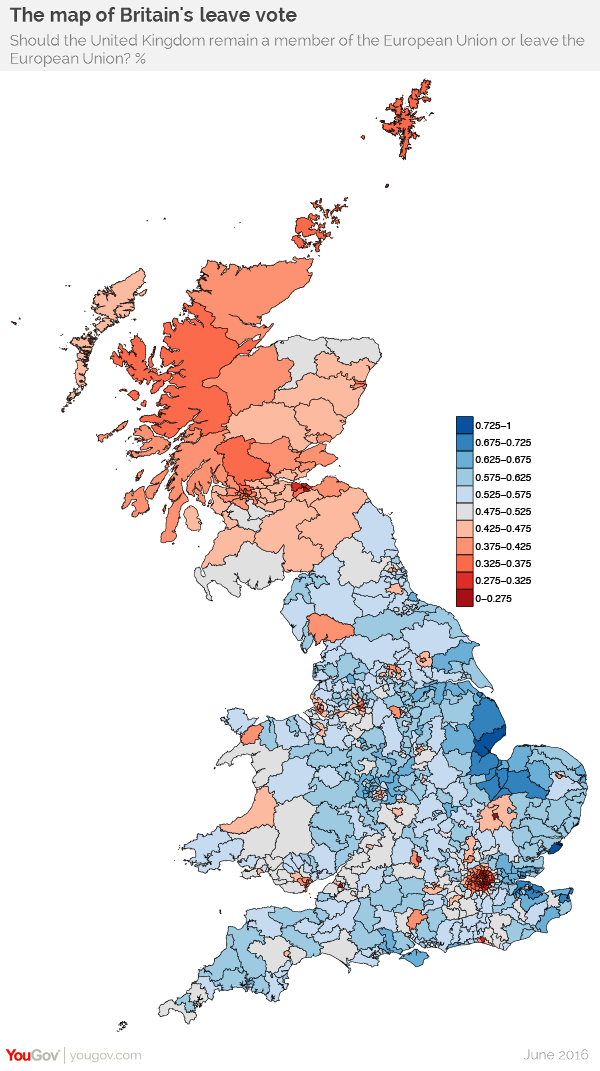
YouGov's map of voting intentions by local authority. Scotland will vote 'remain' and the UK cannot survive Brexit.
For cycling, the usual topic of this blog, the freedom of movement we have enjoyed since EU accession I am convinced has contributed to the cultural and information-exchange process that has allowed us to reach the point of importing some of the best pro-cycling policies Europe has produced into at least some British cities. For example, if we hant't had freedom of movement, would the Hembrows have settled down in Assen and provided us with the information and cross-cultural Dutch translation that we needed for the Go Dutch campaign in London? Such questions are unanswerable, and I need to get this blogpost out in time to make, I hope, one or two undecided voters to think in some new ways.

England was deeply part of cultural Europe until the reign of Henry VIII, the break with Rome, and the destruction of most English art by his henchman Thomas Cromwell. Our focus was more on remote territories for the next four centuries, but our attention was forced back to Europe by the wars of the twentieth century and the loss of our empire. The accession to the EEC was an important, defining event for those of my generation, too young to vote in the 1977 referendum called by Harold Wilson (whose Labour cabinet was divided over Europe), but brought up, post-decimalisation and post-metrication to think, at least to some extent, of ourselves as European citizens, with our maroon European passports. I am a product of the wider Europe, coming from a family on my father's side of wandering, Sephardic Jews, traders between the Christian and Moslem worlds, who had come from Spain at the time of the Inquisition, and spread across Europe, North Africa and the Near East, to Morocco, Italy, Greece, Turkey, Israel, France, arriving in my great grandfather's time in England in 1898; while on my mother's side I am a descendent of  mid-european Catholics, inhabitants of a mountainous and fiercely independent region, the South Tyrol, fought over by Papal, Napoleonic, Hapsburg, and Italian armies for centuries, and still not really, comfortably settled into one of the states of modern Europe (though now forming a largely German-speaking Italian province with a high degree of autonomy from Rome).

I am one of those people whom Boris Johnson claims don't exit: who feel an 'underlying loyalty to the idea of Europe', that is, feels 'European'. I think there are a lot more of us. I think there may be enough of us to swing this divisive and dividing referendum against the old England post-Imperial delusionists on Thursday. We will see.

Saturday, 9 July 2011

Cyclenation and Europe, again

I see there has been a reaction in the June edition of CTC's Cycle magazine from Cyclenation (previously known as the Cycle Campaign Network) to the magazine's excellent article in the previous edition, Don't ride, won't ride? That article was a welcome offering because not particularly characteristic of CTC; the last time they covered the subject of continental cycling culture was in October 2007, in a similar article entitled Going Dutch. In the April 2011 article, Dave Horton, the leader of Lancaster University's major Understanding walking and cycling study, on which I have blogged before, discussed the reasons why so few people in the UK use the bike as everyday transport, contrasting this with the situation in other parts of Europe. As he put it so succinctly:
In Britain we have so far failed to civilise the car, and we have failed effectively to separate cycling from the car. In doing neither, we have failed to produce a cycling culture.
So Simon Geller, the Secretary of Cyclenation, has written a letter published in the current Cycle magazine, as follows:
I was very disappointed by Mikael Colville-Anderson's comments in the April–May issue. I really think he ought to find out more bout cycle campaigning in the UK  before he passes judgement on us. We seem to be in [sic] caught in a cleft stick – on the one hand we are characterised as vehicular cyclists who are confident on the road and have no conception of what it is like to be a novice cyclist, and on the other we are only interested in fighting our own corner. If the former were the case, why would we bother?

Mikael Colville-Andersen [correct spelling] is the man behind the famous Copenhagenize blog, one of the most influential cycling blogs in the world. If you read that, you will know that he knows a thing about cycling cultures. He has seen and compared them across the world. And he does also know a lot about cycling and cycle campaigning in the UK, contrary to what Simon Geller says. If he did not, he could not have written something so cuttingly accurate as this, quoted in the article by Horton. This is what Geller is complaining about, as it strikes to the core of the Cyclention and CTC ethos and tradition:
Britain could learn volumes from the Danish and Dutch experiences. [Your] reluctance to advocate protected infrastructure is the broomstick in the spokes.
In Britain, it seems to be small groups of [different] "cyclists" advocating for no one but themselves insted of promoting a return to a Britain where the bicycle was, if not king, then crown prince. This sub-cultural focus on cycling is the greatest hindrance to Britain's re-emergence as a cycling nation.
Which is bang-on. The CTC's practice of claiming to represent "cycling", and by implication, all UK cyclists, to government, while actually only representing one minority tradition, or sub-culture as Colville-Andersen puts it, that of leisure cycle touring on the roads, has long been a big problem with cycling's representation and image in government. The CTC has made some effort to broaden, but not enough. Their re-branding of a few years ago, changing their name, from "Cyclists Touring Club" to "CTC", was a classic fudge, a missed opportunity to really change, get a proper new name, and become the proper national UK advocacy body for all cyclists. The basic problem is that they have never advocated for the conditions necessary for the large mass of the population who will never define themselves as "cyclists" to start to use the bike for the short utility journeys to which it is ideally suited. Similarly Cyclenation, which also claims to be a representative national body for cycling, an overarching body to which local campaigns subscribe. Cyclenation cannot seem to escape from the tyranny of the close-minded John Franklin Cyclecraft vehicular cycling philosophy, which effectively just excludes the vast majority of the population from the joys of the bike, while re-enforcing the grip of car culture in the UK. It is into this yawning gap in UK national-level cycle advocacy that the Cycling Embassy of Great Britain has been brought into being, by a group of extremely frustrated individuals.

Note how Geller's letter on behalf of Cyclenation does not really deal with the issues. It criticises a foreigner's subjective impression of the UK cycling advocacy scene, but does not broach the, for Cyclenation, too-delicate substance of the original article, the assertion that a mass cycling culture in the UK comparable to what has been achieved in several European nations is simply not possible without substantially separating the car from the bicycle, through high-quality dedicated cycle engineering.

The CTC's traditional stance on this issue is a bipolar one of lack of enthusiasm for dedicated cycle engineering coupled with a bizarre faith in the powers of persuasion for getting UK citizens to cycle under current conditions, mostly though repeating the mantra "cycling is not dangerous"– a faith that remains undented by all real experience. There are some signs of shifting of this, but not clear ones. CTC's official policy spokesman, Roger Geffen, seems really undecided on the critical issues. He writes here, in an article published on 3 June:
CTC would of course agree with the proposition that large-scale investment in quality cycle facilities could substantially increase cycle![sic] After more than 50 years of car-centric planning and highway design, much of our road network is thoroughly off-putting to the majority of would-be cyclists, especially children (and of course their parents). We would like to see every road in the UK transformed, so that cyclists of all ages and abilities can get from A to B easily, confidently and safely, wherever they are going. We are a very long way from achieving that vision. 
Actually, on most urban streets, the solutions don't require a great deal of funding – we just need to introduce 20mph speed limits. Even in the most cycle-friendly countries such as the Netherlands, most urban streets simply have a 30kmh limit, perhaps with some nicely-designed traffic calming, and no cycle-specific provision whatsoever.
.... Elsewhere though, busy urban streets and one-way systems may require more radical overhauls, and major inter-urban dual carriageways and their associated junctions certainly do!
However if the answer to those main roads is segregated facilities, we first need to work out how we persuade politicians and traffic planners to allocate the road-space and the funding needed for these to work well.


If the answer is segregated facilities, if... How much evidence do Geffen and the CTC need? And in a later response to comments on that article, after others have referred to the "too pessimistic" and "deeply depressing" attitude of CTC, he just goes on again about a "divisive debate" (my paraphrase) on segregation:
It is really important to build on this political will, and not to scupper it though in-fighting. In the early 1990s the cycling lobby did a fantastic job of building the political will for the then-Government to launch a commendably ambitious (but woefully under-resourced) National Cycling Strategy in 1996. Then what happened? - we managed to fall out spectacularly over this very issue of segregation. The result? - Ministers concluded that cyclists themselves couldn’t agree what we wanted, and therefore gave us nothing. The NCS fell apart and the targets were quietly dropped a few years later. Please let's not make that mistake all over again.
I am afraid this is a funny old interpretation of history. For the National Cycling Strategy of 1996 was deeply flawed from the start and was never going to go anywhere. For, influenced by CTC and CCN (now Cyclenation), it was a vehicular, and thus an exclusionist cycling strategy. Geffen is right in saying "Ministers concluded that cyclists themselves couldn’t agree what we wanted, and therefore gave us nothing", but much of that disagreement came about through disinformation put out by CCN, as I pointed out before.

Then, in another response to another Guardian piece the same day Geffen repeats all the usual CTC "cycling is not dangerous" and "we can persuade loads of people to take it up even under current conditions" happy-clappy rubbish:

The good news is that cycling gets safer the more cyclists there are: cyclists really do gain from "safety in numbers". London is an excellent example of this: cycle use has more than doubled in the past 10 years (up 117% on London's main roads) while cyclist casualties are down by 24% - which means that the risk per cyclist is down by something around 50%. Leicester is one of a number of other towns and cities which have achieved [a] similar result.

That isn't to say that London has reached cycling nirvana - far from it. The point however is that, if we portray cycling as far more dangerous than it really is, we are shooting ourselves in the foot in our efforts to encourage more people to cycle, and to discover all its benefits in terms of health, time-saving, money-saving, and the sheer fun one can have while simply getting from A to B. Is there any other way of getting around to match it?
Meanwhile, promoting the positives of cycling can help improve cycling conditions, not just through the "safety in numbers" effect itself, but also potential[ly] by boosting the number of votes in cycling. The more people there are cycling, the more politicians will be prepared to support its continued growth.
So please, for anyone looking to build increased political support for cycling, we do ourselves no favours by "dangerising" it. We have far more to gain by promoting its health and other benefits, rather than giving people safety-related excuses for deciding not to cycle. 
It's true that not everyone will respond to the positive promotion of cycling, not under current conditions...
Not everyone... Not everyone!!?? I ask you. I think definitely 1% of the population is not everyone.
The CTC conception of "not everyone".

(OK, I am assuming the identity of mode share with "number of cyclists", and "number of cyclists" could be greater than mode share, depending on how you define "cyclist", but you get the idea.)

The "safety in numbers" hypothesis I have dealt with before on this blog. It is false. Cycling is currently increasing but getting more dangerous nationally. In London, on the TfL road network cycle safety has flatlined since 2004 despite a 70% increase in cycling there. The question is, who is really "shooting themselves in the foot", in Geffen's words, those who are realistic about the danger of cycling and about the fact that it is danger that is putting virtually everybody off, and who recognise that to reduce that danger and get more people cycling the only sensible option is to learn from what has worked elsewhere in Europe and the world, or the CTC and Cyclenation, who remain in denialist mode about the real reason that 99% of British people will not consider cycling, and unwilling to learn the international lessons?

For, though Cycle magazine doesn't cover this debate very much explicitly, in every issue there are contributions from ordinary CTC members that, in passing and incidentally, underline the point, as this in the latest issue, in an article from Chris Bell, who cycled across Europe, and after 50 days experiencing cycling conditions in numerous other countries, four of which he stated provided cycle paths that made for "easy cycling" and on which he was able to average 100km a day (c.f. the common UK view that "cycle paths are for slow cyclists", and also note that none of these countries were The Netherlands or Denmark), returned to England to remark:
My arrival back in the UK on my 60th birthday began with the nightmare of cycling off the ferry and through Dover. I wonder what European visitors think? Cyclists are expected to dice with death – what  grim welcome!
I blogged yesterday about The News of the World scandal, and our politicians cosying up to News International. At the time I didn't think of any connection of News International to cycling, but of course there is one. The connection is Europe. The papers owned by Rupert Murdoch, an anti-EU Australian with a transatlanticist viewpoint, have consistently, over many years, fed the British people a diet of rubbish and misinformation about the European Union and European culture generally (where they have not ignored it totally). The result has been to breed, or encourage, in the British public a tendency to distrust European solutions to any problems, from law and order to the environment to defence to transport.

And this public distrust reflects back on our elected politicians, who have been themselves only too eager to placate Murdoch. Which has been why, for so long, the UK has looked almost exclusively to the English-speaking world for solutions to virtually all political questions, even ones to which the English-speaking world shows a conspicuous lack of credible answers, such as dealing with crime, and organising environmentally-friendly transport. This tendency is based on exaggerating the cultural differences between the UK and mainland Europe, and diminishing the major cultural differences between the English-speaking nations. (One experience that always convinces me of the huge cultural gap between the USA and the UK is watching US television news, and, even more strikingly, sport.)

We had an example of this in the recent referendum on electoral reform, where we were asked to choose between the traditional "winner takes all" system (normally, but inappropriately, referred to as First Past the Post) and the Alternative Vote system. But the opponents of change were able to argue that the Alternative Vote is used hardly anywhere in the world, which is true. It is an English-language world innovation; it comes from Australia. Nobody in the UK really wanted the Alternative Vote, which is very similar to the existing system, but with additional complications, which is why the campaign for change lost spectacularly. People in the UK are split between those who don't care, those who like the current system (which suits the Conservative Party most of all), and those who want Proportional Representation (or "Fair Votes"), as they have in the rest of Europe. But we were not offered the European solution.

The same has been true in cycling. We have not been offered the European solution. David Hembrow has remarked on the unfortunate way our media, where it picks up on cycling stories from overseas, tends to concentrate on those from the low-cycling English-speaking world, while largely ignoring what goes on just across across the North Sea, where the world's highest levels of cycling are to be found.

A contributor to the forum on the CEoGB site wrote:
My wife and I have been discussing the perception of us as everyday transport cyclists with children. Most people including our parents think we are strange and it is an odd thing to do. It is almost impossible to discuss things with people because as soon as you mention that for Holland/Denmark/Germany we would be considered normal they just say, well its different there and ‘bang’ they have closed their minds. This closed minded attitude does not exist with American culture which is celebrated and copied ad nauseum. I think people in the UK are culturally conditioned not to want to follow Europe and so our problem of advocating Dutch style cycling is complicated by the general Euro-phobic nature of the UK.
I think this is right. To what extent "the general Euro-phobic nature of the UK" has influenced the policies of our cycling organisations is difficult to say, but they have certainly been influenced by the relative freedom with which information comes to us from the English-speaking world, compared to the restricted access implied by the need for translation, as I mentioned in my earlier post on Cyclenation. And it is a problem that we have to convince politicians that this is an area where we need to follow Europe, when they are mostly mistrustful of European solutions.

The letter from Simon Geller to Cycle magazine shows that Cyclenation do not really take in the issues yet. He has not appreciated the importance of what Colville-Andersen says, because like all people who are part of a problem, he can't see it – like the motorists stuck in jams who complain about the "bloody traffic". I will warm to Cyclenation and CTC the day they break free from the Franklin "training, not infrastructure, is the solution" motorised status quo supporting hegemony, and start advocating for the provision of effective cycle infrastructure for all cyclists.