Showing posts with label campaigning. Show all posts

Sunday, 6 December 2015

Pavement parking and weak campaigning

There have been legislative moves afoot to try to change the absurd situation in the UK (outside London) that parking is generally legal on pavements, though driving is not. (So obviously all the cars parked on pavements must have landed there from the sky.) A Private Member's Bill was proposed that would bring the law in England generally into line with that applying to London; that is, parking on pavements would be made illegal except where the Local Authority has put up signs and painted markings showing where it is permitted.

Typical legal pavement parking in the London Borough of Brent (Village Way, Neasden). It's OK because signs allow it on the right-hand side. But note the illegal double parking on the left-hand side, where the bays are marked on the road, but parking is doubled up on the pavement as well. This is typical of what happens when you erode the concept of the footway in this way.
The Private Members Bill has now been withdrawn following a commitment from the Government to look at the issue, MP Simon Hoare said:
Following detailed discussions, I have withdrawn the bill today following The Minister’s commitment to convene a round table and undertake a policy review. 
This response demonstrates the Government’s commitment to improving access for all pedestrians including disabled and vulnerable people. A government examination of the current issues gives us the best opportunity of securing Government backing for legislative change.
Apparently the Govenment need to "undertake a policy review with stakeholders to examine the legal and financial implications of an alternative regime and the likely impact on local authorities".

This sounds rather fancy, when a simple-minded person like me might think it is absolutely clear that pavements are there for walking on and cars should not be parked on them.

A coalition of charities including Guide Dogs and Living Streets was backing Simon Hoare's bill. However, his bill in no way proposed a blanket ban on pavement parking, he said:
The bill will simply enable local authorities to deal with problem areas in an efficient way. It just provides another tool in the armoury for local government.
The thing that strikes me about all this is how it's a classic example of weak campaigning. There's an extraordinary kow-towing to motordom here, everyone apologetically and oh so 'reasonably' trying to accommodate the convenience of selfish car derivers at the expense of the majority. The campaign should be to sweep away all parking on pavements, pure and simple. But no-one in the political mainstream or 'civil society' is saying this. Yes, these worthy organisations say, let's have Simon Hoare's feeble bill, or something even weaker the Government might come up with after a few years of consulting with 'stakeholders' (who will include such statutory loonies as the Alliance of British Drivers), in order to make the pavements of Burslem and Basildon just as delightful for walking as the cracked-up, routinely obstructed pavements of Brent. Plus ça change.

When I was a member of Camden Cycling Campaign, we had a clear line on pavement parking, which we held to in all discussions with Camden Council. This was that pavement parking is wrong: it messes up the environment, produces shabby streets, and obstructs pedestrians. If it was felt that there was insufficient parking for demands, and there was excess pavement (not common in Camden), then we said the Council should rebuild the kerbs to provide clear, dedicated parking bays that were not part of the pavement. This was the line that was repeatedly put to the council's Walking, Road Safety and Cycling Advisory Group, consisting of councillors and representatives of community organisations. The pedestrian campaigners and residents' associations seemed to back this line, and, as a result, Camden has to this day very little pavement parking. Faced with a choice between expensively rebuilding kerbs, and not giving in to the pressure to provide more parking, the council unsurprisingly tended to go with the latter option – which is why the kind of mess you see in the Brent street pictured above is uncommon in the neighbouring Borough of Camden.

How Camden has organised parking in Russell Square, WC1. This is a good example: the parking is not on the footway, but on a designated, differently-paved area.
There is something a bit attractive for cycle campaigning in the notion of pavement parking, because it means that on minor roads, such as the one pictured above, a clearer space on the road is created and cyclists are less likely to get squeezed and intimidated by car drivers trying to pass them. However, the real answer for streets like these is to follow the Dutch paradigm and remove them from the through-traffic network. When narrow, parked-up streets are no longer rat runs, and motor traffic is reduced to essential access only, the problem of 'squeezing' is largely eliminated, even with substantial permitted on-strteet parking. If there is still a problem of accommodating the parking, because the street is very narrow, it really should be made one-way for motor traffic (not for cycling). This won't work for cycling in the normal UK paradigm, where a lot of through-traffic is still allowed, indeed encouraged, on narrow one-way streets, but arranging the one-ways to eliminate through-traffic will create streets with adequate capacity for all, that are spacious enough and have sufficiently little traffic to be an unthreatening cycling environment.

A minor one-way road in Assen, Netherlands
This type of environment is where the much-abused concept of Shared Space rightly belongs, in minor roads whose design should be orientated to those who live and play in them, and sometimes need to park cars as well.

An example of a 'home-zone' street in Groningen, Netherlands
David Hembrow has a blogpost with further pictures of how car parking is treated on Dutch residential streets, where it is often removed from the carraigeway, but given a distinct space that is not in the way of pedestrains and cannot damage the surface on which they walk. These Dutch designs do not look like the half-on, half-off, painted-lines-with-blue-signs London-type pavement parking messes.

In the UK it seems the general thinking is that parking on the pavement is a legitimate part of a 'settlement' vis-a-vis motoring and walking whereby motorists are allowed to park on the pavements when they feel like it, or it appears to be necessary so as not to obstruct the flow of traffic, but pedestrians are always free to walk in the road, as we have no concept of 'jaywalking' in our law. This is obviously pretty unsatisfactory to anyone of limited mobility or particularly vulnerability, such as the blind, or the mother with a pushchair. It mirrors the attitude to cycling, which is to allow it everywhere on roads, except on motorways and in a few other places, but to accept that as sufficient 'payment' to cyclists and therefore exonerate the authorities from needing to provide for cycling properly as a mode in its own right. Both of these 'settlements', the walking one and the cycling one, short-change the vulnerable road users and cement the domination of the car, though they seem very free and fair, from a certain traditional anglo-saxon point of view. 'We don't need any of those fussy foreign rules about where you are allowed to walk and cycle, you're free here', said John Bull, maybe. Yes. Free to be run over anywhere.

I've linked a few times here to David Hembrow's blog on Dutch cycling, and he also has view about campaigning for the right things, and not those that seem like 'achievable goals' or a 'first step'. I've consistently advocated that UK cycle campaigners should not ask for inadequate solutions, but think big. This message seems to have got through, and cycle campaigners have been making much bigger demands than they used to, in the days when the earlier posts on this blog were written, with striking success in some places. As my previous post about London's emerging segregated cycle network showed, we've started to get the ambitions things, that really make a difference, that we demanded, because of an adherence to clear, justifiable principles and an unwillingness to compromise over them.

It seems to me that pedestrian campaigning is still at an earlier stage, the stage where cycle campaigning was decades ago. It's not political enough, not clear enough in its demands, it's too polite and too compromising, and not asking for the right things. For example, you'll search in vain on the Living Streets website for any reference to the inadequacies of UK traffic law and the Highway Code in relationship to the how pedestrians are treated at junctions. There's no campaign to bring the UK into line with the Vienna Convention on Road Traffic, the failure to apply which makes the difference between UK signalised crossroads, where any pedestrian attempting to cross without a specific signal risks getting run over (and blamed for it), and the equivalent in most of continental Europe, where the pedestrian automatically gets priority over turning traffic (often re-enforced with zebra markings). Just to bring this into UK law and practice would far make more of a difference to walking here than all Living Streets' favoured issues such as ice, the time zone (yes, really, that's trying to make pedestrians safer, not by controlling danger, but by making us do things at a different astronomical time), and the (rather more sensible) 20mph campaign.

The current pro-pedestrain campaigns won't make the real difference they needs to, like the weak cycle campaigns of yesteryear, with their reliance on asking for mutual respect and poor but uncontroversial infrastructure like Advanced Stop Lines. Pedestrian campaigning should be virtually one with the cycling movement in demanding a complete re-design of our physical transport environment and re-thinking of the balance of rights and responsibilities accorded to motorists and vulnerable road users. The pro-pedestrian, pro-cycling, 'urbanist' and 'better streets' campaigns should all be virtually identical in their demands, and mutually supporting, and would be so much stronger if that were the case. But it is hard to see a transition to this situation when the largest part of this potential coalition is as reluctant to challenge the motor-centric status-quo as standard pedestrian campaigning in the UK still seems to be.

Friday, 20 November 2015

A tour of London's emerging cycle network

This Sunday I will be leading a pre-emptive tour of some of the most promising cycle infrastructure currently under development in London. It's pre-emptive because much of it is not yet finished. Therefore it won't be as particularly pleasant ride because in parts we will have to cycle outside not-yet-open cycle lanes tussling with the motor traffic. However, I think it is worth seeing what is going on and assessing it at this stage. Some of the infrastructure is open and can already be enjoyed.

There are three start points, starting from near my house and working in though Brent. They are:

11:00 am Kingsbury tube station
11:45 am Gladstone Park railway bridge (at the south end of Parkside NW2)
12:05 pm Queens Park Station car park

If you'd like to join somewhere else on the route described below, tell me and I'll see if it can be arranged.

Under-construction segregated cycle tracks. Larger map here.
This map shows approximately (not exactly) the recently-completed and under construction segregated cycle tracks in London. It also shows the location of Brent's not-yet-approved Carlton Vale scheme. This was the starting concept for planning the ride, to take in as many of these locations as possible. (But starting from the north-west suburbs, it proved necessary to leave out Cycle Superhighway 3 and the east part of the East-West Superhighway).

There's no infrastructure to speak of on the ride before reaching Queens Park, though just past Gladstone Park a pile of stuff is encountered in Park Avenue North, which I suspect is the first sign of construction of Quietway 3 in Brent.


Quietway 3 will run from Regent's Park to Gladstone Park in its first phase, with hopefully an extension across the north Circular towards Wembley and Harrow later (though that will be in the lap of the next Mayor).

Near the final pick-up point at Queens Park Station we will pause to have a look at the Brent section of Carlton Vale, with a copy of the plans for semi-segregated cycle tracks that I have in my possession. These have not yet been put to public consultation, so this is a good stage to feed suggestions for improvement back to the Brent Council.

The next objective of the ride is to look at the location of the future East-West Superhighway in Hyde Park. Unfortunately to get there is to try to pass through a terribly bike-impermeably part of London, through the need to cross the Westway, Grand Union Canal and Paddington railway corridor. There is no legal way through here north-south for cyclists between Royal Oak (Lord Hill's Bridge) and the Edgware Road, both of which are most unpleasant roads – a gap of 1km. If the East West Superhighway is extended to the A40, as planned, and if Westminster build their Quietway network, this barrier might one day be surmounted. But it is not clear to me how it will be, or if the planners of the grid have realised what problem this is.

The best that we can do on Sunday is to get off and walk. After passing through the pedestrain-only underpass at Porteus Road, we reach the newpedestrain-only bridge across the Grand Union Canal at the Paddington Central development.


That such a poor piece of pedestrian infrastructure was created so recently in such an important place is quite shocking. Forget about not being bale to cycle across it: how could a wheelchair user negotiate a corner like this?


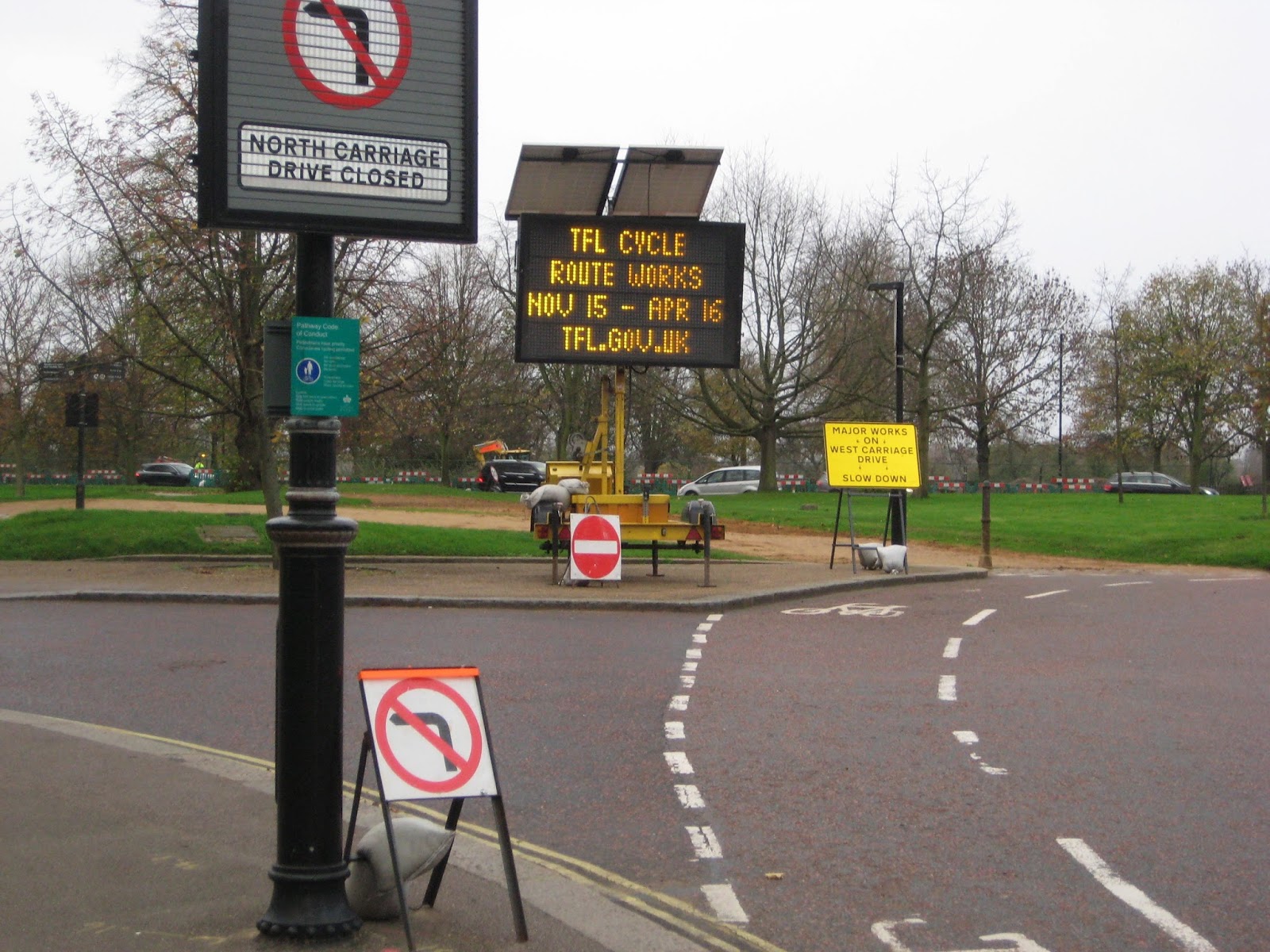
Proceeding via the pedestrain-only waterside and primitively-cobbled path leading to London Road by Paddington Station, we will cycle to Hyde Park. There we see signs of action.


The E-W superhighway will go via the West and South Carriage Drives, which we will follow. This routing is clearly intended to take pressure off the shared (separated) paths Rotten Row and Broad Walk, though I doubt how successful this strategy will be, as Broad Walk and North Carriage Drive will represent a shorter route. We will then follow an old London Cycle Network route, sadly under-engineered, which was originally known as the Ambassadors' Route when created in the early 1980s (it features prominently in this film). This takes us to Pimloco where we can discover what has been built of the north end of Cycle Superhighway 5 in Vauxhall Bridge Road. This is where things start to get impressive.


This sets the pattern for what we will see on the rest of the ride. Here we have a 4m wide two-way cycle track separated by low kerbs from both pavement and road, clearly set-out. We'll be able to observe how, for example, the pedestrian crossings like this one work. This continues to the crossing of the Thames at Vauxhall Bridge.


On the south side of the river the passageway is clear and safe, though not always so wide, through the previously-notorious Vauxhall Gyratory system and under the railway into Waterloo. Segregation continues at the standard shown above to Kennington Oval, whereafter CS 5 reverts to the old-style painted blue blobs. We, however, will turn left to join CS 7 on Kennington Park Road. This is not particularly impressive until one gets near Elephant and Castle, where what appears to be a temporary arrangement takes us, very clearly signposted, through a churchyard and via some minor streets, on to the new CS 6 on St George's Road (previously know as the North-South Superhighway).


Though this is not on the most direct route between Elephant and Castle and Blackfriars Road, the cycle track is again impressively implemented. It leads into similar engineering still being built on the west side of Blackfriars Road, via a signalised crossing of the St George's Circus roundabout. We will be able to judge the efficiency of these junctions for cyclists. My impression was that they are good. By this stage in the ride we have already seen probably more of the low-level cycle signals than has anybody else in the UK. These fantastically sensible features have only just been approved for use, and Transport for London are rolling them out on these tracks.


The track is not yet constructed on Blackfriars Bridge or the slip road off it, but we can see where it will be. The Thames was looking quite choppy when I took these photos on Wednesday.


We will then find, I hope, that we can then cycle a substantial section of the Embankment Superhighway going westwards that is not yet officially open. Here are the works between Blackfriars and Waterloo Bridges.


And here is the section already in use, approaching Westminster Bridge, with the wide segregating island designed so that coach parties can congregate on it without spilling into the track, and chamfered kerb to minimise the chance of pedal-strike. This has already become an 'iconic' view of London, to those of us of a kerb-nerd disposition.


Parliament Square is as awful as always; work on the cycle crossings here has not yet started. We will head up now through the West End, as best we can, showing where is another of the serious gaps in the infrastructure that is in the City of Westminster's court to solve. Charing Cross Road is a disaster-area that desperately needs complete re-planning including Space for Cycling, or most of the traffic removed. It is a disaster equally for those on bikes as those stuck in the permanent queues in buses and taxis. It just doesn't work as it is.


We reach more civilised territory as soon as we cross the border into Camden. The Borough of Camden deserves huge credit for, over the last twenty years, rationally re-planning and upgrading its traffic network, particularly in the south of the borough, with an emphasis on removing unnecessary traffic from residential (and some business) neighbourhoods, and facilitating cycling. I have covered the history of Camden's cycle network extensively on this blog. Particularly deserving of credit is the Camden Cabinet Member for the Environment, their roads supremo, Councillor Phil Jones, who has lead a serious expansion of the segregated cycle network in the borough (which was already the only one deserving the name in London), using the money made available by Transport for London under  Mayor Boris Johnson's cycling programme, and, particularly, has bitten the bullet and ordered the doubling of capacity of the east-west segregated cycle link through Bloomsbury (the old London Cycle Network route 0, or the Seven Stations link), so brining to the originally-intended standard the link planned and lobbied for by Paul Gannon, Paul Gasson, myself, and other members of Camden Cycling Campaign in the early 2000s. I need also to mention that the current members of CCC have campaigned energetically for this outcome.

We will see on our ride how this work is progressing. The original two-way cycle track on the north side of the road is being converted to a one-way track eastbound within the same width, and a new westbound track is being constructed using semi-segregating Orcas (already used in Waltham Forest and planned for use on Carlton Vale in Brent). Hence the cycle capacity of this incredibly popular link is being doubled, through a whole lane of motor traffic being removed and the whole of the corridor being converted to one-way operation for motor traffic. Moreover, the motor flows are being opposed on opposite sides of Gower Street, so removing the corridor as a rat-run alternative to Euston Road entirely. This is exactly how the Dutch so frequently use one-way working for motors in dense city centres to eliminate through traffic, and it is great to see a London borough applying this concept. The reduction in traffic on the corridor and simplification of the whole system should remove the junction problems that have existed on this route in its previous layout. The separation of the eastbound and westbound flows of cyclists will remove the risk of cycle-cycle collisions in the old confined space. Pedestrian facilities are being improved as well. It's a win all round.


There is a major backlash (mostly from the black cab lobby) against the scheme already and it is important that Camden Council recieves lots of support for the scheme. As Camden Cyclists state on their website,
If you like the scheme when you have tried it, tweet about it with #taviplace or send an e-mail to Camden Council: torringtontavistocktrial@camden.gov.uk to help ensure that the supporting voices outweigh those of the objectors – who will undoubtedly be many. ‘Winning the peace’ also entails all who use the new scheme riding legally and courteously so as to maintain the respect of local residents.

Not everything Camden has done for cyclists in recent years has been quite so clever. After experiencing this (unfinished) project we head up to Kings Cross and St Pancras, and one curious thing we experience is the Pancras Road tunnel under the railway (below) where the cycle lane is the bit bewtween the solid white line and the segregating island, coming into collision with the left-turning stream of traffic. The bit between the segregating island and the pavement is... wait for it... a taxi lane! And the taxi drivers have the nerve to be ungrateful to Camden now over Tavistock Place!


In the northern part of Pancras Road Camden are doing better, with new stepped cycle tracks, which we will also experience, before finding our way to the northbound Royal College Street cycle track, which has had some subtle improvements since I last posted about it when first it opened. We will then follow the route along Pratt Street and Delancey Street that will be going ahead for upgrade to two-way cycling in the next phase of Camden's Cycle Grid programme. From there the old LCN route on Gloucester Avenue and King Henry's Road takes us towards Swiss Cottage (this notorious gyratory also programmed to be reformed for the construction of CS 11 up the Finchley Road next year), and thence back towards the ride's starting points in Brent.

I think the ride will give a good overview of how a proper cycle network for London is now starting to emerge, after many years of hard campaigning for it by a great many people. For me, as I explained recently in a long, personal post, the story began in the late 1990s with the campaign in Camden for the original Royal College Street segregated cycle track (now replaced), a pioneering feature in London then, and then the campaign for the Seven Stations Link. These pieces of infrastructure I believe established and demonstrated in London for the first time the principles that we are now seeing rolled out on a much larger scale in the new Superhighways. Boris Johnson recently commented in the London Assembly that 'Virtually every cabinet member has ticked me off for the Cycle Superhighways', and I think this shows what a fundamentally unpopular course in the British political culture he has chosen to follow here, and how much credit he deserves for doing something really rather good, that will undoubtedly be the major legacy of his mayoralty. Also deserving of credit is his Cycling commissioner, Andrew Gilligan, for pushing recalcitrant officials and recalcitrant boroughs into action on the Mayor's cycling programme. When he was appointed in 2013, many wondered if, as a journalist,  if he was appropriately-qualified for the job, but I commented at the time that his skills as a propagandist might just be those most needed in the role, and I think I was right.

It's a fragile legacy. The next mayor has it in his or her power to get on with the programmes, fill in the worst gaps (for example north-south across the West End), connect up all the segregated Superhighways, extend them into all the outer boroughs, build more mini-Hollands like the successful Walthamstow one, break the major barriers in Outer London like the North Circular, and enhance the quality of the Quietways. Or he or she has it in their power to effectively abort the programme and leave the lovely pieces of engineering that we are now seeing in their glistening newness as sad stubs and monuments to what might have been, a transport revolution never delivered. As Cyclists in the City has recently commented, though the Green and Liberal Democrat candidates for Mayor in 2016 (who are not likely to win) seem highly committed to continuing the cycling programme, the commitment of the Conservative and Labour candidates, Zac Goldsmith and Sadiq Kahn respectively, is really not very clear from what either of them has said so far. It's going to be another close race for Mayor in 2016, and the vote of cyclists is going to make a difference. I invite the two of them to commit clearly now to completing the current programmes and thereafter to further major expansion of high-quality cycling infrastructure, maintaining at least the current level of expenditure on cycling in London.

In the shorter term, I invite you, if you can make it, to my tour of London's developing cycle network on Sunday.

Tuesday, 20 May 2014

Support the Space for Cycling Campaign

A few of the 5000 people on the Big Ride in support of the Space for Cycling Campaign
The London Cycling Campaign is running its Space for Cycling Campaign in the lead-up to the local (and European) elections this Thursday. If live in London, and haven't already done so, I urge you to visit the Space4Cycling website and enter your postcode. The site generates an automatic email to send to all the local election candidates (for whom it has been possible to find email addresses) asking them to support a measure in your council ward, agreed by the local campaign, based on one of the six campaign themes:
  1. Protected space on main roads and at junctions
  2. Removal of through motor traffic from minor roads
  3. Cycle routes through green spaces
  4. 20 mph speed limits
  5. Cycle (and pedestrian) friendly town centres
  6. Safe cycle routes to schools
The themes, and the policies behind them, are explained further here.

There is a national campaign Space for Cycling campaign as well, for those outside London, being co-ordinated here by CTC, based around similar demands.

With one day left to the poll, 41% of candidates across Greater London say they are supporting the asks for their ward. It's an impressive result for a clever campaign. The cleverness lies in it being highly specific and geared to the local elections in being hyper-local in its demands, yet those demands all being tied to broad policy themes. It doesn't allow politicians to get away with mouthing platitudes about wanting to "encourage cycling". To count as supporters, they have to agree with exactly what is being asked for in their ward, and all those things that are being asked for very specifically contribute to the overall strategic objectives. It's a centrally-directed and coordinated local campaign. It's a move on from the days when we just asked politicians to propose what they would like to do for cycling. It is far more pro-active, far more agenda-setting. We know that what we require is not just isolated measures, but joined-up policies, but the cleverer local campaigns have structured their ward asks so that, if they were all really done, they would join up, complement one another, and form the basis for a high-quality core cycle network usable by people on bikes of all capabilities. The campaign also relies on the policy decisions taken at the last LCC AGM, to campaign for one network for all cycling abilities, built to specific standards in terms of the speed and volume of motor traffic with which sharing is tolerated.

Now I don't believe for a moment that after the elections we will suddenly get all these cycle tracks built and road closures put in and we will be living in a slightly less tidy version of the Netherlands. I doubt that many of the candidates fully understand the implications of what they are signing up to. It will be the job of campaigners in the next five years to keep on telling them and pushing them to honour what they have signed-up to: the campaign will not end at the election, it will enter a new phase. It's noticeable that candidates seem very willing to sign up to major roadspace reallocation proposals on big roads, but relatively unwilling to agree to simple measures like road closures on small roads to eliminate rat-running traffic. I can see why. The second category includes very precise and limited demands that it would be impossible to wriggle out of later. Thought the first category also includes measures that are precisely-defined, the "asks" can't go into details of all the concomitant changes that will be required: junction and signal redesigns, movement of car parking spaces, and movement of obstructions such as street furniture and trees: in short, general street re-designs. 

It is these that will of course allow candidates to try to wriggle out of their commitments when elected. They will soon start claiming it is all to difficult, that they didn't understand the problems that have to be solved. Their true commitment will become clear when opposition gets organised by, for example, taxi drivers wanting to preserve one of their traditional back-street short-cuts (the opposition that crippled Camden's pioneering Severn Stations Link route), or local traders get together to oppose the removal of car parking spaces immediately outside their shops, which they misguidedly believe are essential to their continued solvency. As the London Cycling Commissioner Andrew Gilligan said at the rally after the Big Ride in support of the campaign on Saturday, the next six months will be a test of strength between the pro and anti-cycling political forces in London.

The main thing that the campaign does is to start to get the arguments through to local politicians, who form the grass roots of the whole political system, about how our streets could be far better designed to facilitate both walking and cycling, with clear and specific examples. Many of these politicians who previously haven't had a clue about the subject, even if they still don't agree, or intend to do anything much, should at least get to understand that this is a big issue to a substantial proportion of their electorate.

If you have already sent your message to your local candidates, in the last day before the election, try to get all your friends and work colleagues and neighbours to send their as well. One thing about this campaign quite separate to its cycling theme is that it is actually succeeding in raising the profile of the local elections in London, which is welcomed by all the candidates. It also demonstrates to them that the cycling campaigners are well-organised, resourced, and a force to be reckoned with.

Another shot of the Big Ride on Saturday. The campaign is for safe roads and independent mobility for everyone from the guys in the blue to the guys in the trailer.

Monday, 27 February 2012

A view from the cycle path

Unfortunately David Hembrow has deleted from the net his famous blog A view from the cycle path. This breaks many links within this blog, so I apologise for that, but it will probably not be possible to fix them. It would not make much sense to try, as I referenced his writings so often, so good were they, that trying to expunge the references would reduce the sense of past posts.

David's explanation for his action is here. It is, however, extremely hard to see what he expects to achieve with the deletion of a blog which was widely referenced by cycling websites worldwide. Far better would have been to simply end work on it, close it to comments and leave it on line – as was done to another famous cycling blog, Crap Cycling and Walking in Waltham Forest, when its author decided to give it up.

All on-line content runs a risk of plagiarism, mis-quoting and malicious distortion. This is a fact of the net with which we have to live. But it is a marginal fact of the net. Most re-use of material on blogs like this is done respectfully, with acknowledgement, and in a constructive spirit. It is particularly sad that A view was deleted just as the ideas in it were gaining a wide acceptance and understanding amongst cyclists, non-cycling opinion-formers, and even some policy-makers in the English-speaking world, as shown in The Times's Cities fit for cycling campaign, and last week's parliamentary debate – of which more anon – and also shown by many smaller snippets all the time, for example, this one from the Southern Daily Echo, where the editor of a provincial newspaper has picked up on A view and treated it as an authoritative source on cycling in the Netherlands – which is was. Few blogs attain this status. It attained this status because it was so well-written, so concise, and presented the issues so clearly and logically, and it was so well-researched and factually accurate.

The good news is that Mark Wagenbuur, who contributed quite a bit of material to A view in recent times, has set up an new blog, Bicycledutch, and reinstated some of his also excellent and enlightening material, originally published on A view, there. Unfortunately, though, Wagenbuur's contribution was only a small one, the vast bulk of the material on A view was David Hembrow's, which is now unavailable unless he decides to re-publish it in some other form.

I would still like to appeal to David publicly, here, for him to reconsider, and reinstate A view from the cycle path as a an open resource, even one that is never updated again.

If he does not, well, I will continue to campaign for Dutch-style, high-quality cycle infrastructure in the UK, as I, and others, did long before A view form the cycle path appeared, and made our job a bit easier. The Cycling Embassy of Great Britain, in particular, will continue with this work. It was in large part inspired by A view, and I am sure it will continue to grow as a campaign and gain more influence. The current London Cycling Campaign Go Dutch campaign for the mayoral election was also strongly influenced by A view, and though we can all argue until the (Friesian) cows come home about the details of exactly what cycle engineering we are promoting, and I will continue to discuss these details here, and criticise LCC where I think it sensible to do so, the fact is, this campaign is on the right lines, as are other, smaller local campaigns around the country, in a way that such campaigns were not a few years ago. Much of this is down to A view from the cycle path.

So we continue to work away at it.  I think it is not necessary for cycling campaigners, or those for more liveable cities, to constantly set their cause back by falling out amongst one another. It is not necessary for successful campaigns to self-destruct, and it is not necessary for the promoters of more and better cycling in the UK, or anywhere, just as they are winning the battle for public opinion, to seize defeat from the jaws of victory.

Sunday, 28 August 2011

It's not unthinkable for cycle facilities to have priority in the UK

This post comes about, in part, due to a correspondence on another blog. This correspondence is on this page: The extraordinary claims of an anti-infrastructuralist, on As Easy As Riding A Bike. I am not going to go into anything that is there, apart from the fact that one contributor, Grahame Cooper, had this to say:
think I would probably be pigeon-holed as “anti-infrastructuralist” (if there were such a word), but I am not actually against infrastructure per se.
However, there are three key points: (1) I will certainly be long dead before the UK has anything like the kind of infrastructure that the Netherlands enjoys, (2) the so-called “cycling infrastructure” we have here is generally rather dangerous if you use it, and (3) talking of “cycling infrastructure” without thinking about all of the other contextual issues does not make sense. I’ll say no more about (1), but will expand on the others.
Regarding (2), we do not currently have the kind of infrastructure that exists in Holland, so the only safe approach right now, based on my own experience, is vehicular cycling. Unfortunately, the pathetic cycle lanes that exists on my commuting route actually make vehicular cycling more difficult because they damage my ability to negotiate with other vehicles. This causes conflict: “you should be in the cycle lane” (i.e. the gutter).
Regarding (3), in Holland, you have Presumed Liability, which means that in a collision between a cycle and a motor vehicle, it is presumed to be the the motor driver’s fault unless they can prove otherwise. Here, the cyclist has to prove that the driver was negligent, which is difficult even though they usually were. You also have a long history of high cycle use. I think one of the consequences of these is that drivers in Holland treat cyclists with more respect. For example, it is unthinkable here that there might be a place where cycles cross the path of motor vehicles and the cycles are given priority! In our car-centric culture, that would be considered far too dangerous.
I was struck by the extraordinary pessimism of Grahame's point (1), and I will come back to that. But the only part of his message to which I replied was his statement:
For example, it is unthinkable here that there might be a place where cycles cross the path of motor vehicles and the cycles are given priority!
I wrote (perhaps unwisely):
No it’s not. I can show you plenty of photographs of this.
To which he responded:
Go on then.
So, it's perhaps a bit of a tedious exercise, but, bound as I am by my offer, I must here present a gallery of locations
where cycles cross the path of motor vehicles and the cycles are given priority!
Some of these are my own photos, and some drawn from Google Streetview. All are in London. There may be similar examples in the UK outside London, but I am not aware of them.

Junction Royal College St and Pratt St, NW1
Junction Royal College St and Plender St NW1 (plus the minor junction with service road beyond)
Junction Torrington Pl and Huntley St WC1
Junction Torrington Pl and Chenies Mews WC1
Junction Byng Pl and Gordon Sq WC1
 Gordon Sq SE corner WC1
Tavistock Sq SW corner WC1
Junction Cable St and Bere St
Junction Cable St and Stepney Causeway
Junction Cable St and Devonport St
Junction Cable St and Hardinge S
Junction Cable St and Johnston St
Junction Cable St and Watney St
Junction High Road Ickenham and Aylsham Drive (The side road was closed-off for building at this time, and when the development was completed, the road was re-instated with priorities reversed, as they are now.)
Junction High Road Ickenham and Heacham Ave
These are all cases where side roads give way way to a segregated cycle track. I said I could show "plenty" of such photos. I think that's enough.

The point is not that these are all excellent cycle facilities, or "Dutch" standard, they are clearly not. Many are far too narrow and suffer from other faults, such as the side road crossings causing the track to change level. The point is also not that the roads that give way to them have necessarily huge volumes of traffic. If they did I would not expect the road to give way to the cycle track; that would be unrealistic, and wouldn't happen in Holland, I would expect signalising, as here:

Junction Royal College St and Crowndale Rd NW1
and here:
Junction Torrington Pl and Gower St WC1
These are examples of a track being signalised where it crosses a major road, with the bicycle flow treated as a proper flow of traffic to be signalised in the standard way, not treated like a pedestrian flow (the common misunderstanding amongst UK cycle facility designers), to be given buttons to push.

The point is not that at least one of these facilities has been rebuilt wrongly since the photograph was taken. (The photos of Cable Street are from the Google Streetview survey which predate the recent Cycle Superhighway work. Since I have not been there since, I do not know if these junctions are the same now as then.) The point is also not that other junctions on these same routes, not shown here, may have been done wrongly.

My point is to disprove the assertion that
it is unthinkable here that there might be a place where cycles cross the path of motor vehicles and the cycles are given priority!
It is not unthinkable because it has been done in the past and could be done again. I know these examples are not the norm, and that the reverse is far more common. That, again, is not the point.

But this extreme pessimism, this utter disbelief that correct engineering for cyclists could ever be accomplished in the UK, is quite common amongst UK cyclists – or at least, amongst those who put opinions on these matters into print. These people are, effectively, "anti-infrastructuralists", rendered so by this fixed belief in the impossibility of things being done right, though, as Grahame Cooper implies in his comment, this may not be quite the same mindset as held by those who believe that all cycle infrastructure is bad by definition. Nevertheless, the result is the same. They say they do not want cycle infrastructure, and don't campaign for it.

So Grahame underlines this extreme pessimism with the statement:
I will certainly be long dead before the UK has anything like the kind of infrastructure that the Netherlands enjoys.
I am assuming that Grahame does not actually know that he is going to be dead within a five years or so, because he has been diagnosed with something incurable. If I am wrong in this, please forgive me for my insensitivity. But I don't see why anybody in good health and under the age of threescore year and ten should come to this conclusion.

My point of view is totally different. And it derives from experience. My experience tells me that it is possible for determined campaigns to achieve high-standard cycle facilities, but, the fact is,  very few campaigns in UK the past have actually asked for the right things – in part due to dedication to the self-fulfilling prophesy that "there's no point as it can never be done right here". The UK's "national cyclist's organisation" the CTC have often seemed to fall into this "no point" trap when tackled on the question of why they are not fighting for continental-style cycling provision. See for example CTC representitive Roger Geffen's response to the Understanding Walking and Cycling study:
However if the answer to those main roads is segregated facilities, we first need to work out how we persuade politicians and traffic planners to allocate the road-space and the funding needed for these to work well. The last thing we need is yet more of the dreadful "white-lines-on-pavement" cycle facilities which are generally a lot worse than useless, creating hazards and conflict for pedestrians and cyclists alike. Cyclists rightly avoid them like the plague, yet they get shouted at by drivers for doing so.
Yes, we all know about those "white line on pavement" cycle facilities, or, worse still, no white line on pavement "shared facilities", but those are not what the campaign for proper cycle facilities is about. They are completely irrelevant. Nobody is asking for those, and talking about them is a diversionary tactic. The trouble is, in asking for nothing in terms of infrastructure, CTC actually contributes to the vacuum that allows these to come into being.

My experience, which I have discussed before, but which I come back again to here, is that on the one occasion (to my knowledge) when a UK cycling campaign did take a clear policy decision to campaign for Dutch-style urban segregated cycle tracks (Camden Cycling Campaign at the end of the 1990s), and did so, and specifying, in full technical detail, exactly what it wanted to the local authority, it actually got what it asked for: a high-quality Dutch-style cycle track, with full priority over crossing traffic, which actually works, and which has been a success ever since: the Royal College Street track shown in my first two photos in this post. But the subsequent attempt to create a much longer east-west cycle track across central London (the Seven Stations Link), implemented parts of which are shown in my photos 3–7 above, failed, in part, because of the lack of support of other cycling campaigns. There were other factors in the failure, as I explained before, but one major one was that the neighbouring groups of the London Cycling Campaign did not really support the concept of the segregated track, and so did not persuade their councils to support it.

This brings me to my brutal conclusion – "brutal" for what it says about what one hundred years of British cycle campaigning has achieved, or not achieved: the bald fact of the matter is that, with the only exception, to my knowlege, of the Camden case, UK cyclists up until now have never asked for Dutch-style infrastructure, and that is why they have not been given it. 

As it says in the Bible, "Ask and ye shall be given..." The British cycling organisations have, nationally, never clearly referenced the Dutch-Danish model of cycle provision, nor said clearly and explicitly to government "We want that here". Instead, all too often, activists have busied themselves trying to find spurious reasons why "Britain is different" and why "It can never happen here". One favourite excuse (which I haven't heard so often recently) always used to be: "It is because of the war" – something to do with the Second World War was supposed to be responsible for why the Dutch and Danes were able to find space for cycling whereas the British could not – but how come the Swedes, Swiss, Finns and Germans have also found so much more space than we have, when these countries all had totally different wartime experiences? A more common excuse today is to say that "Our cities are old and so our streets are too narrow for cycle tracks". Richard Mann of Oxford develops this line in the discussion on the As Easy as Riding A Bike post with which I started.

Needless to say, I reject all of this manifest nonsense, and many other British cyclists are now doing so as well, in large part due to far better information than we used to have on the "nuts and bolts" of Dutch and Danish provision now available from sites such as A view from the cycle path and Copenhagenize. So things are changing. LCC members have now voted to campaign in the 2012 mayoral elections on the theme of "Going Dutch". And, perhaps more significantly, we have a new national organisation specifically set up to campaign for effective cycle infrastructure: the Cycling Embassy of Great Britain.

Far from believing that I will be dead before we get to see proper cycle networks in the UK (I am now 48 and not intending to die soon), I believe that if the UK cycle community really united around the idea of pushing for high-quality facilities on the Dutch model, we could have the backbone of the network we need in less than 10 years. We could have much of it in 4 or 5 years. UK cycle campaigners so often get wrong the relative time-scales of "changing fabric" versus "changing attitudes". They often concentrate their efforts on the idea of trying to "change attitudes", when this is the hardest thing to achieve in the absence of change in the physical environment, and certainly a project that will not bear fruit quickly, if ever, in the absence of physical change. In contrast, "stuff" can be built quickly. And if it fails, it can be changed quite quickly. Our streets are constantly being rebuilt – usually badly. I firmly believe we could get a network that would transform the experience of cycling in all our cities in a very few years if we all pushed concertedly for it. But to change the typical attitudes of motorists towards cyclists will take far longer, and I am not convinced, on the experience of the past century of campaigning, that this ever happen, while cyclists remain such a small minority group, in the current physical environment.

There are extreme pessimists in every situation. I talked about Libya in my last post. In a news report on Libya the other day I heard an intelligent Libyan man, an engineer, lamenting the current revolution and saying that he wished his country had never risen up against Gaddafi. Things had not been perfect under Gaddafi, he said, but they hadn't been that bad either, and the country had basically worked. He could only see chaos and destruction in the future and things getting worse. He believed "Libyans are Libyans", and were capable of nothing more than running a corrupt, nepotistic, backwards, tribal system. He had no optimism for his people in the future at all. In every situation, there are always people who, for fear any change will be for the worse, never want to rock the establishment boat at all.

If you believe that, for some reason, analogous to what the Libyan engineer believes, there is something "wrong" with the UK which means that we are incapable of arranging a good environment for cycling, that it will never happen, no way, no how, then you will not join the Cycling Embassy of Great Britain, because you will believe this campaign is totally wasting its time. You will not come along to the Embassy's official launch, on Saturday 3 September, the day before the London Sky Ride, at Lambeth Bridge in London, and you will not take part in the picnic in Victoria Tower Gardens that afternoon. Neither will you arrange you own local Cycling Embassy inaugural picnic, nor will you try to spread the word of good infrastructure practice to your local authority. You will certainly not donate any money to the Cycling Embassy, nor give any of your time to it. Because to you, the Cycling Embassy is running a pointless, futile campaign.

But some other people believe that it is worth trying to change things. They believe there is nothing fundamentally "wrong" with the UK that prevents the bike from being properly catered-for here. They believe there is just a chance that if we start to demand, loud and clear, a decent cycling environment, we could start to get it. I hope and expect they will be out in force for the Cycling Embassy of Great Britain official launch on next Saturday, 3 September.

Saturday, 20 August 2011

Another discussion of Dutch-style infrastructure in Camden

This post significantly revised Sunday 21 August

On Monday I was invited to speak to Camden Cycling Campaign (Camden LCC) on the subject: Going Dutch: Let's clarify what we think this means. This followed the 54% vote for "Going Dutch"in the LCC poll on its options for its main campaign for the 2012 mayoral elections.

I was keen to avoid having a re-run of the endless "theological" argument that UK cycle campaigners can get into on the principle of whether cyclists should be integrated with, or separated from, motor traffic. That, in my book, is all very old hat. LCC has had its vote, and the result was that most members wish LCC to campaign for Dutch-style cycling. That means separation from fast or heavy motor vehicle flows. In the event it was a productive discussion that avoided the "theology" but focussed on the questions of how, in practice, politically, can we work in London to get started on building a network of high-quality segregated cycle tracks, where should we start, and what should Camden Cycling Campaign be asking Camden Council for? Jean Dollimore has written-up an account of the discussion, so I don't need to repeat it here.

Camden Cycling Campaign pioneered on-road Dutch-style segregated cycle tracks in London in the early 2000s with their designs for the Somers Town (Royal College Street) and Bloomsbury cycle routes (the latter only partially implemented), as I have covered extensively before. Now that LCC has decided that it wishes to campaign concertedly, as a whole, for this type of infrastructure, it makes sense for local groups to start working to identify which would be the best candidate roads in their boroughs.

The best candidate in Camden, the meeting concluded, is Tottenham Court Road. This is already part of, or connected with, several cycle routes of varying quality, most importantly the Bloomsbury track (LCN+ route 0 in Torrington Place, Maple Street and Howland Street), and it is, of course, a key N-S axis route for central London, with currently high levels of cycling. Moreover, Camden Council, in their 2011 Transport Strategy, already have a plan for this road. The plan proposes:
Introduction of public realm improvements and 2-way traffic along Tottenham Court Road (cycle and buses only) and Gower Street. The scheme would improve journey times for buses, the attractiveness of streets, pedestrian and cycling facilities, and help to remove the queue of buses on New Oxford Street.
Tottenham Court Road now 
Camden's artist's impression of the future Tottenham Court Road
This sounds quite progressive, if it means the removal of private cars from Tottenham Court Road and putting them all on a two-way Gower Street, as that would represent a significant reduction in space for cars. (But how will Camden's planners justify it to Boris Johnson's "capacity maintenance" freaks?)

Realistically, I can't see Camden succeeding politically in removing black cabs from Tottenham Court Road. There will also need to be lorries delivering to the shops (as seen in the "current" photo). So it will not look quite as rosy as in the artist's impression. In fact, it may be significantly less rosy. If we have large numbers of buses and black cabs directed on to a two-way Tottenham Court Road, plus the servicing of businesses, plus private cars and minicabs that go that way anyway, because nothing physically stops them, then the result could be very like Oxford Street – not a pleasant road for cycling on.

Even assuming Camden can go so thoroughly against the thrust of current TfL policy as to severely reduce the space for cars and exclude all but buses and bikes from Tottenham Court Road, according to David Hembrow, there is nothing like having to share space with buses for reducing the feeling of subjective safety for cyclists. I agree with him. The constant "swapping over" game when you have to overtake a bus at a stop, judging whether or not it is suddenly going to take off again, then it does, just after you have passed it, and it overtakes you again, and stops in front of you again, all this is deeply tiresome and offputting to all but hard-core cyclists. Particularly on routes where there are large numbers of buses, or they where can travel fast, buses and cyclists need to be separated to create an attractive cycling environment.

In the Camden artist's impression, with the space-wasting central strip in the road, there appears not to be enough space for buses to overtake cyclists with good clearance. This will result in cyclists having to compete with buses for space, "taking the lane" (as indeed the artist has shown) and potentially suffering aggression from bus drivers behind. Children, old people, the unfit, those on cargo bikes, and many other potential cyclists, do not want to, or simply cannot, adopt a cycling style that requires them to "take the lane" in order to act as human traffic calming in front of a 10 ton vehicle travelling at 20mph or more. This simply is not a quality cycling environment, however sunnily and cheerfully the artist has rendered the picture.

The way you make cycling really attractive is to allocate dedicated road space, preferably protected road space, to it. That is what "Going Dutch" is all about. In Dutch street designs, by and large, cycle space is separated from bus space. I hope Camden Cycling Campaign will be able to get the current design for Tottenham Court Road changed for a better one for cyclists, where cyclists are allocated attractive, safe, protected space in this high-profile location. The pictures suggest that one possible solution in the space could be a two-way road for buses and taxis, then a separating island, and then a two-way tack for cyclists. But this would probably entail moving the massive central lamp columns (which I recall from past discussions have always been an issue in Tottenham Court Road). Alternatively one could have two single-direction cycle tracks on the outsides of the carriageway.

This is exactly the kind of high-profile location where we need "Dutch" facilities, where there are many people passing through, pedestrians and bus users who, if this were done, would see for the first time in a British city cycling being taken really seriously in urban planning, and a good proportion of whom would then think: "Yes! I might try that". This is not a case of needing to spend loads of money on cycling. Camden are going to have to spend a tidy sum to change the road in the way they are planning anyway. To incorporate international-standard cycle tracks would probably hardly affect their calculations at all.

There are still many UK cyclists who don't see the need for segregated cycle tracks. They sometimes say to me, "We are doing fine as it is. Cycling is increasing in London; we don't need lots of money spent on elaborate street engineering".

Some graphics in the Camden Transport Plan show clearly, however, what the problem is. Yes, cycling in Camden, as measured by screenline counts, has increased quite a bit in recent years. Here is the graph.

Traffic in Camden
Cycling traffic (though not necessarily number of cyclists, or cycling mode share) has increased by 100% in 8 years in Camden. And to what level, exactly?

Mode share in Camden
To a 3% mode share, that's what. To the dizzy heights of 3% – what Freewheeler would call a "risible modal share". That's good for London and high for the UK. But it's a long way from Copenhagen's 40%, or Groningen's 50%. It's not a "critical mass" or close to any kind of breakthrough point. And looking at the trend, seeing that on aggregate there was almost no change between 2006 and 2009, it looks like the increase was due to factors in place before 2006 (the main one almost certainly being the Congestion Charge, introduced in 2003), and that it has now levelled off. There's been a huge emphasis on encouraging cycling in Camden. The new Transport Plan is full of pictures of bikes and stuff about cycling, as have been many previous Camden publications. Camden has been one of the most pro-cycling local authorities in the UK over a long period. And the result of all that effort has been that cycling has remained very marginal in Camden – a borough which includes a large part of the centre of London.

And here's the problem:

Road casualties in Camden, 2008
The 3% mode suffers 19% of the casualties, that's the problem. Cycling in Camden, as in the rest of the UK, is too dangerous. That's why more people won't do it, however you try to encourage them.

The answer is to change the infrastructure. You need to make cycling feel safe, and actually be safe, and convenient, at the same time. Quality segregated infrastructure achieves this. It gives high levels of real safety along with a pleasant environment and a high priority for cycle movement. Camden already has some segregated infrastructure, but it's very limited. It's on nothing like the scale you find in any city in the Netherlands, Denmark, or in many cities in Germany. Camden, and the rest of London, needs more and better (and better-located) segregated infrastructure to start to approach mass cycling. Tottenham Court Road would be a good place to start.