Showing posts with label Politics. Show all posts

Tuesday, 5 July 2016

A nice walk

I went for a nice walk in Central London on Saturday. It was great to be in the sunshine and showers, slowly ambling past the architectural treasures and follies in the historic heart of our democracy at Westminster. The experience was rendered infinitely more pleasurable by the fact that the authorities had, for some reason, decided to ban all traffic in those streets for the day – even (shock, horror) bikes. So the air was clean and there was no threat of getting run over, even walking in the middle of the street.

It wasn't as quiet as you might have expected, however, as 30,000 other people had decided to do the same thing. And some of these people had trumpets and other noise-making gadgets (and I realised for the first time exactly why it was that, historically, the trumpet was always the primary instrument of the army).

This was clearly a family day out for many, and the huge crowd was good-natured and boisterous. Many of these walkers had created very clever posters lampooning the politicians who led the campaign for the UK to leave the EU. I think my favourite was the one paraded by some children referencing the Scooby Doo cartoons. With Gove, Johnson and Farage dressed as fake spooks, it stated You won't get away with it, we are the meddling kids.


Some of my acquaintances, even left-wing people, actually disapproved of this march. They called it 'anti-democratic'. 'We've had the referendum, we didn't like the result, but that's it, we've got to live with it, that's democracy' went the argument.

I beg to differ. I think we have a duty to continue to campaign, if we really believe that Brexit is so wrong, in particular to defend some people who may be rendered vulnerable by the result of the referendum. Majority votes have the potential to damage the weak if the question asked is a bad one. That's why generally why we don't use referendums, we use representative democracy through Parliament. Additionally we have a high duty to European peace and solidarity, if we truly believe that that is what the EU is ultimately about. If we believe the 52% got it badly wrong, it's our duty to go on saying so.

The constitutional position is fairly simple. The referendum was only advisory, and Members of Parliament, have, as I stated in my letter to my MP, the duty to take not just the referendum result, but all the circumstances, and all their best judgement about what is best for the nation, into consideration in coming to their decision as to whether to allow the UK to secede from the EU. It's totally legitimate for the Remain supporters to go on lobbying parliament to try to convince them that we should not leave the EU, for many and various reasons, after the vote has been counted, and even after we start to leave, if we do, to continue to lobby to reverse the process. This isn't anti-democratic. it's fully a correct part of the democratic process. If an MP was on the losing side of a vote in the House of Commons on a subject that he or she cared passionately about, no-one would be surprised if he or she continued to try to persuade fellow members of their point of view on the subject and to agitate for a further vote. Many important reforms have historically come about in this way: the principle was lost first time round but succeeded in the end. No-one would argue this is an undemocratic process in a legislature – why so if amongst members of the public after a referendum? I would expect the supporters of any cause who believed in it strongly, even the Leave camp, if events were going against them, to do the same. Ultimately, of course, the objective is not to make Parliament take an unpopular decision. It is for the populace to realise that they got it wrong first time round. Public sentiment and politicians' minds need to be turned at the same time.

But in the shorter term, before most people realise that Brexit is wrong, there's another relevant argument: 48% simply isn't a mandate for the scale of destructive change that will be brought about. As many have pointed out, it is normal in not only developed political systems, but in voluntary organisations, for change to the constitutional status quo to require a supermajority of 60%, or two-thirds, or majorities simultaneously in two levels of government (for example in all devolved authorities as well las the central one). Such a stipulation wasn't put in place in this referendum, though it was in the first Scottish and Welsh devolution referendums. Instead all we have is the discretion of MPs to call upon.

I'm not over-optimistic about the effect that a march of 30,000 people will have. The Stop the War protests were bigger, and they didn't stop the war. But protest is an essential element in the combination of levers the ongoing Remain campaign will need to use turn this around. There is an important difference with the Stop the War movement. The war was inherently self-limiting, as the people will not stand for an indefinite foreign military involvement. Marching may not stop a war, but may bias the politicians to pull out more quickly. Separation from the EU just goes on once triggered, and the period for campaigning about it is indefinite. The arguments by the Remain side will become ever more convincing with time as the problems with separation ravel up in ever-more tangled knots, growing more intractable as they are further examined. We are seeing this currently as the Conservative party debates who will be the next Prime Minister.

Now the EU emigrants in the UK and UK emigrants in other countries have become the political pawns in the Conservative leadership contest. 'Give everyone working here the right to remain' some say. 'No, we need to use them them as a bargaining chip against the other states where are own expats are' say others. So the lives of both their expatriates and ours are tossed about by these politicians in their own game.

The truth is it isn't possible for the UK government to give a guarantee about the EU nationals here because they can't be confident of getting a reciprocal deal from the EU. The truth is that the EU will not want to offer such a deal quickly, if at all, because the UK has to be seen to be punished for separating. The further truth is that some states in the EU probably would not be that averse to no deal being achieved, ever, and mass repatriations resulting, because in due course the expanding economies of the East European states might well need more of their workers back, and the Spanish and Provençale authorities may be quite happy to get rid of the burden of a large number of elderly British from their healthcare systems. Recall that every member state will have a veto on the final deal reached. The worst deal for Britain is the one that will take it. The UK is the biggest exporter of people in the EU: we have most to loose from negotiations on 'right to remain'.


It's not clear to me that the Bexit campaigners thought any of this through in advance. There is one huge, critical question that none of our pro-Leave politicians are asking, as French commentator P Y Gerbeaux (spelling?) commented right at the end of Radio 4's Westminster Hour this week (after recounting how many EU immigrants in the UK are now feeling scared and alienated): What hasppens if, down the road of the Article 50 process, all the UK negociators can get out of Brussels is a deal that is terrible for the UK? What happens if what the UK is offered is trading terms less favourable than those offered to Turkey, plus an insistence on full freedom of movement, plus fees? The UK then has only two rational course available: leave with no agreement, in which case we might get our 4.9 million mostly elderly nationals back pretty quickly, which will do wonders of our health and social care bills, or stay in the EU on current terms (if the other states unanimously still want us, which seems doubtful).

The likely real results of negotiations are seen in the actua example of Switzerland, which did have a binding referendum on limiting immigration, which the Swiss government has not been able to implement because it conflicts with trade agreements with the EU. The Swiss example shows how a favourable al la carte European relationship won't be possible. We'll either end up in a very subservient relationship, as Switzerland is now finding itself in, or with no more relationship with the EU than, say, Russia.

The fundamental problem with the concept of Brexit, is, and always has been, that it doesn't mean any one clear thing. That was the main difficulty with asking the populace to vote on it. The referendum asked a bad question. The EU is a continually evolving entity, shaped by it's member states and their government's policies. What Brexit means this year is different from what it might mean in the future. But there are several things we can say it definitely does mean. It means our government does not send any Commissioners to Brussels. It means our people do not elect members of the European Parliament. It means our ministers are not part of the EU Council of Ministers. It means our representatives are cut out of the decision-making of Europe. On the other hand, Brexit does not definitely mean control over our borders, and it does not mean definitely no contributions to the budgets of European institutions. Far from meaning 'taking back control', in most likely scenarios, Brexit amounts to a desperate loss of control.

How did this state of misunderstanding arise? It seems to go back to a kind of post-Imperial British feeling of entitlement and inflated self-importance. We're still a nuclear power after all. We may have the second most impressive lot of aircraft carriers in the world by 2023 and we're still at the top table of the UN in the Security Council. There's been this feeling all along that Europe needs us more than we need them; an arrogant conceit that we, the anglo-saxons, are still going to show those failing Eurocrats exactly how it all should be done.

So on Saturday protestors filled the pavements, carriageways and cycle tracks of London, clambering over the brand new granite kerbs of Cycle Superhighway 2 in Parliament Square to push for a different, more realistic course than the one the 52% chose. I will leave the EU debate and go back to discussing cycle infrastructure in my next post. Some divisions are bad, but kerbs are OK.

Wednesday, 29 June 2016

Letter to my MP Barry Gardiner on the EU and Parliament

To Barry Gardiner MP, Member of Parliament for Brent North

Dear Barry,

Allow me to congratulate you on your appointment as Shadow Energy and Climate Change Secretary.

What I am writing to you about however is not primarily this, but the EU referendum result and the role of Parliament. It is not disconnected, however, to your portfolio, as you well know that the role of the EU in trying to reach global agreement on limiting emissions and climate change has been critical, and this role threatens being diluted by the prospect of UK disengagement from the EU.

Fundamentally, my points are these:

  • The referendum result was marginal: too marginal to be a mandate for such far-reaching change that will affect generations to come. We know that young people voted primarily to ‘remain’, and they will have to cope with the long-term consequences of a British exit from the EU. The marginal result needs to be taken with consideration that the very young, but of age, i.e. 16 and 17 year olds, were not allowed to vote, and that long-term EU foreign nationals resident in the UK, working and paying taxes here, were not allowed to vote on this measure, hugely important to their futures. This obviously includes a huge number of residents of Brent North.
  • Your constituents, and Londoners more widely, voted by a large majority to ‘remain’.
  • The ‘Leave’ vote has already led to economic and financial instability, and more importantly, fear in many communities you represent, with an upsurge in racial harassment and racially-motivated crime across the country
  • The main planks of the 'Leave’ campaign were based on misleading information and false promises, already widely discredited and acknowledged as false by the leaders of the ‘Leave’ campaign, such as the promise that the UK could control migration from within the EU while retaining some kind of access to the Single Market, and the promise to send an extra £350 million on the Health Service
  • We know that many ‘Leave’ voters now regret their vote in the light of coming to understand the above
  • The referendum, in the light of the above, cannot be considered a reliable indication of the will of the British people, and its result is manifestly not in their long-term interest
  • The jobs of many of your constituents, particularly those working in the City and financial sector, are threatened by the prospect of the UK leaving the EU, and by the uncertainty that the referendum result has generated
  • The referendum was only advisory, and Parliament is not bound by the result. Parliament is sovereign and Members of Parliament must use their own best judgement to decide whether the UK should remain in or leave the EU – this is their duty
  • The present situation, with the leaders of the 'Leave’ campaign stating that they will negotiate a deal with the EU before formally beginning the Article 50 secession process laid down by the Treaty of Lisbon, and the leaders and officials of the EU stating clearly and unanimously that this is not possible, and that the UK must invoke Article 50 before negotiations commence, is a recipe for ongoing paralysis, vacuum of leadership, and economic and social instability
  • In any case, the type of deal that the leaders of the ‘Leave' campaign state is their goal is not possible, as all the leaders of the EU have said that there can be no access to the Single Market without full Free Movement of people – so, again, we face paralysis leading to long-term economic and social damage to the country
  • Parliament has it within its powers to solve this dreadful situation in the only way possible: by refusing to agree to the invoking of Article 50 and refusing to agree to the UK leaving the EU.

Therefore, I am calling on you to say that you will vote in any vote in Parliament to oppose any steps that may be taken to facilitate the UK leaving the European Union, and that you will work to persuade your colleagues to do the same.

Thank you very much.

Yours Sincerely,

Dr David Arditti

Edgware,
Middlesex

Tuesday, 21 June 2016

The Brexiters' dream is a post-Imperal delusion

As we draw to the end of this very unpleasant referendum campaign, it is worth, I think, recalling why we are where we are. It essentially goes back (as do so many things in modern Britain) to Mrs Thatcher. It was her volte-face on Europe that split the Conservative Party, the split that ultimately led this referendum to be called. After being strongly pro-European in the early part of her premiership, continuing the tradition of pervious Conservative leaders (including Edward Heath, who took the UK into the EEC, as it then was), including signing the Single European Act (the Luxembourg Treaty) in 1986, which gave the first real powers to the European parliament, she did a 180 degree turn on the subject for reasons best known to herself. Half the Conservative Party follwed her, and half continued allegiance to the older conservative pro-Europe line. The next leader, John Major, was bedevilled with this problem, and could not solve it, though he got the Maastricht Treaty, which created the modern EU, through. David Cameron's solution to this same, ongoing problem of the bitterly-divided Tory party was to call this referendum. The nation overall did not want it: it is important for our European friends to understand this.

The European Union was actually proposed by a British Conservative Prime minister in the first place: Winston Churchill. But it was always unclear whether he saw Britain as part of that future entity or not. Probably, he did not: he shared the romantic Victorian-Edwardian attachment to the dream of some future theoretical and impractical 're-union of the English-spaking peoples' (presumably including the USA, Canada, Australia and so on) that would then separate us from Europe. A similar transatlantic-gazing viewpoint is it the root of the views of many of the current Leavers: that we can somehow go on to exploit our cultural and economic attachments with those anglophone parts of the world more thoroughly if only we can leave the EU behind. Unfortunately, in the real world, as opposed to that of Rudyard Kipling's and Arthur Conan Doyle's fiction, we can't.

There are of course some on the radical left of UK politics campaigning for 'Leave'. Some of these are people for I have great respect. Baroness Jones (Jenny Jones, former Green London Assembly Member) is one of these. I attended her leaving party at City Hall before the May election to congratulate her ( and her colleague Darren Johnson) on all they had done for cycling in their time at City Hall. Nevertheless, I'd like to take her to task on her pro-Brexit position (which is at odds with the majority opinion in her party). This essentially amounts to: 'THe EU is broken and undemocratic. There's no chance we can fix it, so we should leave'.

I find this a very strange position for anyone of an internationalist disposition to take. So if the EU is 'broken', we leave, and what? We leave 300 million people in a 'broken' institution, and we give up any influence in trying to improve it or reform it? That can't be right. I can only imagine the rationale is that she (and others like her) hope that the EU will simply fall apart in reaction to Brexit. I have to say I find this a deeply improbable proposition. The UK leaving the EU will not have that much effect on the citizens of the rest of the Union, or on their politicians. The EU will be able to adapt and continue. The supposed fragility of the EU and its institutions has been consistently overplayed by our media. We've heard nothing about the Euro (ever) except 'It's on the brink of collapse'. Except that it hasn't collapsed. It's had a rocky time, but basically, this project, to place under a monetry union the economically diverse and divergent nations from Portugal to Austria and Finland to Crete , this incredibly improbable and ambitious project, has succeeded. It's not going back.

Similarly, if the UK leaves, there's going to be no shortage of new nations wanting to accede to the EU, and there's going to be no domino effect of old members wanting to leave. The EU is going to continue, grow, and strengthen as an entity, without us. We'll have to negotiate a new deal with the EU over trade and labour movement, and it's going to have to have many of the characteristics of the deal we have now. If we cease to pay into the European budget we're going to lose all influence over how the rules are set up, but we're basically going to have to continue to abide by those rules to trade. There's not going to be the free lunch the Brexiters want. We're going to have to accept freedom of movement if we want to be within the trading block on anything like reasonably advantageous terms. Or, maybe we'll be offered a deal whereby we pay to be out of the agreement on freedom of movement but within the trading area. In either case, we're not going to get what the Brexiters claim we might get. The EU has to defend itself, ultimately, in response to  defection. It obviously can't offer an ex-member state a deal so advantageous that it might tempt others to secede. There has to be a punishment for leaving the club. That punishment will surely be felt in the purse of ever UK citizen in a Brexit world.

An anonymous cartoon gleaned off Twitter which crudely but effectively summarises the problem with the Brexit position

The world of science and the world of the arts both thrive on international co-operation, and their representative organisations are uniformly sending out the message that Brexit would be a scientific and cultural disaster: see for example the press release from the Royal Astronomical Society, or this piece by, extraordinarily, Jenny Jones's ex-GLA Green colleague, Darren Johnson and champion of cycling in Outer London (with whom I got drunk in a south London pub not long ago), now turned music journalist. The response of the Brexiters, that the EU is 'not a magic money tree' really doesn't cut it. It completely misunderstands what the experts in these fields are saying, what they know. As the RAS puts it:
Participation in trans-national programmes... has more impact than those carried out by single countries, even if they are funded at the same level. The coordination of projects across the European continent prevents duplication of effort, and allows scientists to more effectively share resources.
Much the same goes for the arts, for which freedom of movement is hugely important. And anyway, the Brexiters aren't saying the money we would save from EU membership would be spent on science and the arts. They seem to have committed that money to building more hospitals. Or something. But we won't have the money for hospitals if our science base, on which our high-tech industries depend, collapses.

In fact the Leavers have no coherent economic plan, and little understanding of why the EU is there in the form that it is in the first place. It was a response to a Europe almost destroyed by a century of war between major powers (if you date that century back to the Franco Prussian War of the 1870). The EU has made the Europe that generated those wars an unimaginably remote history to all who are young today.

The 'democracy' arguments trotted out by the Bexit side make no sense. None of them seem to have noticed that the UK is still dominated by a monarchy and a hereditary aristocracy and that two-thirds of our law-making parliament is unelected. The European Parliament, elected by proportional representation, is the most democratic layer of government England (outside London, which has the GLA) has got. The Council of Ministers consists of people appointed by the Westminster government and its equivalents in the other member states. There is a huge range of public bodies in the UK that wield great influence over citizens' lives that are far less democratic. I don't hear the Brexiters in general talking about removing the undemocratic influence of mediaeval bodies within the UK like the Corporation of London, the Royal Parks Agency or the Verderers of the New Forest.

Of course the EU is deeply imperfect in its democratic structures. But it is misrepresented as some sort of monster developing in its own way beyond the control of the citizens of its constituent states. Most of the nonsense claims of the Brexit side in this respect are simply knocked out by the observation that our government and parliament have had a veto over every significant change in the powers and operation of the EU over its history since we joined. We have agreed to it all: our Prime Ministers, cabinets and parliaments from Heath to Cameron have agreed to it all. We could have stopped anything we didn't want, and in fact we did stop lots of things. Other provisions, like the Shengen agreement on open borders, and monetary union, we opted-out of, for better or worse. The veto we had over treaty changes, plus the influence that being one of the biggest economies and biggest contributors made us, ensured that the UK influence in the development of the EU was always huge. We created the EU, with others. For us to leave it now would be like a person abandoning a house they had built, and into which they had sunk all our resources, with no realistic prospect of finding another remotely as comfortable or accommodating.

The EU is not a superstate, and is not heading to be one. There's a simple economic reason it can't be one. It's central administration takes only about 0.5% of the member nations' GDP. Its bureaucracy is on the scale of that of an English county council. I've seen it. I've been to Brussels to talk to the Transport Committee Chair of the European Parliament about cycling (who was then an English MEP). Such a small organisation with that level of funding can never take control of Europe in the manner of the Federal Government of the United States. It would take a massive change of policy on behalf of all the governments of the member states, acting unanimously, to start heading it in that direction. That ain't going to happen. And as for Ever closer union, that famous phrase, what doea it mean? I think it is correctly interpreted not as a vision of a superstate; I think it means rather an ever-closer spiritual and cultural union, an evolution towards a state of cooperation between the European peoples that makes conflict between them ever less conceivable. I believe this is what the founding fathers of the EU meant by that phrase. Then again, perhaps it doesn't mean anything at all.

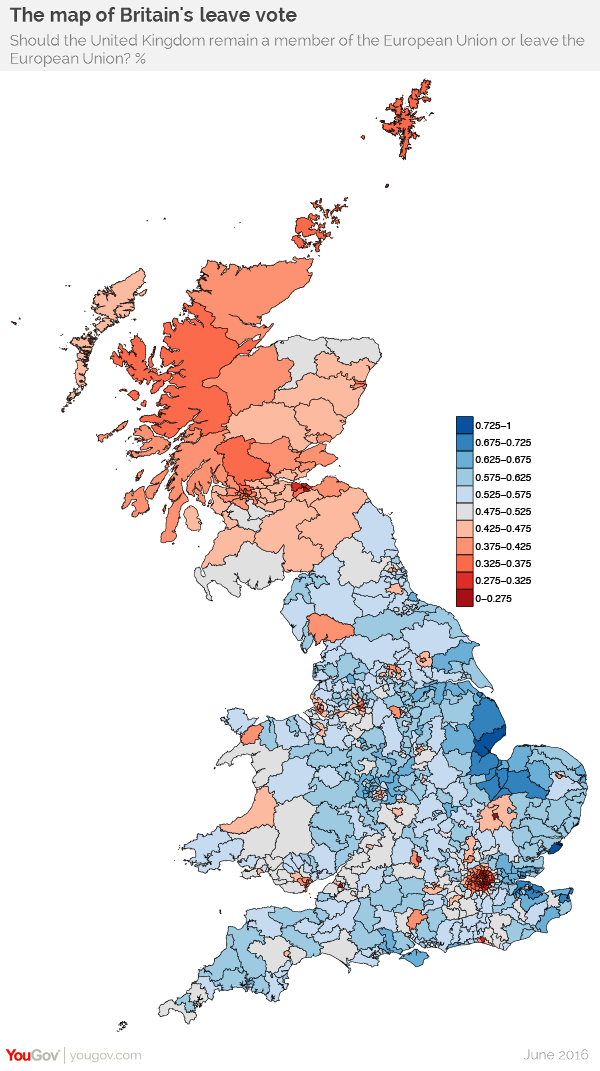
I could go on and on on this subject, but I had better not. I haven't mentioned environmental legislation, worker's rights, so many other aspects of the story of why the EU is a worthwhile institution that has done the its peoples good. And I haven't touched on the how a UK vote to leave the EU will almost certainly herald the break up of the UK, through triggering another Scottish independence referendum, as Scotland will certainly vote to remain. Even more serious are the likely consequence for Northern Ireland and peace in the Island of Ireland, where the existing post Good Friday Agreement consensus, of devolved provincial government within a UK that is united with the Republic within the EU, will be broken. And, in case you are one of those worried by immigration (I'm not, like most people in London and other big cities who are used to everyone being immigrants from somewhere) I haven't touched on the fact also, that with less co-operation from EU member states and France in particular, we'll probably get more illegal immigration and asylum claims to deal with.
YouGov's map of voting intentions by local authority. Scotland will vote 'remain' and the UK cannot survive Brexit.
For cycling, the usual topic of this blog, the freedom of movement we have enjoyed since EU accession I am convinced has contributed to the cultural and information-exchange process that has allowed us to reach the point of importing some of the best pro-cycling policies Europe has produced into at least some British cities. For example, if we hant't had freedom of movement, would the Hembrows have settled down in Assen and provided us with the information and cross-cultural Dutch translation that we needed for the Go Dutch campaign in London? Such questions are unanswerable, and I need to get this blogpost out in time to make, I hope, one or two undecided voters to think in some new ways.

England was deeply part of cultural Europe until the reign of Henry VIII, the break with Rome, and the destruction of most English art by his henchman Thomas Cromwell. Our focus was more on remote territories for the next four centuries, but our attention was forced back to Europe by the wars of the twentieth century and the loss of our empire. The accession to the EEC was an important, defining event for those of my generation, too young to vote in the 1977 referendum called by Harold Wilson (whose Labour cabinet was divided over Europe), but brought up, post-decimalisation and post-metrication to think, at least to some extent, of ourselves as European citizens, with our maroon European passports. I am a product of the wider Europe, coming from a family on my father's side of wandering, Sephardic Jews, traders between the Christian and Moslem worlds, who had come from Spain at the time of the Inquisition, and spread across Europe, North Africa and the Near East, to Morocco, Italy, Greece, Turkey, Israel, France, arriving in my great grandfather's time in England in 1898; while on my mother's side I am a descendent of  mid-european Catholics, inhabitants of a mountainous and fiercely independent region, the South Tyrol, fought over by Papal, Napoleonic, Hapsburg, and Italian armies for centuries, and still not really, comfortably settled into one of the states of modern Europe (though now forming a largely German-speaking Italian province with a high degree of autonomy from Rome).

I am one of those people whom Boris Johnson claims don't exit: who feel an 'underlying loyalty to the idea of Europe', that is, feels 'European'. I think there are a lot more of us. I think there may be enough of us to swing this divisive and dividing referendum against the old England post-Imperial delusionists on Thursday. We will see.

Wednesday, 4 May 2016

A crossroads

As we approach the Mayoral election tomorrow in London, and the end of Boris Johnson's eight years in office, so the builders race to finish his principal legacy to London before he finally vacates the chair. Not the bus that gets too hot, not the cable car that only has one regular passenger, not the quite pointless two-way conversion of a few streets around Piccadilly that were one-way, not, for God's sake, the preposterous, as yet unbuilt, Garden Bridge. No, his principal legacy is the four segregated Cycle Superhighways, and principally the East-West Superhighway (which it would appear now will be eventually designated CS3, continuous with the existing CS 3 to Beckton), and the North-South superhighway, which has been designated CS 6. These meet at the crossroads of Blackfriars Bridge north side. The system is not yet fully open, but it seems likely to be so within weeks or even days.

Cyclists waiting at the signals at the interchange between the two Superhighways at Blackfriars (via @London_Cycling)
This blog started with articles covering the cycle protests at Blackfriars towards the end of Johnson's first term in office, at which stage he had done little for cycling except paint meaningless and dangerous blue 'Superhighway' markings on some roads. The protests were against this lack of progress, the danger at major London junctions controlled by the mayor for cyclists (and pedestrians), the cycle deaths that had occurred at Blackfriars and elsewhere on account of poor or non-existent cycle infrastructure and terrible, antiquated motor-centric road designs, and against a scheduled rebuild of the Blackfriars junction that promised to make it no better for cyclists and pedestrians. Blackfriars was where all this started.

I reported on the cycle hustings, organised by The Times, in 2012, where Boris appeared to lose his temper with the cycle activists and insulted us with silly remarks about 'morally superior' cyclists and 'brown skinny legs'. I reported:
It appeared to me that Boris made no concessions to the campaigns of the last year at all. He did not admit that his Cycle Superhighways have been very poor and have not lived up to the initial promises he made for them. He did not agree that cycling casualties per mile are increasing. He several times referred to people who want a cycling infrastructure "ideal world" which is unachievable, implying that talk of giving cyclists proper, protected space on London's main roads, in other words, Going Dutch, is not really possible. Towards the end of the meeting he seemed to be implying that the cyclists in the room were all greeny unrealistic lefties, wanting to see the back of all motor traffic in London, saying, in a bizarre improvisation on words, that it was not possible to "Pasturise [or should that be Pasteurise] London".
Well, what we didn't know at that moment was that Boris had already agreed, by the time that meeting started,  to sign the LCC's Love, London, Go Dutch pledge to build proper cycle infrastructure in London. The die was cast. Cycle lobbying had become a significant political force in London, which he had to realistically acknowledge. This may have been a cynical move for him at that moment, as I believed in 2012, it is hard to tell, but the evidence now is that he came to believe late, but sincerely, that Go Dutch was a good policy.

Fast forward to last Friday, and we had the second Times cycle hustings, this time badged as The future of London transport: a recognition (perhaps) of the way cycling has been moved, by campaigners and enlightened politicians, from a niche subject associated with sport and fitness to one that is regarded as having major economic and social significance in the likely future development of the city.

Ashok Sinha, CEO of London Cycling Campaign, introducing The Times cycle hustings last Friday
At this hustings, we had none of the Boris-style rancour. In fact it was almost bland, with all the mayoral candidates (with the exception of the UKIP one) having signed-up to the LCC's demands this time round (due to another fantastic effort by campaigners, not just in LCC, but in Londoners on Bikes and Stop Killing Cyclists) and a general agreement that cycling has become mainstream transport policy, that future growth in the capital is anticipated and to be catered for, and that the infrastructure developments started under Johnson must be continued. This, at least, was the general rhetoric of the meeting.

On the other hand, none of the candidates were themselves regular cyclists, with the exception of the Green candidate Sian Berry. Boris always had that going for him. He definitely knew what it was really like on the streets. There was a lack of real passion from the Labour and Conservative candidates, Sadiq Khan and Zac Goldsmith on the subject that may ring warning-bells. Formally they all seemed to be saying the right things: Khan talked about making London a by-word for cycling, 'On a par with Amsterdam, Copenhagen and Berlin'. (The inclusion of that last city will raise eyebrows for anyone who has a first-hand knowledge). Goldsmith promised to spend £100 million per year on cycling if elected. This would potentially keep the infrastructure building programme going at its current rate, though might not be enough to achieve LCC's demand of a tripling of the length of segregated Superhighways, plus a mini-Holland scheme in every borough that wanted it. Khan refused to be pinned down on money, while Berry promised 15% of the TfL budget, which would be almost four times as much as Goldsmith's commitment.

Johnson's margin of victory in 2012 was only 62,000 votes. With the polls close again, and with certainly at least 100,000 regular cyclists in the capital, and enough others interested enough in the subject to be willing to vote primarily on the basis of this issue, or be strongly swayed by it, and with the level of organisation of the cycle lobby, it is clear that candidates now have to court it, as has been noted even on BBC news.

Goldsmith should have been the easy winner of the cycle vote. He came with a track-record of supporting 'green' causes, unusually for a Conservative MP, and he was a one-time editor of The Ecologist magazine. And as a Conservative successor to Boris, sharing many similar views, he might have been expected to want to continue his legacy. But from the beginning of this campaign he has blundered and fumbled about this issue. At every opportunity he has seemed to want to talk up electric cars as being the future of personal transport in the city, almost as if he were in the pay of the manufacturers. He even suggested in an early interview that they might be allowed to use bus lanes, which would of course be disastrous for the many cyclists who still depend on bus lanes for some small measure of protection and priority where cycle lanes do not exist, should electric cars actually become popular. Later he became known for a quote in an LBC interview where he commented that if cycle highways did not work and were shown to increase pollution he would 'rip them up'. When this caused consternation, he claimed he was being 'hounded' by cycle campaigners.

He tried to clarify and distance himself from these earlier comments in the hustings last week, claiming he had been misrepresented, and that he had only been stating a common sense position that if any piece of transport infrastructure were shown not to be working, one should consider removing it. But I think that emotive, unforgettable phrase, 'rip them up' is going to be inscribed on the tombstone of his campaign to become Mayor of London. Of course I'd agree that if a cycle facility isn't working, and isn't attracting cyclists, and isn't facilitating their progress in a safe manner, it should be removed. But, heres the point: it should then be replaced with a better facility. Goldsmith doesn't say this second part. He has never said that. He also seems to not understand that a piece of cycle infrastructure cannot 'cause pollution'. It is the motorists who are doing that. Goldsmith has repeatedly adopted the rhetoric of the 'bikelash' anti-cycle lane campaigners: the bizarre idea that cycling schemes force motorists to pollute.

He may promise to spend money on cycling, but when it comes to all specific cycling issues, Goldsmith has been found wanting. He has repeatedly criticised the consultation process for the Superhighways and mini-Holland schemes, and repeated this criticism at the hustings. This criticism mirrors that of the 'bikelash' campaigners who want consultations re-run indefinitely to try to achieve a different result: consultations that typically have seen about two-thirds backing for the cycle schemes, after a huge response and a hugely expensive public engagement exercise. Goldsmith always comments that the Walthamstow and Enfield mini-Holland schemes have had poor consultation and been unpopular (not true), while, according to him, the scheme in his constituency, the Kingston mini-Holland, has been well-consulted and has been popular, and he states he 'hasn't received a single letter of protest about it'. But he doesn't seem to have noticed that the other mini-Holland schemes are far more ambitious, particularly the Walthamstow one, which has achieved a far greater change in a short time.

Part of the Enfield mini-holland scheme: Orford road, a town centre street transformed for walking and cycling
There is always going to be more resistance to more ambitious and more effective cycling and walking schemes. Goldsmith has shown he lacks the backbone to stand up to the short-term, short-sighted reactions of those who initially feel threatened. He has stated that he would waste TfL money and waste time by re-running the consultation on CS 11, decisively supported by a two-thirds majority. He has clearly allied himself with the opponents of effective cycling schemes. We've all noticed that. He was the last to sign up to Sign for Cycling of the major candidates. He waited for Khan to sign first. His attempt to re-establish his cycling credentials in an interview with the estimable Chris Boardman (that Boardman had to pretty much hound him to obtain) came too late. And still he comes out sounding wrong. In an interview for the Evening Standard today, Wednesday 4 May, headlined I'd be the greenest Mayor: pledege to clean up air with tax penalty on gas guzzlers, there's no mention of cycling in 25 paragraphs. With the East-West Superhighway likely to open tomorrow, election day, and under a headline on air pollution, he doesn't feel the need to mention cycling. He's not going to get many cyclists' votes.

His Labour rival, Sadiq Khan, has wisely avoided commenting on specific current cycle schemes, by and large, apart from one odd interview in which the expressed an idea that some of the new cycle tracks were too wide: a comment greeted with incredulity in a city famous the world over for having ridiculously narrow cycle lanes and tracks. But he has repeatedly emphasised, and did so again in the hustings, the need for more segregated  cycle tracks. Goldsmith has not done this, preferring to talk about Quietways (which have failed) and min-Hollands. Khan's manifesto commitments to cycling are more complete and convincing than Goldsmith's, despite his refusal to be specific on the money he would spend. Khan's comment that he would not yet be happy with his close family members cycling in London doesn't say to me he is talking down the potential of cycling, it says to me he understands the real safety issues that still prevent most Londoners who would benefit from cycling from using it as a daily means of transport. As the son of a bus driver, associated with the bus lobby, he doesn't seem the best politician to continue Boris's cycling legacy. Nevertheless, he seems a far better bet than Goldsmith.

Anyone who takes up the mayor's chair and tries to promote cycling will experience a backlash from some of the old guard officials at Transport for London: we know that. There are people there who think they have now 'done' cycling, and with the opening of Boris's cycle tracks, they can get back to more serious business. The new mayor has to face them down and tell them, 'Sorry son, we've only just started on this'. We have to judge whom of the main candidates is most likely to do this. Cycling commentator Bill Chidley attended the meeting on CS11 that Goldsmith organised in St John's Wood, and commented:
My own impression... was that Zac is nice but dim, but entirely lacking in stomach. At one point, he said that he didn't believe in "imposing grandiose schemes on local communities" - which is exactly what the Mayor is mandated and obliged to do.
And an observer from Camden Cyclists commented on the meeting on how  
He visibly shifted in response to sentiment in the room. [Most of the attendees were from the noisy minority of car-centric NW8 residents opposed to the Superhighway]
At least Boris wasn't afraid to appear unpopular in a meeting. He wasn't afraid of that at the 2012 cycle hustings, but we've also seen in a video of a TfL board meeting how he personally pushed the E-W Superhighway project along against prevarication from other Board members. Would Goldsmith do this? It looks very unlikely. London is at a crossroads, and it looks like a Mayor Goldsmith would turn in a different direction. The London 'cycling revolution' would be in severe danger with Goldsmith in charge.

The London Green Party has consistently been the most in touch with cycling issues over the past four years, with Green Assembly Members Jenny Jones and Darren Johnson consistently asking pertinent questions of the Mayor, compiling relevant papers and reports, and actually getting out on bikes on the roads in all parts of London to find out what cycling conditions are actually like there: not just in Westminster and the City, but in remote car-dominated suburbs too. I showed Jenny Jones round the appalling Neasden gyratory system on one occasion (which she said was the most depressing experience she had had on her cycling survey of London), and this (and this blog) influenced a valuable report on cycling in Outer London produced by the London Greens. Very recently I showed Green Assembly candidate Caroline Russell around the Brent Cross area and the A41 Hendon Way, where TfL seem to have abandoned plans for an outer section to CS 11, but where safe space for cycling is desperately needed.

Retiring Green Assembly Member Jenny Jones and Green Assembly candidate Caroline Russell studying the awful cycling environment around Brent Cross in Barnet with me this April (Photo by Jonathan Briggs)
The Greens have been engaged in the issue beyond other parties, pushing Boris every step of the way, though there has also been sterling work by Caroline Pidgeon, Liberal Democrat Assembly Member and mayoral candidate. I'm therefore going to be voting for Sian Berry for Mayor as my first preference. I'd like to vote for Pidgeon as well, but the system means that the second preference vote must go to the candidate who can stop the worst candidate, who is Goldsmith. So my second preference vote will be for Sadiq Khan. I recommend all those who give their first preference vote to Berry or Pidgeon to give second preference to Khan.

In the vote for London-wide assembly members, I recommend a vote for 'Green' for the reasons given above. The two Green Assembly members (who are both retiring) have been critical to ensuring London has progressed this far in creating a cycleable and walkable city, and their successors I am certain, from personal discussion, will carry on that work. The more of them that are elected under the proportional London-wide ballot the better.

The vote for Constituency Assembly members is a 'first past the post' system. For those in my constituency, Brent and Harrow, I recommend a vote for the sitting Labour Assembly Member, Navin Shah. He has also worked hard on behalf of walking and cycling, persistently asking the mayor awkward questions, particularly about Barnet's proposed ugly, car-centric Brent Cross Cricklewood development. At a recent meeting in which I personally questioned him, he affirmed his support for more segregated Superhighways and a mini-Holland in every borough, and said he believed CS 11 should go ahead as planned. For those in the Barnet and Camden constituency, I recommend a vote for Andrew Dismore, again the sitting Labour Assembly member, as he has also been helpful.

Things have moved on so far from when I first started campaigning, decades ago, when cycle schemes were so insignificant and below the public radar as never to be discussed even by senior councillors, and were hardly known to anyone except some sad campaigners and equally sad junior council officers, who were never promoted. We're in a different world today, with national-level politicians forced to answer on exactly what they will do for those wanting to travel on two wheels, and knowing that their answers will matter for their future. London is at a crossroads on its journey to become a people-friendly city. The opening of the Superhighway within hours of election day will be apt and rather symbolic. If you have votes in this election, please use them carefully to ensure that journey continues.


Tuesday, 3 May 2016

Antisemitism in Labour

Disclaimer: I'm not a member of the Labour Party, or a registered supporter. I'm not Jewish, but I have a Jewish background and live with a Jew.

The business of 'antisemitism within the Labour Party' is basically nonsense. The affair is clearly constructed to undermine Jeremy Corbyn by his opponents both inside and outside the party and fed off by an uncritical press. There's just no evidence for the accusation of real antisemitism being a significant trend in the Labour Party (unlike various types of racism being significant trends in several other major parties).

The worrying thing to me is that the very terrm is losing its meaning. People are forgetting what real antisemitism is. There appears to be an attempt by some to define critical comment on Israel as 'antisemitic'. This is an affront to freedom of speech and is illiberal.

Indeed, it should be possible to argue even against the existence of the state of Israel in its current form – that is, in favour of a completely different political settlement for all the peoples in that region of the Middle East – and not be accused of antisemitism. (I am not going to do that here, but it should be possible, according to the supposed maxim of Voltaire I disagree with what you say but will defend to the death your right to say it.) The states of the world are artificial creations and we must be able, in free and liberal debate to question, not merely the actions and policies, but the existence of any of them, or to argue that the world would be better not organised into independent states at all, but in some other way. After all, the way states cut across ethnic and religious divides is a problem all over the world, not just in the Middle East. It's wrong to try to shut down such debate with accusations of various kinds of racism. Racism, hatred and prejudice based on race, of which antisemitism is a special case, is nothing to do with this, indeed it lies at an opposite, irrational, pole of discourse.

Former Mayor of London Ken Livingstone is not a racist in any way and I don't believe he is an antisemite. He does very make ill-judged comments. As has been pointed out in a perceptive piece by Adam Ramsay, though it is true that Hitler did at some stages of his career propose transporting Jews to Israel, to mention this is the flippant way he did, just before mentioning 'Zionism', risks, without much more detailed clarification, recalling a truly antisemitic conspiracy narrative of 'Zionists being being in league with Hitler'. I doubt Livingstone was aware of this, but he should have been aware of the fact that,  as Ramsay writes,
The speed with which conversations about anything relating to Jewishness in politics return to something relating to the man who murdered the parents or grandparents of many of the Jewish people around today must be deeply hurtful for huge numbers. It's generally not appropriate to turn such conversations to Hitler and Nazis without a very compelling reason.
Saying in his next sentence Hitler had 'gone mad' in order to kill six million Jews (and many others) compounded the problem because 'madness', or insanity, is an argument used to try to reduce culpability for those accuse of murder and other heinous crimes: it is a legal defence that barristers try to use to diminish punishment for those accused. Nobody argues that Hitler was 'mad' in that sense, and I don't think Livingstone meant that, he was talking casually. But his words could be misinterpreted as an attempt to 'clean up' Hitler, which is actually the last thing I believe he was trying to do.

Livingstone's later attempted clarification of his remarks tended to make matters worse. Speaking on BBC Two he said:
A real antisemite doesn’t just hate the Jews in Israel, they hate their Jewish neighbours in Golders Green or Stoke Newington, it’s a physical loathing.
Clearly if you 'hate the Jews in Israel' you are an anti-semite, full stop. And racism may not be a 'physical loathing'. It may be just a vague background framework of attitudes. But to build a case on the basis of these remarks for Livingstone himself being 'antisemitic' is loading far too much meaning on to flip comments and slips like the preposition in that sentence 'just'. I predict that Labour's investigation into him will end up exonerating him of the charge of antisemitism,  cautioning him to speak more carefully in future, and re-instating him to party membership.

There are bad eggs in every basket, but the Labour Party has actuially been fantastically hot at investigating all claimed cases of racism, including antisemitism, in its ranks, unlike other parties. This is in its tradition and nature. But we see, simultaneously, Conservative candidate for London mayor Zac Goldsmith running a thinly-veiled anti-Islamic campaign against the Labour candidate Sadiq Khan (A campaign which, I predict also, will do him very little good in this cosmopolitan city.)

Livingstone has often made silly and insensitive comments on various topics. They should be ignored and people should move on. This is not antisemitism. It's a storm in an anti-Corben and Conservative teacup.

I hope to return to London cycling matters shortly. In the meantime, I agree wholeheartedly with the voting recommendations (and rationale) of Londoners on Bikes.

Wednesday, 17 September 2014

Devo max is not on the ballot paper

As the title indicates, this post is intended mostly for my Scottish readers. If there are any.

This post is not about cycling, except, in a way, it is related.

I've always thought that the general lack of progress on improving Britain's environment is bound up with a democratic and constitutional failure. It is notable that the most democratic countries in the world tend to have the best-manged environments, and the most dictatorial, the worst. The UK has always fallen somewhere inbetween, but not very close to the best.

I view the Scottish referendum as an opportunity to force some constitutional change on the UK establishment. I think the result of a 'yes' vote would, in the long run, probably, be a better, more modern and more democratic, Scotland, England, Wales and Northern Ireland, that looked after their people and their environments better.

If, as looks likely, there is a narrow win for 'no', I expect little to change. Cyclists, more than most, will know how promises made by politicians at the point of an election disappear like Scotch mist after they have won. The 11th-hour commitment by the main Westminster parties to devo max in the event of a 'no' vote is deeply unconvincing. The British establishment is extraordinarily resistant to fundamental constitutional change that would break down its powers and privileges. We have been let down on this front by the Coalition, and in particular the Lib Dems, who did not use their bargaining power effectively to gain reform. We had a referendum on changing the voting system for Westminster, but that was meaningless as it did not offer the real reform of proportional representation that constitutional progressives want. The promise to reform the house of Lords has been broken. Promises of devo max I am certain will also be broken in the same way.

The party leaders in Westminster cannot deliver devo max because there would not be support amongst English MPs for an even more asymmetrical devolution arrangement that is even more unfair on England. There is no overall, final constitutional solution being proposed here, because the party leaders haven't been able to think of one that is in the least bit probable or stable. The 11th hour pledge is a transparent panic measure that has not been thought-through. It would, indeed, be the duty of English MPs to vote against some elements of the bribe that has been proposed to try to stave off the Scottish independence bandwagon.

The referendum debate should never have focused so relentlessly on the currency, which is actually not that fundamental an issue. Scots after independence could use the Pound, or the Euro, or their own unit, or whatever currency was found to be most convenient and beneficial for Scotland and all her main trading partners, including England, Ireland, and the rest of the EU,  through international negotiation, the results of which cannot be predicted before independence, because so much would change afterwards.

The focus should be on democracy, on representation, and on systems. If the parties in Westminster had been interested in a federal UK, they could have proposed one by now. But the problems are deep. England would be too dominant in a federation, if kept as a unitary governmental entity, yet England has been a united entity for so long that it cannot now be broken down in any obvious way into provinces that should appropriately have a similar level of devolution even to Wales, let alone Scotland.

My feeling is that the Union has served its purpose, a long and honourable and historical one, and it is time to move on, for Scotland (and indeed Northern Ireland as well, but that is an altogether knottier problem). We have so many international institutions that have an effect of partially pooling sovereignty that did not exist when the Union was founded: the EU pre-eminently, of course, but also the Commonwealth, the UN and NATO. Borders have effectively been broken down between all EU states now. The Union is a level of cross-border organisation that, though there was great justification for it between the 17th and 20th centuries, has now been rendered fairly surplus to requirements.

I think only a 'yes' vote by Scots will deliver the kick needed for real constitutional, democratic, change, leading to long-term social and environmental progress,  in any of the nations of the current UK. The next opportunity, should this one be missed, will be a long time coming.

Saturday, 23 February 2013

The whining, wheedling voice of the motor lobby

Since soon after the automobile was invented, a constant, influential refrain in public policy debate has been that whining, wheedling voice of special pleading emanating from the motor lobby, insinuating that motoring is somehow uniquely linked to economic prosperity and national wellbeing – be it a case of lobbying for employment subsidies, or more motor infrastructure, or less taxation, or no more increases in taxation, or other subsidies for motoring. In modern times this voice has been run a close second by the equally whining voice of the air transport industry, but air transport is still a small part of the economy compared to King Car.

So it is that:
The Automobile Association (AA) is warning that rising petrol prices are forcing drivers off the road. 
The group is calling on the chancellor to cancel a planned rise on duty in September.
Paul Watters of the AA is the genuine whining, wheedling voice of the motor lobby. He tells us in this video, broadcast across all BBC's news outlets yesterday, as if it were a bad thing that:
Up to 70% of our members are cutting back on driving, or cutting back on spending, or doing both.
We know fuel prices are high, and this is linked to recession. If people are driving less, this is either linked to them having to drive less, for one reason or another (e.g. less work around), or them making smarter, more environmentally-friendly travel choices (including travelling less, or finding ways to do the same work with less travelling). The latter is a good effect that is being achieved by higher fuel prices.

But what is this "cutting back on spending" Mr Watters talks about? This is unclear. Does he mean cutting back on spending on fuel? That doesn't make sense, as he's also telling us that fuel is more expensive. He seems to be insinuating that high fuel prices cause less spending in the rest of the economy, and therefore lowering prices, or lessening the burden of tax, will benefit the economy: the classic plea to politicians from the cohort of the petrol-addicted.

Of course there is less spending in general, but this is because of the recession. A shift of taxation away from fuel would effectively be a subsidy towards imports, as most fuel is imported, requiring heavier taxation elsewhere in the domestic economy to balance it up, which would be more damaging to economic recovery. Lowering the tax burden on motorists will also imply raising it on non-motorists, people who are trying to do "the right thing" by environment (or just doing it accidentally or through force of circumstance), and be a perverse incentive.

Since in the UK however, the "motorist" is perceived to be the average person, this whining, wheedling plea is one that politicians traditionally find it almost impossible to resist.

Wednesday, 5 September 2012

Musical chairs are no way to run a railroad

So Justine Greening was Transport Secretary for about five minutes before being replaced with Patrick McLoughlin. I am sure she just about got to understand her brief before being turfed out, aparrently because as a West London MP she was likely to represent the veiws of her constituents, who of course do not want more runways at Heathrow, and it seems to be becoming creeping, unofficial government policy to have more runways at Heathrow.

Much was made, in London cycing circles, when Greening was appointed, of the fact that a photo existed of her on a bike, taken when she was a subject of Wandsworth LCC's Movers and Shakers project to get leading community members on bikes.* Well, much good that did. But I suppose they had to try. As the Cycling Embassy of Great Britain had to try, when it sent her a letter welcoming her to her new portfolio last October, and suggesting, of course, she look at the untapped potenial of cycling in the UK. Now they will have to send a letter to the new man, but I'm sure it won't need to be adjusted much, as little has changed.

It is this kind of administrative insanity, as well as the kind of smaller-scale administrative insanity that I described in my last post, that tends gradually to sap the determination of those who campaign for saner transport policies in the UK. The "churn" of cyclists on the roads is often discussed, but it is linked to another "churn", that of people willing to campaign on the issue, when they see this game of mad musical chairs, when all the effort they had put into trying to convince one policitican of their case is largely thrown away as that politician is propelled elsewhere, or into obscurity, before they have had time to even attempt to change anything in the status quo.

Continually changing the peronnel at the top of government sounds like a recipe for radicalism, for continual shaking-up, but in reality it is quite the reverse. It is a recipe for nothing ever changing, a recipe for mainntaining the status quo in a very conservative country, because nobody who has the power to change anything ever understands properly the things they might change and what the consequences might be while they are in a position to make change, so basically very little does get changed, apart from administrative structures (for the NHS, local government, watchdogs, regulators, the railways etc.) which get changed with wearying frequency. But changing these does not change fundamentals.

Politicians respond to the mood of the media and what they perceive as the populatr zeitgeist, but beyond that, beyond progressing towards any more rational, evidence-based policy making, there is little hope in a system as short-term as ours. For as soon as they realise things might not be as simple as they first thought, hey presto, a new man or woman is in with all the popular prejudices and misunderstandings that have to be corrected once more. I quote a Tweet from railway journalist Keith Barrow:
Germany has had three transport ministers since 2002, so has France. Britain now on No. 8. No wonder transport policy is a mess.
I have no idea what former Chief Whip Patrick McLoughlin's views on transport are. He could be very enlightened for all I know, so I can't criticise him personally. But I can find nothing to say that he has ever taken much interest in the subject, though he was a junior minister for aviation and shipping under Margaret Thatcher for three years 20 years ago.

The last Transport Secretary we had who actually did anything much was Andrew Adonis, who decided to build a high-speed rail line at least as far as Birmingham (welcome to the Europe of the 1970s, Britain), and, to his credit, actually cycled round London trying out the cycle parking at all the mainline stations, condemning it as inadequate, which did lead to some improvements.

Justine Greening made no impact at all. I recall reading an interview with her in The Standard when she was appointed, and people on the greenish side of politics were being quite enthusiastic about her, because she had once been photographed on a bike. But it was obvious from this article that she had no vision for her new post. Her big idea seemed to be flexible use of the M4 Olympic Lane. She joined in the popular campaign against Westminster Council extending parking charges to weekends and evenings, not condemning it outright, but in a mealy-mouthed, coded way (Westminster subsequently dropped the plan). She never condemned nor contradicted the rhetoric of her predecessor, Philip Hammond, on the War on the Motorist. I considered blogging about her, but never bothered. On her watch, plans for large-scale road building revived (though it seems likely that the Chancellor was the main one behind that).

I'm not sure that any Conservative Transport Secretary is likely to do much differently. Most people consider that the big transport issues are Heathrow (or other airports near London), high-speed rail, and motorways, not how our children get to school and housewives (or husbands) get to the shops, and ministers absorb that popular concept. That priority needs to be inverted if we are to get joined-up transport policy making for the long-term social, economic and environmental good. The millions of unnecessary sub-two-mile car journeys should be the top priority for any new Transport Secretary to address.

*Update: I have been informed that that photo was not in fact taken as part of the "Movers and Shakers" project, but on an earlier occasion during a Bike Week treasure hunt on Putney Embankment. This does not alter the thrust of the post though.

Sunday, 2 September 2012

The red tape that strangles cycling provision

I wish to draw your attention to an excellent piece on the Chester Cycling blog, entitled Partition is a panacea. There, the author argues that the provision of safe and attractive cycling infrastructure would not only be a boon for personal mobility in the UK, and good for the environment and public health, but that it fits in exactly with the widely-perceived, in many political circles, need to actually spend public money to generate growth in the economy: the Keynsian theory, which suddenly (over the last few months, as the sustained nature of the recession has become evident to all) has become popular from left to right on the political spectrum. Those on the right tend to emphasise the "investment" aspect of such expenditure, in terms of its proposed future benefits to economic efficiency, rather than the Keynsian "stimulus" aspect. Nevertheless, the agreement over the kind of thing that needs to be done, in practice, seems widespred.

But there is, it seems from statements by government ministers, a problem with this investment, aside from whether we can afford it or not: "red tape". It suddenly seems to be the idea of the moment that "red tape" needs to be swept away to allow government, in collaboration with the private sector, to build the infrastructure that we need. According to George Osborne today, the planning system is too cumbersome and it is getting in the way.

In fact, I agree with this, but on, I suspect, completely different grounds to the ministers who have been talking about it, and the kinds of projects I am thinking about are quite different. I am thinking not about a new runway for Heathrow, but about modest changes to the streets of London. But these things are all related. Let's face it, if we can't get kerbs and signs right, what chance have we with airports and high speed rail?

So, on Friday I was looking at a little street in Brent, just north of Harrow Road, called Hazel Road, with a consultant and some council officers. This street has been closed-off to through-traffic for some years. There is a pedestrainised area by a small playground. We noted that many cyclists were using this street as a bypass to a congested junction on Harrow Road. Good on them, why shouldn't they? This is what "filtered permeability" is all about: giving cyclists easier journeys than other road traffic by letting them use routes that are blocked to motor traffic, in the process, separating them from motor traffic, for the good of all. But unfortunately, cyclists are not officially allowed to pass through the pedestrainised section of Hazel Road. The meeting was convened to consider how to change the street to make it better and regularise the cycle route through here.

Hazel Road, Kensal Green
A few minutes study of Hazel Road and all could agree that esssentially nothing needed to be done to this street apart from a bollard needing renewing, signs at either end bearing cycle-pedestrian shared space symbols needing to be put up, and dropped kerbs needing to be put in. It should cost only a few hundred pounds. A couple of workmen could do it in an afternoon.

But in reality, in UK town planning, things are never as simple, or as cheap, as this. For this road has has a "traffic order" put on it that excluded all wheeled traffic from the pedestrianised section, and it will need another traffic order to create an exception for bikes. That means that Brent has to go through an expensive legal procedure. Public notices need to be issued, adverts need to be placed in obscure papers that nobody reads (and that exist only for the purpose of having these public notices that nobody reads placed in them), consultation documents need to be sent out to all and sundry, lawyers need to be paid, and officers must get bogged down in masses of paperwork, all, in effect, to allow a couple of workmen to come out for a morning with a pick and shovel to relay about eight kerbstones. It's a situation that the Charles Dickens of Bleak House would have revelled in grimly satirising.

As a result, the cost of this tiny, modest change to the road network, and to the cycling infrastructure in London, will be thousands of pounds. Multiply this by the many other small changes that are needed all over London to create even the most rudimentary cycling network, and you can readily see why such a project seems unaffordable. And the great worry of council officers is that if the proposals are slightly ambitious, involving changes to parking or motor traffic flow patterns, then there could be quite a few objections in a public consultation, and councillors may take heed of these, and block the scheme. Then all the money spent on it will have been wasted.

So we have a crazy situation. Leading politicians are saying we need to spend money on new infrastructure, not merely for the reason of actually having the infrastructure, but for the reason of actually spending the money to revive the economy. Yet when we ask for small changes to create better cycling connections in London, and improve the streetscapes for everybody, we are told that there is no money because we are in a recession, and money is tight. But in fact, there was no money for these changes when the economy was booming either (or they would have been done by now).

The money to change Hazel Road comes from the "Biking Borough" grant awarded to Brent by Boris Johnson. It is around £300,000 to be spent over three years. But at least half this cash is being spend on promotional measures to encourage cycling, because that is what should happen in Biking Borough schemes, according to TfL. That leaves about £50,000 per year to be spent on infrastructure, for three years. That means two or three very small-scale schemes like Hazel Road per year, plus maybe a few more cycle stands. This is a minuscule rate of progress, even if all goes according to plan, and nothing gets objected to.

A mad system of red tape, legalism, and excessive emphasis on expensive public consultation over small matters currently strangles attempts to provide for cycling in our cities.

Some of the consultation thing comes from legal judgements that stem from legislation put in during the Thatcher era. The "Primrose Hill Judgement" of 1995 against Camden Council, where Camden attempted to introduce controlled parking in that well-heeled (and well-wheeled) district, without, according to a judge, adequate consultation, along with other developments and emphases by local government ministers in successive governments, has fostered an idea that residential roads "belong" to the people who live on them. It has become very difficult for councils to put in schemes on such roads with which a majority of residents disagree. And this makes strategic planning for cycling extremely difficult, because cycle networks will be, in part, on minor roads, but if each section of network can potentially be blocked by a vociferous group of nimby residents who see only their own short-term interests, and don't understand the strategic reasoning, then it is no wonder that council officers are very loth to propose anything remotely ambitions, beyond painting some cycle symbols on a road.

So I agree with George Osborne. The infrastructure we need for both growth and environmental benefit is being strangled by foolish bureaucratic rules imposed by government. But at this level, the level of kerbstones on tiny residential streets, I don't think this problem is on the radar of ministers. It needs to be, if councils are to deliver any sort of cycling infrastructure, and deliver it within sensible budgets.

Tuesday, 31 July 2012

Bread and circuses

It was said in ancient Rome that the way to appease the populace was to give them bread and circuses. This of course was in the context of an authoritarian system where dissent was not tolerated and there was no concept of "human rights".
In modern usage, the phrase is taken to describe a populace that no longer values civic virtues and the public life.
And if the bread becomes more meagre, then of course the circuses become more important. So as it is announced today that disposable income of UK citizens, on average, is at its lowest now since 2003 (quite an indictment of the economic performance of the country under two contrasting governments), the fact is somewhat lost in the razzmatazz around that greatest circus of all taking place in East London and elsewhere. Everybody feels so great about that, don't they? They more or less have to, don't they? Nobody really was allowed not to like the Danny Boyle spectacular, you were putting yourself in the company of a rather weird right-wing Tory and pretty much no-one else if you did not.

But while Britain's turbulent history of activism and political dissent was being celebrated in the ceremony and on TV, while the Suffragettes, who got arrested and mistreated for their fight for equality were remembered, strangely enough, right outside the Olympic arena, the great circus, people fighting for a equality and fair treatment in a different field were being arrested and mistreated by the police, pepper-sprayed and kettled. If a novelist imagining a dystopic sci-fi future Britain had composed the scene, he would have been doing a pretty good job.

It was probably inevitable that the Critical Mass bike ride on the night of the opening of the Games would end in trouble. Not because those involved wanted trouble; far from it, but because there was simply "no room" on the streets of Olympic London, both in a physical and a spiritual sense, for an event like this on that night. The police could not let it it happen. They could not allow the possibility of an area of streets close to the Olympic Park being gridlocked at that time. On any other occasion, yes, they could grudgingly live with it, but not on this occasion.

Yet Critical Mass is not a beast which can be controlled, for it has no organisation, no plan and no leader. It is merely a tradition, the kind of tradition which might otherwise have been celebrated in a show like Boyle's opening ceremony: a tradition of gathering of people on bikes at a particular time, the evening of the last Friday of the month, in a particular place, on the South Bank of the Thames, for a particular purpose, a meander round streets on a route determined on a whim by those at the front of the group, the objective being to fill the streets with a slow-moving cavalcade of bicycles in which riders feel safe and freed, for the moment, from the otherwise ever-present threat of dangerous interaction with motor vehicles: a critical mass of bikes.

It has often been said in the last few days that Critical Mass in not a protest, it is just a ride or an event, but in fact it shares characteristics of both protest and festival. It exists because the normal conditions for cycling on the streets of London (and other cities around the world where Critical Masses take place) are no good at all. There is no right enforced for cyclists to proceed safely, with fair and civilised treatment, on our roads as they stand. Critical Mass is definitely a kind of protest against, and a reaction to, that fact. It is a protest demanding a different order in transport and street hierarchy as much as the Suffereagettes were a protest demanding a different hierarchy in sexual politics. There is no Critical Mass in the Netherlands, where cycling is treated as a first-class form of transport, prioritised equitably with other modes.

The police tried to ban Critical Mass from the north side of the Thames, and they tried to prevent it from invading the sacred space of the Olympic Lanes, both of which conditions were inconsistent with the freeform nature of the event. There was a fundamental discordancy between the spirit of Critical Mass and the nature of Olympic Lockdown London. Eventually, after considerable unpleasantness, the police broke up the mass and herded the rump of it into a small street in Bow, where the participants were kettled, and in the end 182 of them were arrested and taken away in buses. Of this 182, only three have been charged with offences. The experience of one of those not charged, but held overnight in a cell, has been written up on opendemocracy.net. It makes a salutary read. You have to keep reminding yourself that the place where all this took place was not Burma, but London.

I have no relationship with Critical Mass. I have been on it, twice I think in two decades, in order to find out what goes on, and I am neither a fan of it not a detractor. I seek to understand. As with the suffragette movement, it seems to me there is a clear way for the government to deal with the recurring problem that Critical Mass poses, and that is to understand what the problem is that it is a reaction to, and to address that problem, by starting to correct the lack of resources and rights, the fundamental power imbalance, between those who choose to use the streets using their legs and using human-powered machinery, and those who choose to use them in motor vehicles.

It's not a thing that will be achieved in one legislative stroke, as was possible with Votes for Women. It will be a policy process. It has not started yet. Until it does, our cities will have to accommodate events like Critical Mass. There is a third alternative, which is that the right to peaceful protest on the streets will be stamped out in the UK. We seem to have gone a long way down that road already.

A police statement said:
People have a right to protest and it is an incredibly important part of our democracy … What people do not have the right to do is to hold a protest that stops other people from exercising their own rights to go about their business – that means athletes who have trained for years for their chance in a lifetime to compete, millions of ticketholders from seeing the world's greatest sporting event, and everyone else in London who wants to get around.
That of course is an argument that could effectively be used to end all street protest, at any time. A right is not a right if it can be taken away whenever it has inconvenient consequences for some people. It is a method of oppression to try to forcibly prevent protest rather than listening to what the protesters want and adjusting policy accordingly, which would, if not bring an end to all such protests, reduce their support and nuisance value.

Like the Roman rulers criticised by Juvenal, the rulers of modern Britain seek to distract attention from the decayed and disfunctional states of both our democracy and our environment by giving us entertainment and spectacle, while shoring up the privileges of an elite. The Roman Empire did not fall for 300 years after Juvenal wrote of panem et circenses: it's a policy that can work, for the emperors at least, for a long time. It's a Big Mac and an Olympic ticket now – never mind that all the expediently-made promises about the green and socially-responsible Olympics were all broken and forgotten.

A state run in this way, is however, quite inefficient, and, as the declining disposable income of citizens attests, I expect a continuing slow economic decline for a UK that neither modernises its political culture and structures, nor embraces dissent and alternative views, nor tackles significant social inequalities, nor learns to live in harmony with the natural environment, nor allows safe space in its cities for children and old people and others on bikes.

There is a petition to sign demanding justice for the Critical Mass 182, and the campaign against the closure of the Lea towpath goes on. And there's a good outsiders' view of what is going on in London from, of all people, the Americans, on NBC News.