Showing posts with label David Cameron. Show all posts

Tuesday, 21 June 2016

The Brexiters' dream is a post-Imperal delusion

As we draw to the end of this very unpleasant referendum campaign, it is worth, I think, recalling why we are where we are. It essentially goes back (as do so many things in modern Britain) to Mrs Thatcher. It was her volte-face on Europe that split the Conservative Party, the split that ultimately led this referendum to be called. After being strongly pro-European in the early part of her premiership, continuing the tradition of pervious Conservative leaders (including Edward Heath, who took the UK into the EEC, as it then was), including signing the Single European Act (the Luxembourg Treaty) in 1986, which gave the first real powers to the European parliament, she did a 180 degree turn on the subject for reasons best known to herself. Half the Conservative Party follwed her, and half continued allegiance to the older conservative pro-Europe line. The next leader, John Major, was bedevilled with this problem, and could not solve it, though he got the Maastricht Treaty, which created the modern EU, through. David Cameron's solution to this same, ongoing problem of the bitterly-divided Tory party was to call this referendum. The nation overall did not want it: it is important for our European friends to understand this.

The European Union was actually proposed by a British Conservative Prime minister in the first place: Winston Churchill. But it was always unclear whether he saw Britain as part of that future entity or not. Probably, he did not: he shared the romantic Victorian-Edwardian attachment to the dream of some future theoretical and impractical 're-union of the English-spaking peoples' (presumably including the USA, Canada, Australia and so on) that would then separate us from Europe. A similar transatlantic-gazing viewpoint is it the root of the views of many of the current Leavers: that we can somehow go on to exploit our cultural and economic attachments with those anglophone parts of the world more thoroughly if only we can leave the EU behind. Unfortunately, in the real world, as opposed to that of Rudyard Kipling's and Arthur Conan Doyle's fiction, we can't.

There are of course some on the radical left of UK politics campaigning for 'Leave'. Some of these are people for I have great respect. Baroness Jones (Jenny Jones, former Green London Assembly Member) is one of these. I attended her leaving party at City Hall before the May election to congratulate her ( and her colleague Darren Johnson) on all they had done for cycling in their time at City Hall. Nevertheless, I'd like to take her to task on her pro-Brexit position (which is at odds with the majority opinion in her party). This essentially amounts to: 'THe EU is broken and undemocratic. There's no chance we can fix it, so we should leave'.

I find this a very strange position for anyone of an internationalist disposition to take. So if the EU is 'broken', we leave, and what? We leave 300 million people in a 'broken' institution, and we give up any influence in trying to improve it or reform it? That can't be right. I can only imagine the rationale is that she (and others like her) hope that the EU will simply fall apart in reaction to Brexit. I have to say I find this a deeply improbable proposition. The UK leaving the EU will not have that much effect on the citizens of the rest of the Union, or on their politicians. The EU will be able to adapt and continue. The supposed fragility of the EU and its institutions has been consistently overplayed by our media. We've heard nothing about the Euro (ever) except 'It's on the brink of collapse'. Except that it hasn't collapsed. It's had a rocky time, but basically, this project, to place under a monetry union the economically diverse and divergent nations from Portugal to Austria and Finland to Crete , this incredibly improbable and ambitious project, has succeeded. It's not going back.

Similarly, if the UK leaves, there's going to be no shortage of new nations wanting to accede to the EU, and there's going to be no domino effect of old members wanting to leave. The EU is going to continue, grow, and strengthen as an entity, without us. We'll have to negotiate a new deal with the EU over trade and labour movement, and it's going to have to have many of the characteristics of the deal we have now. If we cease to pay into the European budget we're going to lose all influence over how the rules are set up, but we're basically going to have to continue to abide by those rules to trade. There's not going to be the free lunch the Brexiters want. We're going to have to accept freedom of movement if we want to be within the trading block on anything like reasonably advantageous terms. Or, maybe we'll be offered a deal whereby we pay to be out of the agreement on freedom of movement but within the trading area. In either case, we're not going to get what the Brexiters claim we might get. The EU has to defend itself, ultimately, in response to  defection. It obviously can't offer an ex-member state a deal so advantageous that it might tempt others to secede. There has to be a punishment for leaving the club. That punishment will surely be felt in the purse of ever UK citizen in a Brexit world.

An anonymous cartoon gleaned off Twitter which crudely but effectively summarises the problem with the Brexit position

The world of science and the world of the arts both thrive on international co-operation, and their representative organisations are uniformly sending out the message that Brexit would be a scientific and cultural disaster: see for example the press release from the Royal Astronomical Society, or this piece by, extraordinarily, Jenny Jones's ex-GLA Green colleague, Darren Johnson and champion of cycling in Outer London (with whom I got drunk in a south London pub not long ago), now turned music journalist. The response of the Brexiters, that the EU is 'not a magic money tree' really doesn't cut it. It completely misunderstands what the experts in these fields are saying, what they know. As the RAS puts it:
Participation in trans-national programmes... has more impact than those carried out by single countries, even if they are funded at the same level. The coordination of projects across the European continent prevents duplication of effort, and allows scientists to more effectively share resources.
Much the same goes for the arts, for which freedom of movement is hugely important. And anyway, the Brexiters aren't saying the money we would save from EU membership would be spent on science and the arts. They seem to have committed that money to building more hospitals. Or something. But we won't have the money for hospitals if our science base, on which our high-tech industries depend, collapses.

In fact the Leavers have no coherent economic plan, and little understanding of why the EU is there in the form that it is in the first place. It was a response to a Europe almost destroyed by a century of war between major powers (if you date that century back to the Franco Prussian War of the 1870). The EU has made the Europe that generated those wars an unimaginably remote history to all who are young today.

The 'democracy' arguments trotted out by the Bexit side make no sense. None of them seem to have noticed that the UK is still dominated by a monarchy and a hereditary aristocracy and that two-thirds of our law-making parliament is unelected. The European Parliament, elected by proportional representation, is the most democratic layer of government England (outside London, which has the GLA) has got. The Council of Ministers consists of people appointed by the Westminster government and its equivalents in the other member states. There is a huge range of public bodies in the UK that wield great influence over citizens' lives that are far less democratic. I don't hear the Brexiters in general talking about removing the undemocratic influence of mediaeval bodies within the UK like the Corporation of London, the Royal Parks Agency or the Verderers of the New Forest.

Of course the EU is deeply imperfect in its democratic structures. But it is misrepresented as some sort of monster developing in its own way beyond the control of the citizens of its constituent states. Most of the nonsense claims of the Brexit side in this respect are simply knocked out by the observation that our government and parliament have had a veto over every significant change in the powers and operation of the EU over its history since we joined. We have agreed to it all: our Prime Ministers, cabinets and parliaments from Heath to Cameron have agreed to it all. We could have stopped anything we didn't want, and in fact we did stop lots of things. Other provisions, like the Shengen agreement on open borders, and monetary union, we opted-out of, for better or worse. The veto we had over treaty changes, plus the influence that being one of the biggest economies and biggest contributors made us, ensured that the UK influence in the development of the EU was always huge. We created the EU, with others. For us to leave it now would be like a person abandoning a house they had built, and into which they had sunk all our resources, with no realistic prospect of finding another remotely as comfortable or accommodating.

The EU is not a superstate, and is not heading to be one. There's a simple economic reason it can't be one. It's central administration takes only about 0.5% of the member nations' GDP. Its bureaucracy is on the scale of that of an English county council. I've seen it. I've been to Brussels to talk to the Transport Committee Chair of the European Parliament about cycling (who was then an English MEP). Such a small organisation with that level of funding can never take control of Europe in the manner of the Federal Government of the United States. It would take a massive change of policy on behalf of all the governments of the member states, acting unanimously, to start heading it in that direction. That ain't going to happen. And as for Ever closer union, that famous phrase, what doea it mean? I think it is correctly interpreted not as a vision of a superstate; I think it means rather an ever-closer spiritual and cultural union, an evolution towards a state of cooperation between the European peoples that makes conflict between them ever less conceivable. I believe this is what the founding fathers of the EU meant by that phrase. Then again, perhaps it doesn't mean anything at all.

I could go on and on on this subject, but I had better not. I haven't mentioned environmental legislation, worker's rights, so many other aspects of the story of why the EU is a worthwhile institution that has done the its peoples good. And I haven't touched on the how a UK vote to leave the EU will almost certainly herald the break up of the UK, through triggering another Scottish independence referendum, as Scotland will certainly vote to remain. Even more serious are the likely consequence for Northern Ireland and peace in the Island of Ireland, where the existing post Good Friday Agreement consensus, of devolved provincial government within a UK that is united with the Republic within the EU, will be broken. And, in case you are one of those worried by immigration (I'm not, like most people in London and other big cities who are used to everyone being immigrants from somewhere) I haven't touched on the fact also, that with less co-operation from EU member states and France in particular, we'll probably get more illegal immigration and asylum claims to deal with.
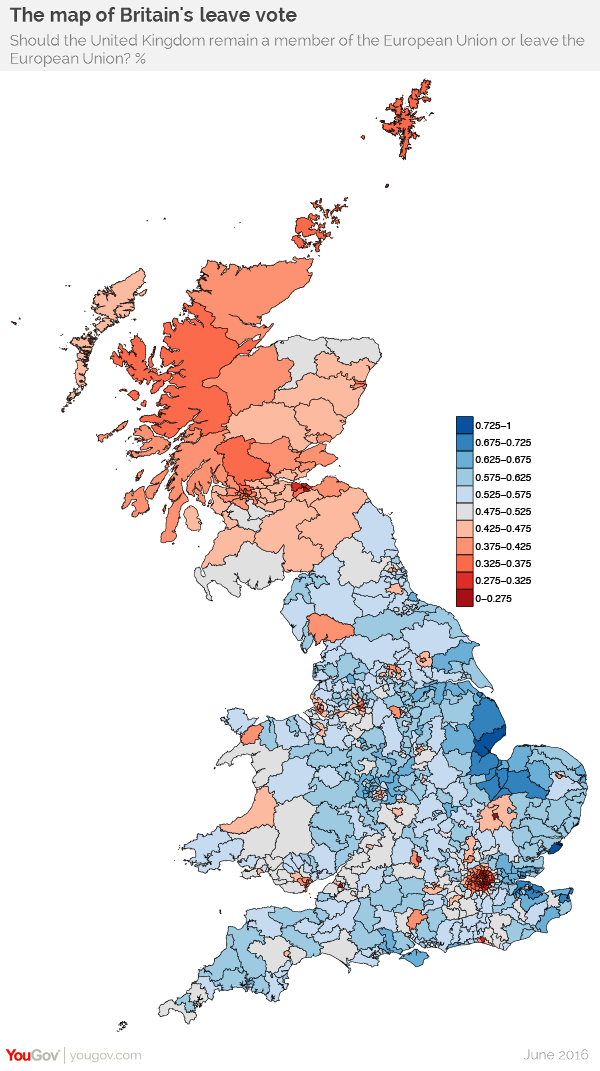
YouGov's map of voting intentions by local authority. Scotland will vote 'remain' and the UK cannot survive Brexit.
For cycling, the usual topic of this blog, the freedom of movement we have enjoyed since EU accession I am convinced has contributed to the cultural and information-exchange process that has allowed us to reach the point of importing some of the best pro-cycling policies Europe has produced into at least some British cities. For example, if we hant't had freedom of movement, would the Hembrows have settled down in Assen and provided us with the information and cross-cultural Dutch translation that we needed for the Go Dutch campaign in London? Such questions are unanswerable, and I need to get this blogpost out in time to make, I hope, one or two undecided voters to think in some new ways.

England was deeply part of cultural Europe until the reign of Henry VIII, the break with Rome, and the destruction of most English art by his henchman Thomas Cromwell. Our focus was more on remote territories for the next four centuries, but our attention was forced back to Europe by the wars of the twentieth century and the loss of our empire. The accession to the EEC was an important, defining event for those of my generation, too young to vote in the 1977 referendum called by Harold Wilson (whose Labour cabinet was divided over Europe), but brought up, post-decimalisation and post-metrication to think, at least to some extent, of ourselves as European citizens, with our maroon European passports. I am a product of the wider Europe, coming from a family on my father's side of wandering, Sephardic Jews, traders between the Christian and Moslem worlds, who had come from Spain at the time of the Inquisition, and spread across Europe, North Africa and the Near East, to Morocco, Italy, Greece, Turkey, Israel, France, arriving in my great grandfather's time in England in 1898; while on my mother's side I am a descendent of  mid-european Catholics, inhabitants of a mountainous and fiercely independent region, the South Tyrol, fought over by Papal, Napoleonic, Hapsburg, and Italian armies for centuries, and still not really, comfortably settled into one of the states of modern Europe (though now forming a largely German-speaking Italian province with a high degree of autonomy from Rome).

I am one of those people whom Boris Johnson claims don't exit: who feel an 'underlying loyalty to the idea of Europe', that is, feels 'European'. I think there are a lot more of us. I think there may be enough of us to swing this divisive and dividing referendum against the old England post-Imperial delusionists on Thursday. We will see.

Sunday, 4 March 2012

'Cities fit for cycling' flashride and debate – the Ship of State moves

I have not yet reported on the 22 February protest ride organised by ibikelondon, Cyclists in the City and the London Cycling Campaign, in advance of the Commons debate on cycle safety inspired by The Times's Cities fit for Cycling Campaign.

Well the ride was a huge success – as we knew it would be. Cyclists, for the first time in my 26 years of riding in London, are now prepared to stand up (or sit in the saddle) and be counted, and are not prepared to let the status quo continue. I arrived at the top of Duke of York steps to see a picturesque sea of winking red lights from the throng of riders gathered below on The Mall. There were clearly hundreds here, though all of them were not in view.

Looking down on the start of the ride from Duke of York Steps
The ride took off, and wound its way very slowly down The Mall and into Horse Guards Road, then headed for Parliament Square, turning right at the Palace of Westminster, down Millbank, across Lambeth Bridge, then back along the south side of the river to Westminster Bridge, across the bridge, past St Stephen's Tower (Big Ben) and up Whitehall, to Trafalgar Square, and back to The Mall. Police on bikes did an excellent job of keeping impatient motorists, taxi drivers and motorcyclists at bay, and of minimising conflict, and the LCC marshals also did a sterling job in keeping the ride together.

The police estimate was that 2000 cyclists took part. This is a similar number to that on the last Blackfriars flashride, but this ride felt symbolically and emotionally far better, and just more like an important historic moment. It was a protest ride in the right place, winding round the centres of power, Westminster and Whitehall. It was enthusiastic and noisy (previous flashrides had been quite quiet). It included MPs, London Assembly members and councillors. It was a ride riding a national wave of publicity and concern over the issue. Everybody on it, from "almost never cycle" people on bikes in their ordinary clothes, to long-distance touring cyclists and road racers in their usual get-up, knew why they were there and what they wanted, united in pushing the messages that cycling needs to be made safe, and that the way to make it safe is to build "cities fit for cycling". No more victim-blaming, no more persecution, no more putting the burden of taking all the protective measures on to the cyclists, no more letting motorists get away, literally, with murder, no more road designs that ignore cyclists – the slogan Cities fit for cycling encapsulates the point: it is the environment and the law which need changing, not the people on the bikes. The point was made, and made to people who matter, as subsequent events proved. It felt like a turning-point.

The ride was noticed, and had its effect on the debate next day. Several of the MPs taking part in the debate had been on the ride. The debate, attended by 75 MPs, has already been widely reported and commented-upon. Of course, those MPs attending were largely those converted to the cause already. But it proved that a surprising number have been converted to the cause, and a surprising number either are cyclists already, or know that they want to be, and would be, if the necessary measures to increase safety on the roads were taken. The Prime Minister's disarmingly honest statement on the afternoon of the flashride that
Anyone who has got on a bicycle – particularly in one of our busier cities – knows you are taking your life into your hands every time you do so...
had already galvanised the debate. There was mercifully little of the traditional UK pantomime of "cyclists should do more to protect themselves" and none of the equally-traditional comedy number "cyclists must get their own house in order and obey the law before we spend money on them" (when was that argument ever used against any other social group?). The MPs here basically understood the agenda that The Times has been driving home: our streets on which cyclists have to ride are not fit for purpose. And they, broadly, recognised that fixing the situation was going to cost a good deal of money, and take much time and political determination. There was also a recognition we has been here before – the National Cycling Strategy of of 1996 had aimed for 10% of trips to be done by bike by this year, 2012 – and a feeling that the same failure must be avoided, at all costs, this time around.

I can pick out a few problems with the debate. There was quite a lot of harping on the "safety in numbers" fallacy, which just confuses the debate on cycle safety. I've written about this in detail before. Basically, my position is that "safety in numbers" is a kind of illusion resulting from the fact that the places that have both large numbers of cyclists, and good safety for cyclists, also have much better physical conditions, either through separated infrastructure, or motor traffic removal. As the Director of SWOV, the Dutch institute for road safety research, says:
I do not expect that a greater number of cyclists will on its own result in a risk reduction for the cyclist....Policy that only focuses on an increase in cycling and at the same time ignores the construction of more cycling facilities will not have a positive effect on road safety.
The trouble with the "safety in numbers" concept is that, though it contains a grain of truth, there is certainly a correlation there, it is basically unhelpful for forming policy, as it encourages a view, that UK cycling organisations have often come dangerously close to suggesting, that all you have to do is to encourage and train as many people as possible to cycle on the roads, and the roads will then automatically become safe for cycling, and we will have solved the problem of how to create a mass cycling culture without all of that annoying, expensive, dedicated cycle engineering clutter that those silly continentals put in. As David Hembrow puts it (in his now miraculously resuscitated blog)
Cycle training can help a few nervous but keen individuals to cycle in a hostile environment. However, it's not something which scales to support the entire population in cycling for a significant proportion of all journeys. 
Talk of "safety in numbers" just distracts attention from the real, hard-engineering measures that are needed to create mass cycling in an advanced industrialised nation. As I say, it just confuses the debate, and it did indeed confuse some MPs' advocacy of the cycling cause in the debate. It is an idea we need to move beyond.

Then there was the "strict liability for drivers" issue, another thing where there is a bit of a correlation with high cycling levels in various countries, but we get the causation, again, the wrong way round in this country. Driver liability is an insurance technicality, legal small-print, if you will, which really cannot affect people's real-world, moment-to-moment decision making on the roads. It can have little effect on safety. It was introduced in the Netherlands after they already had mass cycling based on good infrastructure. It came as a consequence of that. It doesn't itself create, or significantly contribute to, mass cycling, anywhere. It's another distraction.

Then there was the minor distraction raised of "the need for showers and workplace lockers" – whereas a characteristic of mass cycling based on good infrastructure is that it is relaxed, not fast and furious, and people dress for their destination, not for their mode of transportation. These things again should be seen as largely irrelevant to what we are trying to achieve.

Then again, there was a lot of mixing up of cycle sport with "cycling as transport" in the debate. Unfortunately, because the one word "cycling" in English covers both of these quite different and largely unrelated areas, this usually happens. (The Dutch have two different words.) This was all the more understandable in view of the impending Olympic Games, and I do not entirely discount the possibility that some people may be inspired to start cycling, either for leisure or utility, as a result of media focus on the sport, and I recognise this to be a good thing. But unless we follow up this burst of enthusiasm with real change on our roads, to make people continue to cycle, by making it a pleasurable experience for them to do so, we will be back to how we were within a year or two. So: cycle sport, nothing wrong with it, but not really the issue here.

So there were these bits of foolishness and confusion in the debate. But overwhelmingly it was on the right lines. There was a huge amount of concern by MPs at avoidable deaths and injuries of their constituents while cycling, and a recognition we have both to physically put our roads right, and get prosecution and sentencing of road traffic offenders right. Ian Austin talked memorably about "the derisory sentences drivers [who kill] receive". Julian Huppert came down to the hard facts of the case when he said that "£10 per person per year is needed to turn Britain into a prime cycling nation".

Ben Bradshaw, a Labour ex-minister who has been involved with cycling at the parliamentary level for many years, noted, from his experience of government, how getting action on cycling tended to be dogged by two things: firstly, a failure of the different government departments that need to be involved – treasury, transport, environment and local government, and health – to collaborate, with what he described as conflicting cultures between the departments, and, secondly, the presence of so many disparate voices from the cycling lobby. This last certainly has been a problem in the past, but my sense now is that cyclists are far more united now in calling for the measures that really increase safety and cycling numbers. I think the flashrides have been evidence of this.

MPs merely having this debate doesn't actually get anything done. Cyclists, and The Times, still do not have any of what they are asking for. Delivering those is down to the Prime Minister, who knows that cycling in the UK involves "taking your life into your hands', and his senior ministers, particularly the Chancellor, and the Secretary of State for Transport. There was nobody at the debate who could deliver for the government. Under Secretary of State for Transport Norman Baker was really the fall-guy for this debate: he was in clear, and embarrassing, difficulty, trying to justify the record of the coalition so far – that of his government, that had abolished the already meanly-funded Cycling England quango and not replaced it with anything coherent, and which had nothing to offer but £11 million per year for training cyclists in techniques to avoid getting squashed on the roads by negligent drivers and lorries that shouldn't be there in the first place, and a Local Sustainable Transport Fund that mixes £15 million for a paltry few cycling schemes of questionable quality with far too much other stuff. Everybody, including him, seemed to know that this is just not action on a scale that is going to work. He candidly revealed his "envy" for the "fantastic" cycling environments in Amsterdam and elsewhere in the Netherlands. He knows that they achieved it by spending about 80 times his total expenditure, per person per year, for forty years. He knows what is needed, but can't yet deliver it.

So the onus remains on cyclists, and their supporters in the media and politics, to keep pushing to put cycling's supporters in the government, like Norman Baker, (and maybe David Cameron himself?) in a position where they can deliver what is needed. In the London Cycling Campaign, our next step, apart from the Go Dutch petition, will be a protest ride on 28 April, which should be the biggest ever. If you can possibly get to central London to take part in this, wherever you live, start planning to attend now, please. If you don't live within cycling range, there are always trains, coaches (and, dare I say, cars), and Boris bikes at the London end!

There remains much to do, and we are not close yet to getting the demands of even The Times's too-modest manifesto. Nevertheless I think the national debate has decisively changed. If this were a war, this would not be the Beginning of the End, but I think it could be the End of the Beginning.

I'll finish by going back to the start of the Westminster flashride. I arrived at the top of Duke of York Steps. As I took photos from the top of the steps, many pedestrian passers-by, all types of people, asked me what was going on. It was difficult to explain quickly, but I told them it was a peaceful protest to highlight to MPs the need for better safety for cyclists. Everybody I spoke to was 100% in favour of the protest when I told them this. All agreed that this protest was a great thing to happen, even if it did get in their way temporarily.

These people were not cyclists. These reactions, more than anything else, lead me to think that a rubicon was passed on the night of 22 February 2012. The vast ship of public indifference to cycling safety and cycling conditions in the UK, that campaigners have been pushing and shoving at for decades, getting nowhere, had started moving. Almost imperceptibly, over the winter of 2011–12, it had started to slide down the slipway into the river. The Times campaign had given it a welcome shove, but their effort was dependent on those of many others who had toiled away long before.

The ship may yet stick temporarily, and may require many more a hard shove, but I have no doubt it will enter the water, now that it has started moving. In the bar afterwards we toasted the moment. The Vole celebrated with tea.

The riders grouped at Duke of York Steps after the ride

Tuesday, 30 August 2011

The IAM's worthless "research" on accidents

The Institute of Advanced Motorists (IAM), which styles itself, disingenuously, as "the UK's leading road safety charity",  has produced a report called Licensed to skill  (funny-punny-groan-groan) on the contributory factors in road accidents (or what us more enlightened/PC people call "crashes").

The Telegraph breathlessly calls this piece of work "startling" (they must be easily startled), continuing:
Using data gathered by police and spanning 700,000 accidents from 2005-2009, the Institute of Advanced Motorists (IAM) has analysed, in breathtaking detail, the anatomy of a road accident.
Analysis? Breathtaking detail? Anatomy?? Well what this sorry affair is all about soon becomes clear:
Unexpected findings emerged, not least the relative unimportance that speeding plays in road accidents that kill six people each day in the UK, leave 68 others seriously hurt and 535 with less serious injuries. 
"It has been an eye-opener," says project manager Neil Greig, of the IAM. "Not just in terms of what causes an accident but in terms of dispelling some of the popular myths. For instance, if you look at Government campaigns they seem to say that speed is the number one problem. But illegal speeding – when drivers exceed the posted limit – accounts for only 13.9 per cent of fatal accidents. A bigger cause [15.9 per cent] is going too fast for the conditions – entering a bend too quickly, for instance – when you might well be under the actual speed limit."
So it's not about speed then. What is it about? The answer comes (with my emphasis):
The statistics are quite clear on this and it's "driver error or reaction". It's listed by police as a factor in more than 65 per cent of fatal crashes and the heading covers a multitude of driving sins many of which you're probably on first-name terms with. Topping the charge sheet is failing to look properly (the Smidsy factor – "Sorry mate, I didn't see you', relevant in 20.5 per cent of fatals involving driver error), followed by "loss of control" (34 per cent) which, says Greig, often means leaving yourself with "nowhere to go" after entering a bend or other situation, too quickly. Other errors include "poor turn or manoeuvre" (12 per cent) and "failed to judge other person's path or speed" (11.6 per cent.).
Second biggest cause of fatal accidents, to blame for 31 per cent, is the "injudicious action", an umbrella term for "travelled too fast for the conditions' (15.9 per cent of those labelled injudicious), "exceeded speed limit" (13.9 per cent) or "disobeyed give-way or stop sign" (2.1 per cent)?
Third culprit in the daily gamble on who lives and who dies is "behaviour or inexperience" (28 per cent), which covers faults such as "careless, reckless or in a hurry" (17 per cent), "aggressive driving" (8.3 per cent) and "learner/inexperienced" (5.3 per cent).
.........
So it goes on. So what's the purpose of all this? What's the IAM's purpose, and what's The Telegraph's purpose in their presentation? 'Cause on my reading of this, they are starting out by telling us that the role of speed in "accidents" is a "myth", and then as it goes on, as my emphasis shows, it turns out, it is mostly about speed.

So what the heck are they trying to tell us? All this amounts to saying is that crashes occur because drivers make mistakes that their speed or another's speed makes it impossible for them to correct before they collide with another road user. Amazing. Big deal. Who would have thought it?

One good thing about The Telegraph is that the readership is quite intelligent, so the comments on the story are mostly worth reading, many of them making more intelligent points than the article itself. And Telegraph readers know the difference between "their", "there" and "they're", and think it worth pointing these errors out.

As busmanj comments:
Instead of delivering "evidence on the causes of road traffic accidents" the problem is simply restated. You might as well say accidents are caused by errors. Or accidents.
This is so far behind safety-industry norms - notably, airline risk management - as to be depressing, given the richness of the statistical data. One no longer speaks of 'pilot error', because it is so vague as to be meaningless, implies culpability, and is essentially a truism... but instead seek[s] to get away from obvious proximate cause to underlying, often obscure fundamental causal factors, including (but not limited to) organisational and environmental factors which combine to put the human 'software' we all of us run in a position where it comprehensively fails. 
Exactly. "Organisational and environmental factors", i.e., relating to the way the way our society is run. The IAM's "research" is worthless. As britishbastion notes:
After each injury accident the police fill in STATS 19 report form which lists a set of possible causes of the accident for the officer to chose from. It is their opinion of what has caused the collision.
While there is a wide range of causes of collisions, the injuries that we suffer and the damage to vehicles and property is 100 percent attributable to the speed and energy of collision.
All this work by the IAM seems to be is an aggregation of the STATS 19 data collected by police officers. We know that the amount of time and money spent by the police investigating each collision is grossly inadequate – according to Amy Aeron-Thomas of RoadPeace, they spend typically £2,200 on fatal crash investigations, £250 on serious injury crashes and £60 on slight injuries, compared to £20,000 on a typical homicide. And there are no national standards for crash investigations, so 43 local police forces do their own thing, and it's rare to get accurate speed estimates. So this data is all just based on assessments of which of a set of fixed options on a form best correspond to the causes of an accident as it appears to a possibly ill-trained (for this job) and ill-equipped police officer doing a rushed and often superficial and inadequate investigation of a crash, in a manner that is not even nationally standardised. Just aggregating this published data hardly amounts to real research on the "causes" of "road accidents".

One suspects a "political" motive. One suspects the IAM started by knowing what they wanted the message of their report to be before they looked at any data, and that this was the whole purpose: to put the message out that "speed is not the problem". One may view it in the context of the coalition government's and the right-wing media's campaign against speed enforcement, and Transport Secretary Philip Hammond's declared "end to the war on the motorist". As Amy Aeron-Thomas also points out, the only references to "speed" in the Department for Transport's Business Plan, under the heading "Switch to more effective ways to make our roads safer", are:
i) Stop central government funding to local bodies for new fixed speed cameras
ii) Work with local authorities to publish speed camera data
whereas in fact the contributory factors to road deaths, in terms of enforceable offences, in 2009, looked like this:

Contributory factors to UK road deaths in 2009

The apparent DfT/police argument indicated here about exactly how many crashes are due to drink driving highlights the subjectivity and doubt inherent in all these statistics. But the simple message many motorists will take from the IAM's work and The Telegraph's reporting of it, the message they are intended to take, is that "Speed does not cause accidents, so it's OK to speed".

But as britishbastion and other commentators on the Telegraph story note, the real issue is not "accidents". It is the damage done to people. And that damage is of course closely related to speed, whatever "causes" are attributed to the crash. Accidents will happen, people will come into collision with fast-moving masses of metal, or the fast-moving masses of metal will come into collision with one another, and then it is the speed that counts. As Forlornehope tell us:
The energy dissipated in a collision increases as the square of the speed so at 30 mph you will do more than twice as much damage as at 20.
Unfortunately fake "studies", like this IAM one, and propaganda in the right-wing media, conspire to create the atmosphere that "killer" Hammond and his road safety minister Mike Penning ("Minister for the Slaughter of Vulnerable Road Users" as Freewheeler called him) exploit in their tilting-at-windmills easy-political-win-campaign against the tabloid fantasy of the "War on the Motorist". In response to the 7% increase in the number of cyclists killed and injured in 2009, Mike Penning commented that the Government was "looking at how we can improve cycle safety" – at the same time as ordering local authorities to publish accident and casualty statistics at speed camera locations (a move which the police opposed), using this language:
We want to stop motorists being used as cash cows. For too long information about speed cameras has been hidden in the shadows. This data will end that by clearly showing whether a camera is saving lives or just making money.
(Penning is also trying to push longer lorries on to our city streets, but that's another story.) And, as Amy Aeron-Thomas further points out, the DfT's 2011 Road Safety Strategy states:
We intend for the action we take [on road safety] to be seen as acceptable and proportionate to the majority of motorists.
My (and her) emphasis: it's the majority of motorists, not the majority of people. And here's David Cameron launching the UN Decade of Road Safety:


He's flanked by two racing car drivers. Not many vulnerable road users get killed on the racing track. So that proves it, as the IAM wants us to believe, it's not about speed, it's about skill. It's about being an "advanced motorist". With an institute specially for you. To tell you there's no problem with your speed so long as you are skilful enough. In a nation where everybody who wants to use the roads needs to get into metal boxes filled with airbags and crumple zones to protect them from all these other skilful drivers.

And what if you want to walk or cycle? God help you, because accidents happen, and when they do, it's their speed that kills you.

Wednesday, 20 July 2011

What happens to justice in the ultimate car-centric society

It goes bonkers:
Enter the Marietta, Georgia, case of 30-year-old Raquel Nelson, which has been bandied about in the comments section the last few days. Last April, Nelson was crossing a street with her three children when her 4-year-old was struck and killed by a car. She was crossing at an intersection, but was apparently not in a designated crosswalk. The driver who killed her had been drinking, taking painkillers, and was blind in one eye. He also has two prior hit-and-run convictions. Nelson and her daughter were also struck and injured. Residents of Nelson’s apartment building have complained to the city about the intersection. The nearest crosswalk is a half mile away.
If we have as little to fear from overly aggressive prosecutors as supporters of Caylee’s Law claim, we could expect the prosecutor in this case to show some discretion and mercy for Nelson, right? Yes, she admits to jaywalking. Yes, she erred, and subjected her kids to unnecessary risk. But she just lost her son. It’s hard to fathom a more punishing, heartbreaking sentence. Moreover, the underlying “crime” here was a misdemeanor, one most of us commit every day. So mercy, right?
Of course not. Nelson was charged with second-degree vehicular homicide. Which is insane. She was convicted last week. When she’s sentenced later this month, she could spend more time in jail than the man who struck and killed her son.
Interestingly, the perspective of the "radical" US website from which this snippet is taken, though critical of this case, is not really critical on the grounds that I think UK and European readers of this blog would be. The "radical" US perspective is to see this as about "justice" that might be tempered by "mercy" in the case of an "accident", not about apportioning blame for deaths in a transport culture where the rules have been written by and for motorists: "She erred, and subjected her kids to unnecessary risk," says even this apparently "left-wing" US commentator, seemingly oblivious to where the actual blame for the death lies. And we don't read anything clear about what happened to the driver. But elsewhere we can discover:
Jerry L. Guy, the driver who admitted hitting the child when pleading guilty to hit-and-run, served a 6-month sentence. He was released Oct. 29, 2010, and will serve the remainder of a 5-year sentence on probation....
Guy was originally charged with hit and run, first degree homicide by vehicle and cruelty to children. Charges were later dropped to just the hit and run charge.
Court records show that Guy was previously convicted of two-hit-and-runs on the same day, Feb. 17, 1997.
The first hit-and-run also happened on Austell Road, but when Guy fled from that scene he hit another car, seriously injuring that driver and passenger, records show.
Guy pleaded guilty and received a two-year prison sentence, but was out in less than a year.
There are major cultural and legal differences between the UK and the USA. In the UK, thankfully, there is still no legal concept of "jaywalking" (though many British people have picked this term up from US sources, and use it, incorrectly). In the UK it is, at least in theory, legal to walk on roads and to cross them at any point (excepting motorways), though it is against the Highway Code to cross on zig-zag markings near zebra crossings. In the UK we are a long way from parents being prosecuted for negligence for allowing their children to cross the road in an unwise place, though the argument of negligence is often used in such cases by the lawyers for insurance companies to try to reduce civil damage claims (as they also try to paint cycling victims as "negligent" for not wearing helmets).

It seems to me to be bizarre that both Labour and Conservative UK governments seem to have been fixated with the idea of importing justice and law-and-order related concepts from the United States. From the United States of all places! The United States, which has 0.74% of its population imprisoned! The latest example of this is David Cameron's plan to put elected Police Commissioners in charge of fighting crime in the localities of the UK, a very American concept – an idea which risks the populism, inconsistency, illogicality and political reversibility that characterises US crime-fighting. It is not in the British tradition to elect, on an individual, personal basis, those involved with the administration of the justice system, nor is there the slightest argument for it. There is no more argument for it than for electing who should be in charge of the armed forces. These roles should be independent, professional ones, supervised in a general way by national and local elected politicians.

So far, that (occasional) repository of wisdom the House of Lords has blocked the elected commissioners idea, but the government is still saying it wishes to overrule them, and press ahead with it. This is a not very high profile political issue which is nevertheless of the highest importance. It is an issue people should agitate on, both on grounds of general good-sense, and on grounds of the possible effects on transport justice – with the possibility under elected commissioners of an even more populist, unfair treatment of road crime that gives even less justice to vulnerable road-users.

We don't want the UK going further down the law-and-order basket-case trail blazed by the USA. We don't want mothers imprisoned for having let their slaughtered children cross the roads.

Friday, 8 July 2011

The News of the World

I have to say that have found much of the coverage of The News of the World scandal to be fantastically disingenuous. Yesterday, when it was announced the paper was to close, BBC Radio 4 news did about a 5 minute report detailing the history of the paper. The reporter told us of its original lofty Victorian intentions, its takeover by Murdoch in the 1960s, its subsequent dubious journalistic methods including entrapment of celebrities, how Max Mosely fought back in the courts and won, etc. But never was it mentioned what the most famous thing about The News of the World was, and a major, or maybe the major, contributory reason why many people (of the male sex) bought it. It was full of pictures of naked women.

So now Andy Coulson has been arrested, surprise, surprise, and David Cameron has been defending his decision to employ him as a spin doctor and to keep him on for a long time after allegations against him became widespread. One could argue for a long time about how much evidence there was at what time about the role of Coulson. In July 2009 the former editor of another Murdoch paper, The Times, Andrew Neill, said of The Guardian's revelations about phone-hacking:

It suggests that rather than being a one off journalist or rogue private investigator, it was systemic throughout the News of the World, and to a lesser extent the Sun.
Particularly in the News of the World, this was a newsroom out of control … Everyone who knows the News of the World, everybody knows this was going on. But it did no good to talk about it. One News of the World journalist said to me … it was dangerous to talk about it.
If a journalist comes to you with a great story, one of the first questions you ask is how did you get it. How you got it is relevant to judging its accuracy and preparing yourself for any legal challenge.
If this behaviour was systemic in the newsroom, why would you not know about it, why would you of all people, not know about it? Either you're incompetent or complicit.
At this stage, Cameron continued to give Coulson the benefit of the doubt. But hang on. Let's ignore the whole phone-hacking thing for a moment, which was only an accusation in July 2009, though one coming from very authoritative sources like Neill. Let's get back to the theme of "disingenuousness". Let's get back to the boobs, and all their associated apparatus, that the BBC so delicately overlooked.

What were our leading politicians, Labour and Conservative, ever doing getting into bed with, hobnobbing with, employing in their staff, having anything to do with, a bunch of women-debasing porn merchants, trivial but damaging and public debate-debasing celebrity tittle-tattle scandal mongers, and libellous, scurrilous, contemptible, shabby entrappers? Which it was always totally manifest to all that the editors of The Sun and The News of the World were? What were our politicians doing sucking-up to these miserable specimens of humanity, who any self-respecting person would have crossed the street (even a street run by TfL) to avoid ? That is the real scandal, and a bigger one than parliamentary expenses, in my opinion.