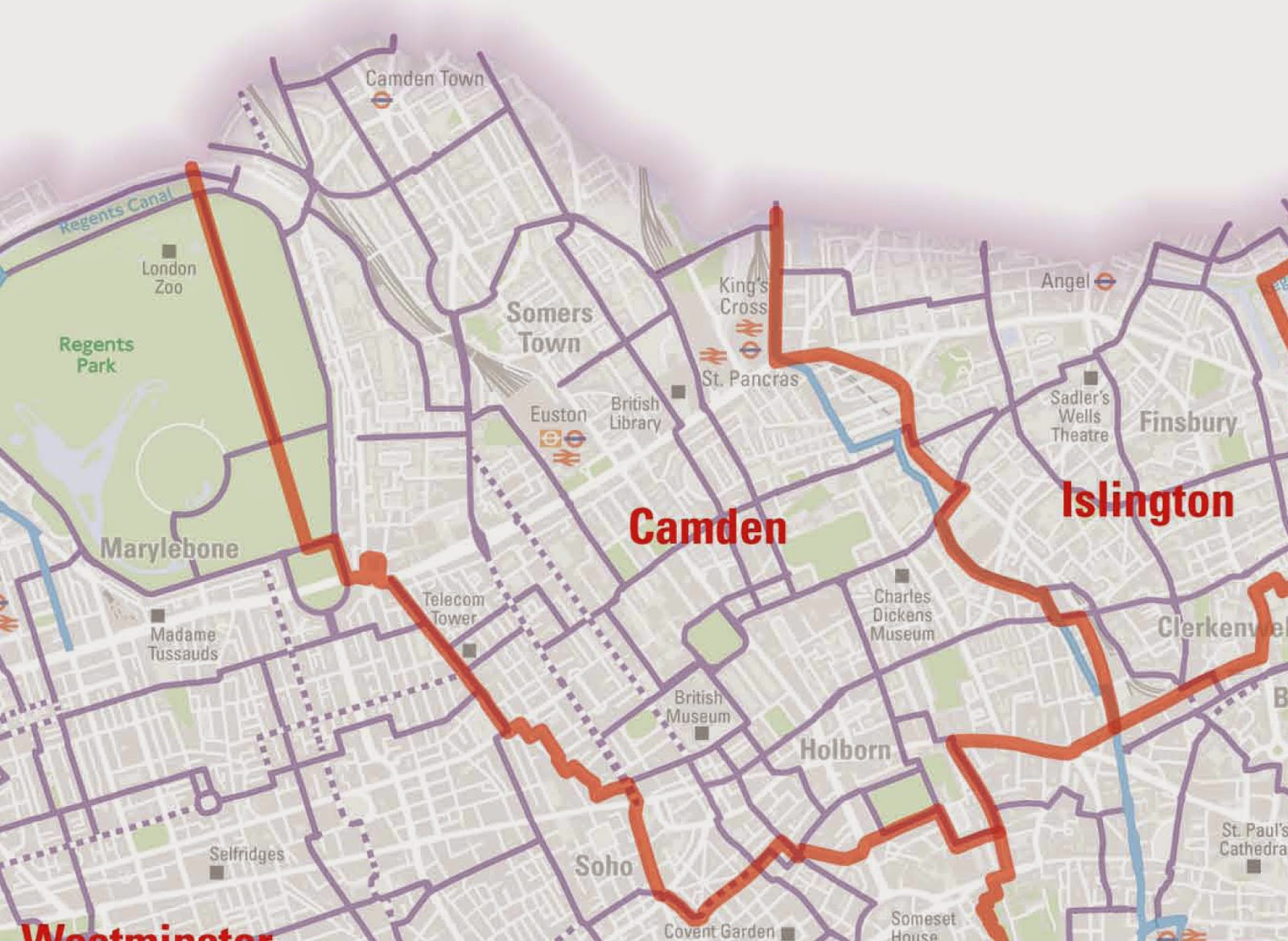
Showing posts with label Cycle Tracks. Show all posts

Thursday, 28 July 2016

Five years ago

Five years ago today the video below was issued by London Cycling Campaign as part of a consultation exercise with its members to find out what their preferred campaign might be for the 2012 London Mayoral election. In it, I argued that the key first step towards mass cycling is the provision of high-quality segregated cycle tracks on main roads. This overwhelming support this concept gained from the membership led directly to the Love London, Go Dutch campaign, the commitments secured from Boris Johnson, his Mayor's Vision for Cyclingand the system of quality segregated cycle tracks we now see starting to be developed on the main roads of London, so conspicuously enabling all-abilites, 'eight to eighty' cycling in places where this had not be dreamed of before. So I am proud of this.


This is not to decry the proposers of the other three possible campaigns mooted in the video. They all make excellent points. But it was a matter of what was the best, most effective strategy for us to pursue at the stage we were at (and largely still are) in our development of a utility cycling system and culture in London.

In the video, the first proposed theme, that of getting larger numbers of children cycling to school, was an objective, not a mechanism. There was no contradiction or competition with my proposal there because the one was necessary for the other. A very large number of schools are only accessed on major roads that would need segregated cycle infrastructure in order to get kids and parents cycling to them. Other schools in other places would require different treatments of the roads around them. But putting a social result of good cycling infrastructure forward to be the campaign itself was not quite logical. And one might be struck by the fact that for a demonstrator background to that bit of video, a temporary 'artificial' situation was used, of the FreeCycle (then called SkyRide) ride round London where children do indeed come out cycling in large numbers because the roads are closed for a few hours. In contrast, the background to my segment was the real, permanent situation created by the Torrington Place cycle track in Bloomsbury (which was doubled in capacity last year).

The third proposal, for 'unwinding urban gyratories,' also contained a fallacy: the idea that merely making these major roads two-way would be of great benefit to cyclists and pedestrians, would actually transform them into pleasant places to be, without measures to also reduce the total motor traffic. I've dealt with that one here, and I think we've moved beyond this concept in policy terms now. I pointed out long ago how, where in it was tried in practice, for example in Piccadilly, the simple unwinding of gyratory systems proved to be no good for pedestrians or cyclists.

Then the final proposal, Love thy neighbourhood, for a campaign for area-wide traffic motor removal schemes through modal filtering, did of course advocate a policy that is essential to creating a truly people-friendly city. But it can never be the primary solution for cycling on the road grid that we already have, because we can't get rid of all the motor traffic arteries that most real cycle trips will need to use for part of the journey. A comprehensive application of Love thy neighbourhood principles would, at best, lead to a series of separate small districts in which cycling was an attractive option, cut off from one another by still-hostile main roads.

Then, proposing this as the first step from where we were, also, I hold, badly underestimated the huge political challenge of creating these calmed neighbourhoods in a political climate where most people cannot imagine everyday transport by bicycle and believe in general that having all possible routes for motor vehicles open is a good thing. The  Quietway element of The Mayor's Vision hit precisely this snag. It turned out, as I expected, that it was actually poltically far easier to carve space for cycling out of main roads by physical segreagtion, than it was to create routes on minor roads by closing rat-runs. Those who depend on car transport typically only think their street should be quieted. The next one, and the next one... they should all be  rat-runs to allow them to get places fast. This is a fundamental problem. We have seen that there is not yet political consensus on the general desirability and practicality of low-traffic residential areas in London.

We've seen that again and again, in Lambeth (Loughborough Road area), Camden (West Kentish Town), Hackney (London Fields) and so on, where progressive proposals from boroughs for area-wide traffic reduction in residential districts have been defeated by opponents. But, judging from consultation results, and also conversations I have with politicians, we do have consensus that main roads should allow protected space for cycling. We need the calmed neighbourhoods as well, of course, for many reasons beyond cycling, but it looks like being a while still before that argument can be generally won. Then again, a main point about the 2012 campaign was we were trying to influence the Mayor, and he controlled not the neighbourhood roads, but the major ones. So it made sense for the campaign to be calling for stuff that he could bring about directly.

The point about the main road treatments is they really do generate new users, they get people out of their cars and off the buses and tubes, and start to build up the mass of influence we need to get the other, more difficult changes through. That's why attempting to start with the other stuff wouldn't be very effective. That's why I stressed in the video: This is the first step to generating a real, mass cycling culture. The propaganda power of the cycle track carved in granite out of what was previously space ruled by motors is huge, and immediately comprehended by those who have never thought about this subject before, in a way that filtered permeability just isn't. In other words, as Paul Gannon said to me back in the last century: people cycling on separate tracks on busy roads make other people think I could could do that too to a far greater extent than any other engineering measure or piece of promotion does.

The proof of all this seems to me to be amply demonstrated by what we see on the roads of Central London today. Mind you, I never expected to see the scene that was videoed by Wayne David last Saturday at the Embankment, site of the East-West Cycle Superhighway, the route for which I first suggested to Andrew Gilligan, the future Mayor's Cycling Commissioner, in 2012.


Clearly this was not the normal usage of the Embankment even on a busy day for cycling. Bike Biz tried to get to the bottom of what it actually was: seemingly a semi-organised, semi-counter-cultural, semi-commercial youth street 'happening'. It attracted criticism, but I cannot but agree with one commentator on the BikBiz article, who wrote:
Looks like they've done a better job at getting young people on bikes than all of the government schemes put together...
They may have been preparing for the RideLondon FreeCycle this Saturday. This annual mass ride around closed streets in Central London has existed for many years under various names and sponsors. It was first suggested to the then Mayor, Ken Livingstone, by LCC. I've been somewhat negative about this event in the past: of the 2011 event, then called Sky Ride, I wrote:
In this event, a seven mile circuit of central London streets is given over exclusively to bikes for a few hours once a year, cyclists are dressed up like yellow canaries for no apparent reason except to unwillingly advertise Sky Sports, and a huge number of obstructive barriers is erected around The Mall to prevent anybody from conveniently walking anywhere, enforced by a huge number of paid-for-the-day officious event staff who shout orders at you and tell you what a good time you are having.
I saw it as  rather tokenistic and an excuse for the Mayor not taking decisive action to make cycling an everyday option for Londoners:
To expect Sky Ride to encourage more people to cycle under everyday London traffic conditions is like expecting the experience of taking a cross-channel ferry to encourage people to swim the channel. It unrealistic, as the conditions are so profoundly different.
But from where I sit now, having seen the changes since then, I reckon I was a bit harsh. Perhaps these events, though demonstrating the suppressed demand, did contribute to generating the political pressure that brought our present infrastructure programme into being. And, strangely enough, I am quite looking forward to this weekend's event. It looks far better than ever before, with a route that does not use the same roads there and back, as in the past, but is a real loop round, with various interesting alternatives to explore, using in part the new East-West Superhighway, but closing a lot of other roads to motor traffic besides. And, of course, if you are lucky enough to come from an appropriate direction, you can use a Superhighway to get there.

Maybe I will see you there. Look out for the Vole!

Sunday, 30 August 2015

It's often only one person

Such is the pace of developments in London cycling infrastructure (planning if not actual execution) currently that a couple of details in my long blogpost of 11 days ago have already been superseded.

The most striking one is that a plan has now been produced for taking the East-West Cycle Superhighway past Buckingham Palace in a sensible manner, with the support of the Royal Parks Authority. There will be, if this goes through, a two-way segregated track on the north and west sides of the Queen Victoria Memorial linking a new cycle track on the north side of Birdcage Walk (currently the most stupidly-designed road in the area, with masses of space wasted in the middle of it, with giant pedestrian islands and dead areas between) with a widened two-way track on the north side of Constitution Hill. The segregation around the Memorial will be with bollards, removable for ceremonial purposes, unlike on most of the Superhighway, where it is with kerbs.

TfL visualisation of the bollard-segregated track in space taken out of the road (middle background)
Plan for the Superhighway link at Buckingham Palace
This all looks sensible enough, and people should respond to the consultation, supporting it, by 4 October. The question that is posed is: what was the problem before? Why was the Royal Parks Authority, until last week, bizarrely insisting there should be a gap in segregated the Cycle Superhighway in front of Buckingham Palace for 'safety, operational and aesthetic reasons', which would have caused, as Cyclists in the City pointed out, the Superhighway flow to get mixed with hundreds of gawping, snap-happy tourists on the Mall Service Road (effectively a pedestrian area, shown hatched just south of Green Park on the map above), obviously a recipe for disaster, and a position made even odder by the fact that, for the Superhighway solution in Hyde Park, the RPA was insisting that cyclists not share any of the current subdivided paths, but be routed via the roadway of South Carriage Drive.

South Carriage Drive, Hyde Park, a bizarrely under-used road space, will take the next section of the route westward 
Of course I've not been party to any behind-the-scene negociations, but Ross Lydall of the Standard, who generally seems to be very well-informed, seems to make things very clear:
The appointment of a new chief executive at The Royal Parks, which is responsible for the roads around Buckingham Palace, has been key to resolving the dispute.

Previous chief executive Linda Lennon was a fierce critic of many aspects of Transport for London’s 18-mile “Crossrail for cyclists” that passes through Hyde Park, Green Park and St James’s Park as it links Barking and Acton. 
The Royal Household is understood never to have objected to the plans. 
Mr Johnson said: “This is the final jigsaw piece in what will be one of the world’s great cycling routes. I am absolutely delighted that we and the Royal Parks have been able to reach agreement and I pay tribute to the agency’s new chief executive, Andrew Scattergood, his staff and TfL officers for the immense work they have put in to make it happen.
So an anti-cycling Chief Executive left, and suddenly the 'safety, operational and aesthetic' objections all disappeared and the RPA was left looking rather less like the car-oriented dinosaur that campaigners had perceived it as before (the Royal Parks of course being full of roads that are full of cars, roads used as normal parts of the through-traffic system of London, with this fact not seeming to cause the RPA any distress or sense of conflict about their purpose). Hopes are raised that, after decades of campaigners asking for it, the Outer Circle of Regent's Park might cease to be a huge gyratory for motor traffic, but might be changed so as to allow only motor access to the car parking, the zoo and residences, and to facilitate a much-needed north-westbound Cycle Superhighway, CS11.

So my message here is that often, despite outward appearances of implacable homogeneity of institutional opposition to progressive schemes, it can often turn out to be only one badly-placed person, in reality, who is causing the problem.

On the flip side, one well-placed progressive person can often galvanise an organisation and create more progress in a short time than has been achieved for many years. And I have to hand it to Cllr Phil Jones, Camden's Cabinet Member for Transport that he has, with the assistance of his officers, got Camden making better progress on actually implementing a Central London Cycling Grid (to complement the small number of built Superhighways) than all the other boroughs combined. I reported in my last post that the promised link between Royal College Street and Primrose Hill was currently stymied by bus-related arguments, but apparently these have been overcome, and Camden is now produced an attractive plan for consultation, which I recommend all London cyclists respond to favourably as well.

Proposals for Pratt Street
The proposals for Pratt Street , between Royal College Street and Camden High Street, and Delancey Street, betweem Camden High Street and Parkway, show a huge improvement over the current state of these space-wasting, unattractive, rat-runny one-way westbound roads, with a stepped cycle track going westbound with the motor flow, and an eastbound contraflow track either stepped (Delancey Street) or fully segregated (Pratt Street). The westbound flow for bikes is currently allowed, but is unattractive, particularly with the competition for road space with large vehicles including buses and squeezing at the corner of Camden High Street and Delancey Street, but the eastbound flow is not possible, cyclists from the very traffic calmed and reduced Primrose Hill area needing to access the Royal College Street or St Pancreas Way routes being forced to go via congested Chalk Farm Road or busy Parkway and Camden Street. This scheme promises to fix this long-standing, bad gap in the cycle network (as well as generally improving these streets for everyone) and others have seen the potential of this. Andrew Gilligan, the Mayor's Cycling Commissioner, has been touting this as making possible numerous long-distance cycle connections across London, in combination with the East-West and North South Superhighways:
Once the links are complete, cyclists will be able to ride from Swiss Cottage and Camden Town to Canary Wharf, Barking or Elephant & Castle entirely on separated cycle tracks or low-traffic streets. It’s testimony to the power of the relationship between TfL and a borough genuinely committed to cycling.
Actually he could go go further. If the Mayor actually builds CS11, promised for 2016, it will be possible to go all the way from Brent Cross to Canary Wharf, Barking or Elephant & Castle on cycle tracks and low-traffic streets. So I congratulate Cllr Jones on getting his plans this far, though I have disagreed with him on the best solution for Tottenham Court Road and Gower Street, Camden's 'West End Project'.

With the West End Project,  I felt, as I said last year, that fixation on the objective of undoing a gyratory system for cars and buses had got in the way of visualising the best possible ways of changing these roads to benefit pedestrians and cyclists, who are supposed to be at the top of Camden's 'transport hierarchy'. Camden's planners are now doing as good a job as they can on trying to solve junction problems that will be introduced by having stepped cycle tracks running in both directions on a two-way (for cars) Gower Street, but I think there are fundamental problems here. The cycle tracks will be on the same level as the motor lanes at the junctions, so reduced to painted markings, Danish-style, and therefore an attempt to signalise the cycle flow separately from the turning motor flow is likely to result in cyclists just getting blocked off by cars and vans invading their space. There is something of an attempt to combine Danish and Dutch junction principles here which I fear will not work. The Danes merge the cycle flow with the left (their right) turn for motors and expect cyclists to turn right (their left) in two stages. A full Dutch signalised solution separates all the conflicting cycle/motor movements in time, but depends on segregated tracks running right up to the junction, which cannot be invaded by motors. Without segregation at junctions, how can separate signalising work without risking the blocking-off of the ahead path for cyclists on what is certain to be a congested road? However, Gower Street clearly is not wide enough for two-way motor flow plus two-way cycling segregated at the junctions in the manner of a large Dutch signlised junction. The problem here is the whole architecture of the system left by removing the one-way flows for motor vehicles. (Another bad problem with the Gower Street plans is that one of the 'Danish' tracks will be interrupted by a loading bay, something the Danes would not dream of.)

But, to get back to my main theme here, we've got some individuals in influential positions now doing a lot of good for cycling in London, and we've got one or two who have been really getting in the way. Linda Lennon may have gone, but we still have a fine example of the latter tendency in Hackney Council's Planning Sub-committee Chair and perhaps Phil Jones's polar opposite, Councillor Vincent Stops. Stops has been a long-standing and clear opponent of segregated cycle infrastructure, and most likely through his influence Hackney Council has prevented TfL implementing Cycle Superhighway 1 on the A10 in the borough, consigning it instead to indirect back-streets in the manner of the old poor-quality London Cycle Network, and sacrificing the safety of the majority of cyclists who will always wish to cycle on the direct, main road, on which 28% of the serious casualties to people on bikes in Hackney now occur. Stops has actually written a blogpost on the subject of Cycle Superhighway through Hackney, but this does not really attempt to justify the route that Hackney Council has forced on the Superhighway on any logical grounds, rather, it attacks the whole concept of cycle routes:
A route-based approach is limiting, when streets are better regarded as a network
Drawing lines on maps, declaring them cycle routes and investing heavily along the route seems to capture the imagination of cycle planners and some campaigners, even though hardly anyone cycles such a route from end to end. Some of the investment that comes from such route-based planning will be good cycling value for money. However, instead of spending all this money on CS1, there are numerous other locations in the borough where investment would have been better directed. Improving these other locations, rather than using a large pot to titivate, and not substantially make things better for people cycling would certainly be better value for money, in terms of improvements to cycling.
In Hackney, in contrast to the route-based approach, the most innovative recent work has been the creation of a Bikeability map which assesses all of the borough's streets, regarding them as a network. Incrementally improving this network, particularly where there are historic clusters of collisions, will provide the best value for limited cycle and road safety funding. Sometimes improvements may be made opportunistically.
Hackney's 'Bikeability map'. The green on minor roads represents a lower 'Bikeability skill level' than the grey-brown on  (e.g) the A10 running straight N-S down the west side of the borough.
The first thing to say here is there is nothing 'innovative' about these 'Bikeability maps' for urban areas; I've been hearing about them for years from various campaigners and officials. The approach sounds reasonable enough, if it is being used to identify the worst locations that require remedial action, but, in practice, these maps are always used as a displacement activity to avoid doing what really needs to be done. Stops is being disingenuous in his talk of 'limited cycle and road safety funding'. Hackney could have had the funding from Transport for London to transform the A10, the road, I repeat, where 28% of all cycle casualties in Hackney occur, the most direct sand useful route in the borough, into an attractive, safe, high-quality cycle corridor. They chose not to take this, but to fiddle about on back-streets instead. Stops' claim that
Hackney Council has to be congratulated for getting so much value from the Cycle Superhighway process
will be regarded with some very raised eyebrows in the borough and beyond.

Of course I'd not dispute that streets should be regarded as a network, and, ultimately, almost the whole network needs its quality raised for cycling, but the points that are missing from Stops' analysis are 'utility' and 'standards'. Some routes are of far more utility and importance to cyclists than others, and it is here that investment at this early stage in developing a cycle network must be concentrated, to develop what I'd describe as the 'backbone network' of obviously attractive and useful routes that is needed to pull people in to cycling. Generally, but not always, these routes will be on the main roads, where, to achieve acceptable standards of actual and subjective safety, cyclists need segregation.

Stops wishes to focus on the wider network, and implicitly, to focus on small roads, because he seems to have a horror of the idea of subdividing the space on larger roads using kerbs, which he considers to be 'pesky' things that will disadvantage pedestrians, bus passengers, or others. But the 'Bikeability map' approach that Stops praises is fundamentally discriminatory and opposed to inclusive cycling, because it accepts a general and permanent compromise between efficiency and safety that is inimical to creating to a quality cycle network with uniform provision. What this 'Bikeability' thing, in this context, is really about is classifying cyclists, not roads. The very concept of 'Bikeability' in play here is a motor-oriented one, confusing 'cycling skill' with 'willingness to cycle with motor traffic'. Brave 'skilled' cyclists (normally young men) will continue to push their way down the A10, with its bad crash rate, because it is the most efficient, useful route for them. The slow and less assertive will, if they try to cycle at all, which most of them will not, be consigned to an indirect, low-priority, hidden 'superquietway' that will not be easy to use and will not get them to the places they need to go. This is not a good approach if your aim is mass cycling. But I sense this may not be Stops', or Hackney Council's, real aim.

Stops goes to a bizarre extreme in inventing arguments against segregated cycle tracks, for example when he commented on Twitter on the forthcoming East-West Superhighway:
How will an 8 year old get through a more congested Parliament Square as a non CSH route user?
...as if there are eight year-old cyclists using Parliament Square now who could possibly could be inconvenienced (rather than enabled) by the cycle track! (Even if you accept the wrong contention that the cycle track will cause congestion, I challenge Stops or anyone to stand at Parliament Square for a day, or a year, counting eight year-olds on bikes. There will be more flying pigs seen, except, of course, when road are closed for events like the RideLondon.)

Stops likes to claim that Hackney is London's best borough for cycling. I'm sorry, but the truth is that cycling in Hackney is, by and large, crap. I've often cycled in Hackney, and I cycled through Hackney the other day. There is no provision on main roads, which are choked with buses and other heavy vehicles, and the minor road routes are slow, deprioritised, badly-maintained and uncomfortable. You are bumping over severe traffic-calming all the time, and badly-maintained surfaces, taking long ways round, trying to follow neglected or non-existent signage in obscure places, you are constantly having to give way to main roads, or even slightly more important roads, and where you meet a main road to negotiate a straight across or dog-leg junction you have no help and no protection. Hackney can't even can't keep these poor backstreet routes open. The famous one running east-west from Canonbury to London Fields is currently blocked by major digging where the railway goes over in Middleton road, and cyclists just have to use the pavement.

Cycling in Hackney is inefficient and dangerous on the backstreet routes that borough provides, and very dangerous on the direct main road routes that it does nothing to make attractive or comfortable. Contrary to Stops' frequent claim that Hackney is some sort of great cycling leader amongst London boroughs, it actually (according to TfL cycle counts) has a similar cycling level to the boroughs of Richmond upon Thames, Hounslow, Islington and Lambeth, places with very different local circumstance and policies. The 2011 census gives utility cycling actually at a higher level in Richmond upon Thames than in Hackney (though I don't put much store by census transport data, as it comes from a self-survey, and may just mean that Richmond people want to believe they cycle more than Hackneyites do).
TfL counts had (2013) Hackney on 6% of journeys compared to Richmond, Hounslow, Islington and Lambeth on 5%

2011 census data had Richmond ahead of Hackney on cycling
Richmond and Hackney are very different places, the former outer London and Conservative-controlled, the latter inner London and Labour, but I think the reasons for the high (by very low UK standards) cycling levels they share are a result of similar factors. Both have within them or very close to their borders a lot of parkland and waterside space where cycling is possible, attractive and car-free (in Richmond Park and other parks and along the Thames in the case of Richmond and in Victoria Park and other parks and and along the canals in the case of Hackney). In neither case is this much to do with the roads policies of the council. Hackney is, in addition, a flat and compact borough within easy commuting distance of the City of London, and it does seem that Hackney does disproportionally well out of commuting to the centre (it is the commuting mode share that the proponents of Hackney's 'cycling success' usually quote), while cycling to school remains at only 2% of trips, not high even by UK standards, and indicating the lack of a genuinely broad-based cycling culture.

Cllr Stops' partner Rita Krishna, is strangely (or not so strangely, if you know the local situation) on the Committee of Hackney Cycling Campaign. Since she appears to share the same views as Stops, those Hackney cyclists wishing to campaign for good-quality infrastructure in their borough had best lend their support to the rival campaign, Hackney People on Bikes, which does support the policies promoted in this blog (which are also the official policies of the London Cycling Campaign). In any case, it looks like Hackney will continue to be a blockage to the development of a high-quality, inclusive cycle network for Londoners while Vincent Stops remains influential on the borough's transport policy.

I paid a visit to the Embankment on Friday to see how the East-West Superhighway construction is getting on (and to examine those pesky kerbs). Only a 500m section is currently open, between Horseguards Avenue and Westminster Bridge, and it is only accessible to westbound (or southbound) cyclists, as there is no way to reach it eastbound. However, looking at the rest of the work on the two kilometre section between the open section and Blackfriars Bridge, I expect all this length to be open by the end of the year.

Completed Superhighway section looking south (up river). The basic two-way track is 4m wide in general.
This is all cycling space. The right-hand area is a lane for right-turning cyclists, who will cross the carriageway using the signals 
Completed Superhighway section looking north (down river)
The track is smooth, machine-laid tarmac. The kerb on the river side has not been altered, though I think it has been made lower by laying of the track. The kerb on the new segregating island is chamfered,  a good detail, allowing wider effective width and reducing the chance of pedal-strike.

Make no mistake, this is the proper thing, and very satisfying to see, as the first piece of truly high-quality cycle infrastructure ever built on a main road in Central London. This is the most significant thing done for cycling in London since Camden built its tracks at the turn of the century, and, before that, well perhaps the most significant infrastructure put in since the 1930s (though that was suburban, not central). It's worth re-emphasising here: this is a gain from road-space. Nothing has been lost by pedestrians (in fact a lot has been gained). A simple transfer has taken place from space dominated and, from the point of view of most people, monopolised by motor vehicles to space dedicated to active travel. We'll see a lot more of this with the rest of this Superhighway scheme, and the north-south one from Elephant and Castle to the border of Camden. The politicians and public servants, like Vincent Stops and Linda Lennon, who say they support cycling, but do not want to see this kind of thing on their patch, will in future be seen more and more as an anachronism and an impediment to the development of a more civilised, pleasant and sustainable city. 

The new Superhighways and Camden's grid routes point the way to a future pattern of use of road space that gives everybody an opportunity to cycle their journeys if they wish. The discriminatory approach based on keeping direct main routes as the cycling preserve of a tiny fit and brave minority must be consigned to the dustbin of history.

Sunday, 19 October 2014

While focus is on the Mayor's Superhighways, Camden plans to double its length of segregated track

I wrote a post about two years ago entitled While Boris so far fails to 'Go Dutch', Camden quietly gets on with it. This is something of a 'second round' of that. Today, there is somewhat more sign of Boris Johnson trying to make a permanent mark on London before his mayoral term ends in May 2016 by building some good-quality cycle routes. Though what he will have achieved still looks likely to fall well short of the commitments he made before the 2012 election in response to London Cycling Campaign's Love London, Go Dutch campaign, in particular, he will not have completed the Cycle Superhighway programme to an adequate 'Dutch' standard on all its routes (nowhere near, in fact), the plans for the East-West and North-South superhighways are a substantial advance and have generally been welcomed by campaigners, business, the public and the media, while plans for Cycle Superhighway 5 in south-west London and the long-demanded upgrade to Cycle Superhighway 2 in east London look pretty good as well.

I'm planning to make a more general assessment of where the Mayor's Cycling Vision has got to, 18 months after it was announced, in another post, although attempts to write that keep getting overtaken by relevant events. However, I will to draw your attention here to the fact that, as coverage has been concentrated on the plans above, the Borough of Camden, pioneers of the on-street segregated or semi-segregated cycle track in London, have been continuing to 'get on with it' in a manner that, though it is not above criticism, must be said is not being replicated by any other borough.

When the rebuild of the Royal College Street cycle track was announced in 2012, replacing the two-way track on one side of the street, which had had an intractable collision problem at two junctions, with two one-way tracks, I supported the scheme because it was linked to a commitment to extend the track northwards to Kentish Town Road, making it go from 'somewhere to somewhere', to adapt the words of Jon Snow when he opened the track in 2000. Since then, this has developed into a plan to extend the route southwards as well, down Pancras Road and Midland road, forming a more main road and direct alternative route to the Kings Cross area than the existing back-strteet Somers Town Route (one of the oldest cycle routes in London, dating from Ken Livingstone's GLC era, before 1986).

The consultation on the northern extension closed earlier this month, and the response from Camden Cycling Campaign can be seen here. The gist of the scheme is that Royal College street will become two-way for bikes all the way, the bike space generally protected by rubber armadillos, and in places by car parking on the east side as well. The cycle tracks bypass bus stops and loading bays on the inside. The southbound approach to the Camden Road junction is not protected, and this is a concern, though the northbound is protected.

The southern extension to the route is now being consulted on. The consultation runs to 14 november, and I encourage people to respond. This will be an enormously important pice of infrastructure, linking residential areas in Camden with the big employment growth areas around Kings Cross and St Pancras, with the new Google headquarters, the Francis Crick Institute opening in 2015, and much else. Argent, the developers of Kings Cross Central, say that their site will eventually be home to some 30,000 office workers, 5,000 students and 7,000 residents. It looks as if, at last, we have some cycle route planning in London that is coming at exactly the right time. This route will link southwards into the existing east-west Seven Stations Link segregated cycle route across Bloomsbury   (which itself needs major improvement of course, to cope with the high number of cyclists it already attracts), and that will link to the Mayor's North-South Superhighway at Clerkenwell. We will have the beginnings of a functioning, continuous segregated or semi-segregated network on the streets of central and north London.

It is of credit to officers at Camden that they are conceiving part of this Royal College Street route extension also as the beginning of an east-west route across Camden Town. Ultimately this should run along Crowndale Road to Oakley Square and Hampstead Road. It is not too much of a stretch to suggest that the stage after that should be the construction cycle tracks on Hampstead Road to connect with Tottenham Court Road. This is consistent with the overall Central London Cycle Grid plan.

The part of the Pancras Road plan that would also form the beginnings of the East-West Camden Town route. I would oppose the advance stop areas, which suggest confused thinking about where cyclists should be on the road. I also think it would be better if the north/west-bound route was on Goldington Crescent, merged with the Somers Town Route, approaching Royal College street via the existing bicycle signals.
More southerly section of Pancras Road scheme. The bus stop bypass looks a bit substandard, and having been set back behind the stop, the cycle track would be better continuing its setback across the Chenies Place junction.
The overall network is being developed in stages, and the current consultation goes down south to the Pancras Road / Midland road junction (the tunnel under the railway lines). This junction was consulted on in August, along with a plan for a 2m wide kerb-segregated cycle track on Midland Road northbound (in the contraflow direction), from Brill Place. This plan showed southbound cycling on Midland Road with taxis segregated to the left (there are lots of these serving St Pancras) but only a painted advisory cycle lane separating cyclists from the general (heavy) traffic flow. The Camden Cycling Campaign response called rightly for this design to be improved.

Curious proposal for Midland Road: the caption misleadingly suggests there are 'kerb segregated cycle lanes' on both sides, but the two sides are actually the opposite of one another. Also the central cycle lane on Pancras Road (section under the bridge) is a poor solution. (North is to the left)
The plans for Pancras Road, currently being consulted on, are for armadillo-separated lanes on both sides, which will be 2m wide for most of their length (actually 2.5m wide for 105m, 2m wide for 375m, 1.5–2m wide for 34m, and 1.5m wide for 30m). There is no parking on this stretch, but there will be bypasses for the bus stops.

The existing Royal College Street cycle tracks seem to be popular and working well, except that the planters have in many cases been bashed out of shape by motor vehicles colliding with them. Camden are looking to find out specifically why this occurs. There are no planters planned in the future schemes. Camden quote, from their surveys, a doubling of cycle traffic on Royal College Street since the rebuild of last year.

If all goes well, by the end of this year Camden should have almost doubled its length of segregated or semi-segregated cycle track compared to 2012, and that means they will have increased the total length of on-street cycle track in London by a considerable fraction, as the other boroughs have little. This is being done for very small sums of money compared to what will be absorbed by the Superhighways – hundreds of thousands of pounds rather than millions. It will be paid for out of the TfL's Quietways funding for the Central London Grid.

Whatever detailed comments and criticisms of Camden's current plans may be made, and I am making a few as you can see, and whether the schemes meet the optimum Go Dutch standard, which they probably do not, it needs to be strongly noted that of all the boroughs involved in the Central London Grid, Westminster, Kensington & Chelsea, Camden, Islington, Hackney, Lambeth Southwark and the City, only Camden is making clear and rapid progress towards realising its section of the Grid to any useful standard at all, genuinely planning for broad-demographic 'eight to eighty' cycling on a grid of major and semi-major roads. For this, Camden councillors and officers deserve credit. I urge you to write in support of the Pancras Road scheme.

TfL's indicative map of Central London Cycle Grid routes, Camden section

Thursday, 10 July 2014

More on Camden's West End Project

In my last post I spent some time discussing Camden's West End Project to change the traffic system in Tottenham Court Road, Gower Street and Bloomsbury Street, coming out against Camden's plan as inadequate for cycling, and suggesting an alternative system that, by leaving the gyratory system in place but reducing the number of motor traffic lanes, created sufficient space for high-quality cycle tracks, while preserving sufficient space for pedestrians. About the same time Rachel Aldred published a post which I highly recommend reading, in which she alludes to the various different designs that have been considered, and also comes to the conclusion that Camden's design is not good enough, for excellent reasons, which are worth quoting at length: 
With colleagues I’ve been analysing English Census data from 2001 and 2011 and I was shocked to see how limited our ‘cycling revolution’ is. I thought places with increases in cycling would see some increased diversity among cyclists. This turns out to be wrong. The gender balance of cycle commuting in Inner London has barely shifted and the age balance has tilted further towards the young. The data suggest even where cycling is rising, cycling conditions still disproportionately exclude women, older and disabled people. Rises in cycling are also skewed towards richer areas. 
It's as if we’ve still been building cycle routes aimed at a minority of adults who are younger, middle-class, able-bodied, fit, and male. Ironically those tend to be groups with good access to alternative modes (e.g. cars) and less need of cycling’s health benefits than those excluded. So I would argue for inclusive design for equity reasons, but also, it’s the only way we will ever achieve mass cycling, with all the associated benefits for our city. And first this means space for cycling, away from fast or heavy motor traffic (although of course, not only that). I think alongside the other laudable objectives of the West End Project, building for mass, inclusive cycling needs to be an explicit priority.
Neither TCR nor Gower will provide safe and inviting cycling under the current plans. Ways of getting there are (a) high-quality segregated infrastructure or (b) filtering to very low levels of motor traffic. My suggested compromise is (b) on Gower Street (close it to through motor traffic) while retaining bus priority on TCR. But if that’s not on offer, I’d want proper segregation from high volumes of buses or other motors, the approach the Vole argues for. Both have pluses and minuses, but I note that Vole’s and my plans both involve reducing and restricting private motor traffic. They don’t hit other sustainable modes to boost cycling, but offer more radically liveable solutions.
And a contribution to the debate on the As Easy As Riding A Bike blog Designing for existing mode share puts the general question that Camden's whole approach here begs: should existing flows of various types of traffic be allowed to constrain designs so that we cannot redesign to accommodate a new balance of traffic which would be preferable for many environmental, economic and health reasons? In other words, because lots of people travel by bus, private car and taxi here now, should we say "We have insufficient space for proper cycle tracks because we have to accommodate these existing flows, or something very close to them, in the redesign", thus falling into an apparently self-prepetuating trap of being unable to in practice alter which modes we prioritise?

On Wednesday 2 July Camden Cyclists held a public meeting at which the arguments were aired. Cllr Phil Jones of Camden Council introduced the scheme, which was then, however, largely explained and defended by two of his officers. The most telling moment for me came when one audience member, a woman, stated that she was not a cyclist, that she found London's roads too terrifying, that she wouldn't cycle on Tottenham Court Road amongst the heavy flows of buses as proposed, and that Camden's scheme whole not encourage her to cycle. A well-known LCC member then pointed out that the road would have a 20mph limit, and asked her how slow the buses would have to go for her to feel safe cycling with them: a question that I thought spectacularly missed the point of what she was saying, accurately representing how most non-cyclists feel about sharing road space with big vehicles.

Cllr Phil Jones of Camden presents the West End Project to the meeting
A fellow campaigner who was present at the meeting has written a letter to Cllr Phil Jones, which I think points up the core issues very well, and, with his permission, I am publishing it anonymously here, as it deserves wider circulation.
Dear Phil, 
Thanks for coming to present the West End Project to us last Monday.

I noticed, as you and [Camden officer] were describing the design process, that there's a persistent lack of consistency between your stated policy, and the way you have been making design choices – and I think this means you're ending up with a project that's much less good than it could be. I thought it might be useful to clarify where the problem lies, and how it might be corrected.

In your own 'Prioritising Sustainable Transport' document, you give the first three core objectives of Camden's transport strategy:
  1. Reduce motor traffic levels and vehicle emissions to improve air quality, mitigate climate change and contribute to making Camden a ‘low carbon and low waste borough’.
  2. Encourage healthy and sustainable travel choices by prioritising walking, cycling and public transport in Camden.
  3. Improve road safety and personal security for people travelling in Camden.
and you give a 'road user hierarchy' (repeated on Monday) of:
  1. Pedestrians
  2. Cyclists
  3. Public transport
  4. Taxis
  5. Powered two-wheelers (motorcycles) and private cars
  6. On-street parking
  7. Freight (including loading and unloading)
This is a great policy.
Its underlying intuition is that people have a choice of transport modes, and that making certain modes easier to use than others will affect those choices. It recognises that allowing people to make better transport choices by making some choices relatively easier has significant both individual and social benefits, in terms of public health, pollution, congestion, severance, road safety etc. It also recognizes that design can (and should) lead user choices.

It also recognizes that, although giving incentives to move from private motorised transport to public transport is valuable, giving incentives to move from motorised transport (either public or private) to active travel is again (socially and individually) valuable (lower pollution, health effects, less road danger, less subsidy, lower costs to individual, etc) 
When you, John, and Sam described the various options you'd considered for the West End Project, and your reasons for rejecting them however, you appeared to be working with a model that assumes everyone is locked into their existing choices, and has no possibility of changing them. (I think this is because your only quantified information here comes from a TFL traffic flow model that takes no account of user choices) This, in turn, seems to be forcing you to make design choices that lead you to, essentially, rearrange the status quo – and lose all the benefits that could come from allowing users a better set of choices.

There's no accounting, anywhere in your comparison of the various designs, for the different choices users could make within these designs, or the value of these choices. (and, oddly enough, when Tom Harrison asked about your quantifying of the value of movements of bus trips to bike trips (as your own policy advocates), you suggested he was 'attacking buses'. ) 
The only way your policy of 'prioritising walking and cycling' can be properly incorporated in design decisions is if you actually attempt quantify the benefits it can give, and make the decisions on that basis. So, for example, rather than saying, 'we can't build an inclusive cycle route because it would involve unacceptable cuts to motor traffic', you might want to say 'we estimate that an inclusive cycle route here will promote significant modal shift and attract 20,000 cyclists a day, and will have such and such health/environmental/congestion/road safety benefits' - and 'we won't be able to allow private motor traffic here because we need to prioritise cycling to get these benefits'. etc. 
Part of the process of quantifying the benefits of removing barriers to active travel will be an attempt to forecast (and target) usage. This can't be just a matter of 'build something and see' – in part because usage is endogenous. If you build very high-quality cycle tracks, many more people will use them. A starting point should be the Mayor's target of 400% increase by 2026 – but I suspect the many existing barriers to cycling on this route are suppressing demand sharply, and it would be good to engineer for at least twice that. It would also be good to know the demand for cycling to school. 
I think it would be useful at this point to return to the main options that were considered, and re-work the assessment process according to Camden's own policy, using a model that allows for users choices (and the possibility of improving those choices) – and attempts to quantify, within each scheme, the real gains from traffic reduction and modal shift (as well as, if you like, whatever real gains from two-way working, and running two-way buses on one street).

It would also be useful to re-think the narrative you're giving to stakeholders. 'Giving better choices to all, for a better environment for all' is a better aim 'than 'balancing the needs of all user groups', which assumes people don't make choices, and leads you back to the status quo. 
Because high-quality cycle routes need to have a consistent standard from beginning to end, and bus routes need to be logical, it would also be useful to have in hand at least an idea of how the rest of Camden should look in the future - where the bikes should go, where the buses should go, where the private motor vehicles should go. To get the West End Project right, we need to know approximately what we will want to do at Holborn, and on and around the High St, in particular. 
I realise this is a lot of work - but given this is a £30 million scheme in the heart of London, (and that, once that money is in Camden's account, it's public money) it seems to me that we should ensure that it's spent for the maximum possible public benefit. I know there has at least been a start in forecasting and quantifiying the benefits of increased walking – someone did this for the Cobden Junction scheme. In terms of cycling I know the TFL cycle superhighways team has done some work on both estimating demand and making a business case – perhaps they could be asked to help out? 
Just as an example, here's how one might start thinking about putting together a scheme following Camden's priorities. (I've no idea whether this would be the best arrangement of the several that have been suggested – one would need to quantify benefits to know.)
To prioritise pedestrians, one could remove all motor traffic from Tottenham Court Road. This would reduce pollution, motor traffic danger, and the obstacle of crossing the road. It would also hugely benefit business, by transforming TCR from a 'route' into a 'place.  
To prioritise cyclists, one could make TCR a pedestrian and cycle through-route. Cyclists don't pose the same danger to pedestrians as motor traffic, they don't get in the way of my place-making, and they'll benefit from a safe, high-capacity north-south route. One could also close Torrington Place/Tavistock to through traffic to make a safe east/west route.  
To prioritise buses, one could make Gower St buses only. It migh be useful to widen the pavements to accommodate more people waiting for buses.  
So here, we've prioritised modes as Camden suggest - and it turns out there's plenty of space for buses, bikes and pedestrians to co-exist. Now we can add in delivery and services, at off-peak hours so as not to delay buses.  
Finally, there's taxis and private cars. If we can let some on, for access only, that's great. In terms of access further south, for now, that's via Woburn Place. We end up with one N-S route with high/quality bike/pedestrian priority, one N-S route with bus/pedestrian priority and one N-S route with private vehicle priority. That seems to reflect Camden's priorities at least a little better than the current design. 
So there's two key points here: 
  • If you prioritise walking, cycling, and public transport here, there's plenty of room for all three, without conflict. It's when you bring in private motor traffic/taxis as well that there begins to be a conflict with buses. So, as in many places elsewhere, the supposed bus/cycle conflict only exists if private motor traffic has priority. 
  • If you bring Woburn Place into the mix, the balance of modes looks very different. Does south Camden need more than one main N-S route for private motor vehicles?
Thanks again for taking the time to come to talk to us.
Yours etc.
-----
As the meeting with Phil Jones went on, I personally became more and more convinced the West End Project is actually a bus priority scheme with some minor walking and cycling improvements tacked on around the edges. There was, as the letter above states, a disconnect between the stated hierarchy and the actual proposals, and a failure to try to model or estimate what the effects of proper cycle infrastructure would actually be on the balance of modes that the streets needed to accommodate. We heard a lot about "massive bus use", but had no information about the average length of those bus trips, so no idea of how many of them would be highly cycleable if conditions for cycling were optimised. Similarly, there was a lot of talk about the need for expanded pedestrian space due to the opening of the Crossrail Station at Tottenham Court Road, but no recognition of the fact that these pedestrians might not need to be delivered by train, many of them might be able to cycle in when (and if) The Mayor's Vision for Cycling really starts to take hold and we have a network of high-quality routes in Central London and beyond. Then the need for pedestrian space versus bike space would look different. Forcing people to use trains and buses because the cycling alternative is so poor is not very environmental.

On the subect of buses, again, there was a contradiction between what the officer said about the huge, and expected increase, uptake of bus travel, and the fact that he claimed the "system was not working for bus users", because of the need to catch north and south-bound buses from different, closely-adjacent streets. I just can't see this. If such large numbers of people are using buses here, they are not being put off by having to walk a few yards to the next street, and I can't see why they should be in general. There are loads of other places in London where bus routing in opposite directions is on different strteets. On the other hand, people are certainly not cycling here in "huge" numbers. People, like the woman we heard from at the meeting, really are being put off from cycling in a massive way by the cycling system, that "just doesn't work" for them. So very different standards of service are being applied to the bus mode and the cycling mode. This is clearly discriminatory, and linked both to the majority/minority status of these modes, and also, I suspect, subliminally, to the way that cycling is perceived as a sporty, athletic activity for tough people who can be expected to put up with a lot of obstacles thrown in their way, while bus use is perceived, in the usual British paradigm, by contrast as being universal and democratic. There is no thinking on how your 80-year old aunty might be expected to cycle on a Boris Bike up Tottenham Court Road.

We also found out there are severe objections on practicality grounds to Camden's scheme. There will be general motor traffic on sections of Tottenham Court Road during the hours of operation of the restrictions, 8am–7pm Monday to Saturday, making E–W journeys, connecting between side-streets, and it will flow at a different time to the bus and cycle N–S traffic on the road because of the phasing of signals. But there will be nothing to physically force that traffic to turn off where it should. There might, we were told, be louvred signs, that change their aspect between "No entry" and something else depending on the time of day. But nothing will physically force general traffic to make those turns off Tottenham Court Road road, and not to continue up it. There was talk of enforcement cameras. But one still wonders how enforceable all this is going to be, as only a part-time scheme.

The scheme that I have suggested is far more practical, because it involves no basic change to the traffic system for taxis, buses and other motor vehicles, just a reduction in the number of lanes. It fits in with the existing engineering of the junctions with Euston roads, which Camden's scheme does not. But I can see that the alternatives proposed above by Rachel Aldred and our corespondent to Phil Jones, which involve one whole N–S street stripped of motor traffic, are very attractive as well, in that they would transform one of the roads even more radically. (Though I can anticipate that one might never get agreement on which road that should be, because one has to balance the commercial significance of the activity on Tottenham Court Road with the cultural significance of the activity on Gower Street – both being able to justify excellent claims for motor traffic-free status.)

Another option that was thrown into the mix at the meeting by Camden Cyclists was the possibility of essential doing the Camden scheme, but having segregation on Gower Street for cycling on both sides in the style of Brighton's Old Shoreham Road (or indeed most main streets in Copenhagen), that is, using half-height cycle tracks with a step up from the road and a step up to the pavement. This would make slightly better use of space than the armadillos proposed by Camden, but I think there isn't much in it really. I still think the pressure for stopping of taxis and delivery vehicles on this space will be overwhelming, and that this form of segregation will be too weak, and will get obstructed in this loction. In any case, there is no way that as much dedicated space for cycling can be made using this basic model, of a two-way Gower Street and TCR, as can be made under my one-way model, as I've taken out more general traffic space.

Half-height cycle tracks on Brighton's Old Shoreham Road. A good solution in Brighton, but I doubt the workability for the more pressurised space of Gower Street
The attachment to the concept of undoing the one-way system for motor traffic on the part of the proponents, and vague 'semi-supporters', one might term them, of this scheme, seems to me irrational and a bit dogmatic. There's no reason why a one-way system can't be even better for pedestrians and cyclists than the best two-way system for general traffic, and I think it might well be. In my model for Tottenham Court Road, pedestrians are separated and protected from all motor traffic by the buffer of the cycle tracks. The larger volume of cyclists encouraged would automatically civilise the street, as well as reduce the demand and need for buses and taxis. Pollution would be reduced, and my scheme would be full time, as opposed to the most-hours-of-the-week free-for-all of Camden's scheme. There's been lots of talk recently about Oxford Street, with it's throbbing red wall of buses, being possibly the most polluted street in the world. This is probably not true, however, it is certainly not a nice destination, a fact recognised by the businesses there. Why would Camden want to even risk reproducing the Oxford Street phenomenon on Tottenham Court Road? Why do these 'semi-suppoters' want it? I can't get my head around that. And where Mark Ames states:
Two way working on Gower Street will significantly improve what - as Londoners - we all deserve to enjoy as one of our most beautifully built streets, full of interesting institutions and seats of learning
– a claim continually made by Phi Jones and other proponents of the scheme as well at the meeting, that there is some property of two-way streets that makes them automatically better for all than one-way streets, I ask for the evidence. I claim that if you look at how things are done elsewhere, you find you can do one-way streets just as badly, or just as well, as two-way streets. Similar claims for how much better Piccadilly would be were made before its conversion to two-way working. The reality proved totally different. Mark Ames, in the same post, also rather implies that those who are asking for a better scheme for cycling than the one Camden is offering are too cycle-focused and not properly considering the needs of pedestrians, or not thinking enough about the demands that the Crossrail station is going to make.

Well, I'd like to draw attention to the following facts. Quite independently of all of us, the Greater London Authority has studied the various options, and, in documents I and other LCC members have seen, and an extract from which which I reproduce here in public for the first time, The GLA's transport experts have concluded that Camden's favoured scheme is not the best for pedestrians.

Extract from GLA briefing on the West End Project
"Scenario C" here is "Existing one way-system maintained, introduction of segregated northbound cycle track on east side of TCR, introduction of segregated southbound cycle track on west side of Gower Street": a very similar scheme to mine, this was judged by the GLA to be the best option for pedestrian comfort. (Scenarios A and B were both variation on the two-way conversion, A being essentially the scheme that Camden are consulting on, and B having instead of the cycle tracks on Gower Street, a two-way segregated cycle track on the east side of Tottenham Court Road.)

The GLA analysis was presented in a meeting at Camden's offices that included London's Deputy Mayor for Transport Isabel Dedring, senior officers of the GLA, Cllr Phil Jones, plus Camden and TfL officers. It makes clear that Camden are significantly at odds with the GLA (and possibly TfL) over this scheme, and that the GLA is trying to do something better for both cycling and walking, which Camden is resisting. I am not sure why Camden have taken this line, but this is important background to know for those considering whether to basically support the Camden plan, with maybe small modifications, as the semi-supporters suggest, or to basically oppose it, and demand something quite different, as I and Rachel Aldred suggest. This is why I have taken the step of publishing the extract from the briefing above.

It seems to me, if anybody is not really considering properly pedestrian needs and the implications of the opening of the Crossrail station, it is Phil Jones and the supporters of Camden's part-time scheme. For, as I pointed out in the meeting, they are proposing, between the hours of 7.00 in the evening and 8.00 in the morning, and and all day Sunday, the opening up a whole new route to the heart of the West End for unrestricted general motor traffic from the north side of London, on the biggest roads, via Hampstead Road and Tottenham Court Road – a route that does not exist now. This route will be in operation during the evening, when the West End throngs with restaurant, cinema, club and theatre goers. It will bering this new stream of traffic right down Tottenham Court Road, bang into the space at St Giles Circus where the new station opens out, bang into collision with all the pedestrian, cycle and bus activity that will be there. To me, this seems crackers. Who has lobbied for it, I'd like to know? Who is Camden actually listening to? In whose interests is this new access stream for general traffic in the evenings and on Sundays down to St Giles Circus? For all its faults, this is one problem that even the current traffic system does not create.


Thursday, 19 June 2014

To gyrate, or not to gyrate?

There seem to be no hard and fast rules as to when a roundabout becomes a "gyratory system", or a "gyratory system" becomes a "one way system";  it seems to be a matter of opinion, but I think we all know what a gyratory is. It is a big system of traffic that circulates in one direction, often so big that there are many buildings in the middle. It is also fair to say that gyratory systems are widely hated by cycling and pedestrian campaigners and assorted other environmentalists and urbanists: associated, in their UK application, as they usually are, with heavy traffic flows, speeding motor vehicles, inconvenient pedestrian crossing arrangements, hellish cycling conditions – where cyclists have been effectively just "thrown to the lions" and told to fend for themselves, with no facilities – pollution, noise, decay, alienation, an un-human, bad-scale environment, and general awfulness.

But then again, we may wander, or sedately pedal, around some of the environmentally best-organised cities in Europe; what about Amsterdam, Utrecht, Copenhagen, Bruges, Münster? We find them to be largely free of this nastiness: clean, easy to traverse, quiet and sociable. But look! Actually, so many of the streets we are traversing are one-way for motor vehicles (two way, of course, for bikes, and often also for buses and trams). And, examined on a larger scale, we will see that these streets are often organised as gyratory systems. So what's happening here? Are gyratories intrinsically bad, or is it just their normal UK application?

This subject has been covered in a very good blog post from last year by As Easy As Riding A Bike, with plenty of pictures of examples from the UK and the Netherlands. I recommend study of this, and I won't repeat what he says, but I'll try to relate it here to some current discussions over gyratory systems in London. The general point is that gyratory systems are just tools of planning which may be used to create very different types of environment, depending on what the intention is. If the planner is determined to force a maximal volume of traffic through a junction, or district of streets in a city grid, they can use an appropriately-designed gyratory system to accomplish this. If they wish to prevent motor traffic from using streets as through-routes, or if they wish to reduce motor traffic in an area of a city to an essential minimum, or if they wish to make space for wider pavements, segregated cycle tracks, or bus lanes, or do a combination of these things, then a system of appropriately-designed one-way streets and gyratory systems is also the way in which to do it. It is the intention behind the planning that matters, not the number of directions of motor travel on any given bit or road. Importantly, one-way and gyratory systems can be designed to give motor vehicles longer, slightly less convenient journeys, and cyclists direct, convenient journeys, and can thus be used to bias travel patterns towards the bike.

I came to understand, way back at the end of the last century, that one-way traffic systems are not necessarily evil creations that cycle campaigners should be on principle opposed to. Paul Gannon, when he started campaigning with Camden Cycling Campaign, had returned from living in the Netherlands, where he had noted the constructive use that was made there in introducing one-ways in narrow grid-pattern city streets to create the space for cycle facilities and block through motor traffic from large areas. I described the campaigns of this period before, in this blog post, where I explained that the Seven Stations Link cycle route through Bloomsbury that we planned was predicated on creating new one-way streets to make space for two-way cycle tracks. (This pattern was common in the Netherlands in this period, though it has become less common since, as such streets tend to have been closed entirely to through motor traffic in more recent schemes). The reason the Bloomsbury cycle tracks are so narrow and compromised now was that Camden Council did not do what we wanted, but attempted to fit two-way tracks into the space that should have been used for a single direction. The tracks were planned to be twice as wide, but lobbying by the black cab drivers, who wanted to preserve their two-way back-street rat-run between Euston and Kings Cross, foiled the plan, amid changes at the council which removed the people who might have had the determination to see the proper scheme through.

The Seven Stations Link in Bloomsbury: half the width it should have been, because the road was not made one-way for motors.
More recently, I observed, and David Hembrow explained, on his excellent study tour of Assen and Groningen, how carefully-worked out one-way systems, with merely signed cycle exception, are the entirely standard, non-intrusive, low-engineering model used in Dutch towns to minimise traffic in small residential streets, which become excellent routes for cycling and walking in consequence. In another type of environment, the one-way system of Camden town, with its many bad features remaining, is at least such that it allowed Camden to progressively reduce the single direction of motor traffic on Royal College Street from three fast lanes to one slow one, which has allowed the construction of the (fairly) successful cycle tracks there, part of the Somers Town route from Camden to Euston Road, give or take a few planters demolished from time to time.

Standard Dutch residential street, where a system of one-ways, with signed cycle exception, minimises through motor traffic while allowing easy access to all properties.

Whereas I used to think, at one time, that roundabouts were necessarily anti-cycling, and that they should be all replaced by signalised crossroads, I've come to realise that this was a simplistic idea, and really quite wrong. Lots of signals are the last things we need on the streets, if we wish cycling to be an efficient, pleasurable and competitive mode of transport. The Dutch and Danes show us how roundabouts properly designed for cycling are an excellent replacement for signalised junctions, reducing delays and congestion for both cycle and motor traffic, enhancing safety, reducing pollution (due to idling traffic waiting in queues), and making the cycling experience easy and smooth. Classic (and usually correct) cycle blogger Freewheeler noted, somewhere that I can't find now, that though removal of London's bad gyratory systems and replacement with normal junctions would make conditions a little better for existing cyclists, it was in no way a prescription, or even part of the prescription, for the conditions for mass cycling, Dutch-style, which requires almost total separation of cyclists from heavy flows of motor vehicles (both for the reason of subjective safety, and the because it is the only practical way of making space for really large-scale cycling).

We've seen the recent disastrous example of Piccadilly and Haymarket, where the return of these streets to two-way working, heralded by the Mayor as a great public realm project for his Olympic city, has resulted in conditions (on Piccadilly) no better for pedestrians than they were before, a hellish cycling environment, as much congestion as before, if not more, as much pollution, no improvement, so far as I can see, in bus service or convenience, and no improvement, so far as I can see, even in conditions for taxi drivers and other motorists.

The dismal sink of the two-way Piccadilly where you hardly see anybody cycling
So I think the subject of what to do about London's anti-cycling, and generally bad, gyratory systems deserves careful consideration, and not dogmatic position-taking. I think there are cases and cases; there are probably cases where the best cycling and walking environment can be most easily got, at minimal expense and reworking, and with minimal opposition, by keeping gyratory systems, for private motor traffic and taxis, as they are, but introducing changes for other road users. There are other cases where the best and easiest solution is the abolition of the gyratory system. I'll raise here two current cases of discussion which I think are examples of both these situations.

I last discussed Tottenham Court Road (in what has become, surprisingly, the second most popular post on this blog), in August 2011. I pointed out then that Camden's plan to transform this road (the northbound arm of the one-way system that also includes Gower Street and Bloomsbury Street) was the best opportunity so far presented of usefully extending Camden's still slight segregated cycle network, that had remained unexpanded since the completion of the Camden section of the Seven Stations link around 2002. I criticised the plans produced at that time by the council, which showed a dishonest artists' impression of a future Tottenham Court Road, two-way and reserved for buses and cyclists, in which cyclists and pedestrians happily thronged. I pointed out that successful cycling systems do not mix cyclists with buses in the same space, that Camden, on past form, would be unlikely to be able to prevent black cabs from using the route, and that the result would probably be very like the environmental sink of Oxford Street, one of the most polluted streets in the world.

These things grind excruciatingly slowly, and three years on, still nothing has happened, but there is a new, supposedly more definitive plan for these streets being put out by Camden, with a consultation, under the title "West End Project", which you can read all about (or all about to the not very high level of detail that has been provided) here. On this page you may see the new dishonest artists' impression of the future Tottenham Court Road.

Camden's current envisioning of the future Tottenham Court Road
This is similar to the 2011 version, except it is slightly better, as there is no fashionable "median strip" to trap cyclists next to the wheels and exhausts of buses a la Piccadilly. But it still has no protected space for cycling, it doesn't show the situation when cyclists get trapped between buses,  or have to pull out around stopped buses into the path of other buses (as the simple, standard Dutch and Danish expedient of the island bus stop with a cycle track passing behind it seems to be regarded as an impossibility here, for some reason, even by the erudite back-room boys and girls at Camden Cycling Campaign), and, importantly, it is a part-time and incomplete vision. Even assuming Camden succeed in banning black cabs, which I still doubt, the road will only be reserved for cycle and bus through-travel between 8am to 7pm, Monday to Saturday, not Sunday, and even between those times, 
Local access for cars, taxis and loading would be allowed on short sections of Tottenham Court Road via side roads. 
So this whole thing is really not how it is presented in the sunny artists' impression. (Funny how they are always sunny, isn't it?)

The other main part of this plan is the design for Gower Street and Bloomsbury Street, which are proposed to go two-way for all traffic. This is where, under the current concept, cyclists get some semi-protected space. This will be in the form of one-way cycle lanes on both sides of the street protected by rubber armadillos, similar to those used in Royal College Street. Differences with that street design will be, however, the lack of planters (which have not proved too successful), and the lack of parking. In Royal College Street, parking outside the armadillos protects sections of cycle track from moving motor vehicles. It seems to me that in the Gower Street design, the cycle lanes protected only by armadillos will be highly vulnerable, in a very pressurised traffic space, far more so than Royal College Street, to getting driven and stopped upon by taxis and loading vehicles.

Royal College street, with planters and armadillos. The line of residential parking, there most of the time, protecting the track, is, I feel, a critical feature of this facility, which will be absent in Gower Street
Unfortunately, the details for the design of Gower Street as given on Camden's site are very poor. There is this image, not produced at any proper resolution, for the northern section, and a similar one for the southern, which contain no dimensions, and in no way explain how the cycle routes northbound and southbound are meant to work. There are, incomprehensibly, loading bays shown within the armadilloed cycle lanes at two points. There are lots of advanced stop areas, features which have nothing to do with Dutch or Danish cycle design for highly-trafficked roads, and which smack of a "dual network" concept (not all cyclists using the cycle facilities, in other words, because the are not good enough).

My understanding is that the "protected" cycle lanes will be 1.5m wide. This is just about wide enough for overtaking in, but not generous, for a main cycle route. I am therefore slightly confused as to what the route concept really is here. I am not sure there is a coherent concept at all. The street that offers the most obvious north-south high-capacity cycle route option through the area remains Tottenham Court Road, as I said in 2011. It connects with Hampstead Road, to the north, and Charing Cross Road, to the south. Though Gower Street offers a route southwards towards Covent Garden and Waterloo Bridge (a currently highly unpleasant route, not all of the problems of which, by any means, would be solved by these plans), the north end of it is not accessible, except via the intimidating racetrack lane system on Euston Road, which is not proposed to be changed. Furthermore, there will be no northbound route on this alignment north of Grafton Way. These look like a pretty fatal flaws in the plans to me.

The most detailed graphic (not very) from Camden's site shows that the protected lanes on Gower Street go no further north than Grafton Way, that there's no further route north on this alighnment, and that access from the north is only from Euston Road via unpleasant high-speed slip lanes. These are really bad flaws in the route design.
As a gyratory-removal scheme, too, note that it is only partial. The northernmost part of Gower Street remains only southbound for motor vehicles, for the same reason as for cyclists: there are no changes to the Euston Road system (suggesting there is no collaboration between Camden and Transport for London, who control Euston Road). So, instead, the Camden plan creates a mini-gyratory system at the north end, via Grafton Way, which I submit is an inappropriate, small side road to take this main flow of traffic.
Gyratory removal? Actually, a mini-gyratory where one does not exist now is created in the Camden plans on Grafton Way, an inappropriate street.
It seems that the concept is that cyclists will only use parts of the Gower Street corridor, connecting with it via the side streets, which are promised to have permeability improvements (i.e. more of them will be two-way for bikes) according to Camden Cyclists. On the other hand, on the obvious, continuous and straight north-south route, Tottenham Court Road, for most hours of the week, cyclists will be mixing with general two-way traffic, so the situation is likely to resemble how Piccadilly is now. At the better times of the week cyclists will only be mixing with heavy flows of buses, and cars and lorries on certain stretches. And I'm assuming perfect enforcement of the complicated and part-time restrictions. Does all this sound like a very cycle-friendly plan? I think not. I hear, incidentally, that the Mayor's Cycling Commissioner, Andrew Gilligan is none too impressed with the scheme either, and is refusing to contribute to the costs from his budget, though he cannot stop Camden doing what it wants on its own roads.

I think Camden Council has got obsessed by this idea of "gyratory removal" and is not thinking radically enough about how the whole area could be optimised for buses, cyclists, pedestrians, and, indeed, businesses. I think a far better result could be got for cycling, and no worse for buses and pedestrians, probably better, by retaining the one-way system, but reducing the capacity of it by having only one general traffic lane lane northbound in Tottenham Court Road and one southbound in Gower Street. I would put a dedicated bus lane all the way down Gower Street and a full kerb-segregated cycle track there as well. These would be southbound only. In Tottenham Court Road I would put one-way kerb-segregated cycle tracks in both directions. In the northern, wide section of Tottenham Court Road I would put a dedicated northbound bus lane, expanding out from the single motor traffic lane in the narrower southern part, and I would have it separated by bus boarding islands from the northbound cycle track at the stops. There would be loading areas for lorries in appropriate places outside the cycle tracks.

My scheme would seriously reduce general motor capacity, and I think this is a good thing. It is what is needed. The trouble with the Camden scheme is that it is more or less capacity neutral. It is another Piccadilly and Haymarket: it is not really prioritising cycling, it is just shifting the deckchairs around a little, pushing flows in certain directions from one street to another. My scheme would instead seriously reallocate road space and seriously protect cyclists, while allowing the other essential functions in the street to continue, and it would do this by retaining the one-way system, making it more like a Dutch city-centre one-way system. The environmental benefits to everybody, cyclist or not, would be enormous.

Gower Street now. I would reallocate these lanes by making the left one a wide cycle track with kerb segregation, making the middle one the bus lane, and keeping the outer lane as it is. All would be southbound. This fits with the traffic system at the northern end as currently configured, which only facilitates the southbound route.
Tottenham Court Road, north of Goodge street, now. I would reallocate this space by getting rid of the rubbish in the middle of the road and creating wide, kerb-secgregasted cycle tracks running in both directions, plus a bus lane and a separate general traffic lane running northbound. Bus stops would be on islands.
Tottenham Court Road, south end, now. I would reallocate this space to wide, kerb-segregated cycle tracks running in both directions, with one northbound lane for all other traffic. Taxis could still have their waiting area, outside the contraflow cycle track, and there would be spaces for loading for shops outside the track.
The benefits of my plan would not only be motor traffic reduction: it is also simpler. The current motor flows are not altered and there is no need for any large junction changes. There is no small gyratory system inappropriately routed via Grafton Way. The current cycle route towards Covent Garden and Waterloo Bridge is maintained and made far better. The Charing Cross Road to Camden Town route via Tottenham Court Road is made safe and pleasant for cycling, and the exact direct reverse route becomes possible, and just as easy and pleasant. This scheme would really open the West End up for cycling and give us a taste of a proper transfer of Dutch principles to central London. Importantly, it would be the same all the time: no time-dependence, no uncertain enforcement. It would be self-enforcing all the time.

Here is the biggest problem with Camden's proposals: for most hours of the week, between 7pm and 7am, and all day on Sunday, they are making Tottenham Court Road a free-for all, no bus lanes, no prioritisation at all, opening it up to all traffic, in both directions, as it is not open now. This is an utterly retrograde step. This is the aspect of the plan that neither Camden's consultation, nor the commentary from Camden Cyclists, nor that from Cyclists in the City dwells on. So I draw attention to it, and I invite you to think about it. This is going to be a massive opening up of the West End to new motor traffic movements, making many car journeys in the evenings, at night, and on Sundays, in central London easier and more convenient. This is the exact reverse of what Camden should be doing.

I said I would mention an example of a gyratory which I think should be removed. So I'll briefly describe another Camden scheme, where it looks like they might actually be getting it right. This is at an early stage, and there is no consultation yet I can point you to, and no clear official plans yet, but I have seen proposals for the removal of the Swiss Cottage gyratory, and these look like a thoroughly good thing – subject to details, not yet present, being got right. This is connected with Cycle Superhighway 11, which on current plans will run round the Outer Circle, up Avenue road, and into Finchley road via Swiss Cottage. The gyratory removal plan is a crucial part of this, and it has support from Andrew Gilligan. 

One option that I have seen sketched out by Camden involves making the main general traffic route up the A41, Finchley Road, continuous, with a signalised junction with the west end of Adelaide Road (to the south of the Odeon Cinema on the current gyratory island). The part of Avenue Road outside the library, the current east side of the gyratory, would be taken out of the traffic system, and only used for buses and bikes, which would have a direct signalised route through to the part of Avenue Road south of Adelaide Roads, and to Finchley Road, to the north. The connection of the A41 with Fitzjohn's Avenue (B511) would be closed off, thereby cutting traffic through into the leafy residential streets of Hampstead on this axis off in one stroke.

Map of Swiss Cottage, for orientation, for those unfamiliar with the area
Cycle Superhighway 11 would run in some sort of segregated or semi-segregated format up Avenue Road, and would cross into the bus-bike section by the library with signals. There would be ample space here to segregate it from bus traffic and to put the bus stops on islands. It would go on northwards into Finchley Road via more signals.

The critical advantage of making the main A41 route continuous on Finchley Road is that we would loose the circulating system that pushes so much traffic from the north down into Avenue Road (B525) and through to Regent's Park. The design of the gyratory at the moment encourages this totally inappropriate flow. Traffic from the A41 semi-motorway from the outer suburbs just goes bombing into this narrow, leafy road, with its big new schools on the left hand side, and ends up at the Outer Circle. Though there will still be a connection between the northern A41 and Avenue Road, in the new plan, it will involve a left signalised turn at the Adelaide Road / Finchley Road /Hilgrove Road (B509) junction, and then a right signalised turn at the Avenue Road junction. It will no longer be an obvious route, the obvious route will become the A41 Finchley Road down towards Baker Street. The traffic in Avenue Road should be massively reduced, and there will be space for a decent Cycle Superhighway there.

This is the pint at which narrow, residential Avenue Road becomes, inappropriately, the obvious route for traffic heading from the north towards central London. The abolition of the gyratory would end this situation.
As I say, these are early days on this scheme, and I wouldn't get my hopes up too far that it will be as good as this. People have been talking about removal of the Swiss Cottage Gyratory for decades, and nothing has happened. But hopefully we will be able to get agreement between TfL, the Cycling Commissioner, and Camden, on a scheme along these lines that I have described, and, if we do, it will be a thoroughly good thing that the widely-hated Swiss Cottage Gyratory goes. So, with gyratories, there are cases and other cases, as I said at the beginning, to be judged on their exact details.

I the meantime, what can be done bout Camden's poor "West End Project" plan? There is a consultation, which can be filled in here.  In addition, Camden Cyclists are organising a public meeting, at the YMCA, Indian Student Hostel, 41 Fitzroy Square W1T 6AQ at 7pm on Monday 30 June. Camden councillors officers will be present to explain their scheme and take questions. I suggest people attend this and make their views known there as well. Register for the meeting here.

There has been a tone to the commentaries so far published by cyclists that the Camden West End scheme should probably be supported, as it will be an improvement on what we have now, and there is no hope of getting anything better, or no-one can come up with anything better. Camden Cyclists say:
We have concluded that we will support the Camden proposal unless some much better alternative comes up. However, we feel that it will not do much to encourage new people to cycle, although the increase of permeability will allow those that want to to escape via the side streets. But being able to escape isn't really the main function of a cycling street, particularly one that is likely to be part of the new Central London Cycle Grid.
I would much rather see this scheme happen than see nothing happen, as is the case in other parts of London. Space4Cycling should be better than this. But this is better than what's there and better than nothing. It's all a bit of a damp squib, really.
I say, this is all rather weak. It's not difficult to come up with a better, more radical plan, and I've done so. The critical step is letting go of the idea "evil gyratory system must go". My plan, to reiterate, is to keep the general traffic system as it is now, but to make a radical reduction in general motor capcity through having only one general northbound lane on Tottenham Court Road, and one general lane southbound on Gower Street and Bloomsbury Street. There would be a dedicated southbound bus lane in Gower Street and Bloomsbury Street, and a dedicated northbound bus lane in the wider, northern part of Tottenham Court Road. There would be segregated cycle tracks, southbound only on Gower Street and Bloomsbury Street, and in both directions on Tottenham Court Road. There would be island bus stops so buses would never cross the paths of cyclists. The whole system would be full-time. You can call this the Voleospeed West End Plan if you like. You can refer to it in the consultation and at the meeting, and direct Camden Council and others here.

I suggest we lobby for this Voleospeed West End Plan. What have we got to lose? As I think Schrödinger's Cat recently asked, rhetorically, are we afraid that what crumbs there are for cycling in the current plans will be removed from the table if we object, and that we will get something even worse? I hardly think that's likely.

What is likely is that Camden will do what they have already decided to do anyway, or they will make some minor modifications to their plan. But if everybody makes enough of a noise, with pressure from Andew Gilligan and parts of TfL as well, perhaps they can be forced to go back to the drawing board. I certainly don't believe we will be sitting here in a few years' time, thinking "If only we had not objected to that West End Project as proposed by Camden and not proposed our own silly, impractical, too-ambitious plan to make London WC1 really look like Amsterdam, then we would not have got this horrible thing that doesn't even have the half-hearted cycle facilities that Camden was offering us then". In my two decades of cycle campaigning experience, I can't recall a case that has ever unfolded like that. We have never regretted scuppering a half-hearted plan because we asked for something better. Either we suggest the best and lobby for the best, and get something a bit worse, or we moan a bit, let the planners do their own thing, and we get the crumbs that they offer. Let's have a bit of courage about this. 

Keep the Tottenham Court Road gyratory gyrating for motor vehicles, and civilise it for cyclists and everyone else.