Mostly about cycling in the
"Biking Borough"of Brent
and elsewhere in London,
but also touching on
environment, politics,
philosophy, science,
society, music and art
About a year on from the first meeting of the organisation, and six months on from its official launch, members of the Cycling Embassy of Great Britain gathered in fashionable Kensington last weekend for some serious business: to bash out the optimum policies for an organisation dedicated to making riding a bike in Britain for everyday purposes as easy as possible – an organisation truly and seriously aiming to make mass cycling a reality here, as it is already in many other countries. Some preliminary information about the discussions constituting the "Policy Bash" is available on the CEoGB site here.
For those not familiar with the story, I give the background. The Cycling Embassy of Great Britain was founded by Jim Davis, now the chairman, early last year. Its early members were mostly cycling bloggers who had often used their blogs to criticise the standard of cycling provision in the UK and the lack of safety for cyclists on the roads. Some were, or had been, active in existing cycling campaign organisations, some not. Apart from being highly critical of government policy towards cycling, they were all rather dissatisfied with how existing cycling organisations had treated the "infrastructure issue". All had noted the increasing information and evidence available on how high cycling levels have been achieved in many European towns and cities through deployment of cycle infrastructure that has no real parallel in the UK, and all were dissatisfied with the response of the existing UK cyclists' organisations, which tended to either to ignore or downplay the role of quality cycle infrastructure in creating these cycling cultures, preferring to concentrate campaigning around issues of cycle promotion, cycle training, law-enforcement and road user behaviour.
Ride round Manchester at the second Embassy meeting
The founder members of the Embassy believed, and still do, that networks of effective infrastructure for cyclists that separate them safely from motor vehicles, on the European pattern, are the absolute keystone of the arch in generating mass cycling, without which all the other measures and campaigns will always fail. Because no other campaign was prepared to state this position clearly, a new one had to be formed: the Cycling Embassy of Great Britain. The name was intended to draw a parallel with the Cycling Embassies of Denmark and the Netherlands, which are quasi-official bodies that aim to export cycling know-how from those successful cycling cultures. The British Embassy is different: it is an entirely voluntary organisation that aims to import good and proven ideas that really increase cycling, from wherever they can be found, and campaign for their deployment in the UK.
So a group of bloggers acquired a collective website, a constitution, a mission statement, a committee, and a bank account, and started meeting both virtually and physically to make plans. They were then no longer a group of bloggers, but a real campaign. There is still no membership fee to join the Embassy, though donations are requested. "Members", or "Ambassadors", are those who have registered an interest on the website, and there are no tangible benefits of joining, in terms of insurance or any of the other usual inducements. The Embassy is thus not in direct competition with other cycling membership organisations; rather, it seeks to augment their efforts.
After the formal launch of the Embassy, with participation from the Embassy of the Kingdom of the Netherlands (a real embassy!), the next major event was the study tour to Assen and Groningen in the Netherlands, in company of David Hembrow, for members to get vital direct experience of how the Dutch engineering solutions actually work. This experience was documented in many photos, videos and write-ups.
The Embassy launch, September 2011
Around the same time, late last year, other significant developments occurred. The (claimed) largest urban cycling organisation in the world, the London Cycling Campaign, held a vote to determine its headline campaign demand for the 2012 London mayoral election. The winning option, by an overwhelming majority, was Go Dutch: Clear space for cycling on London's main roads. LCC subsequently published the objectives of its Go Dutch campaign, focussing on the need for quality separated cycling infrastructure on busy roads to create a real "cycling revolution" in London. So now the LCC and the CEoGB were singing from the same hymn-sheet, both referencing clearly the Dutch infrastructure example as the one to be particularly emulated. The LCC also started organising large protest rides to demonstrate the anger of cyclists over the Mayor's lack of progress in changing London's dangerous, anti-cycling street and junction designs. Other cycling protest organisations arose in London, and a campaign was launched to get cyclists to vote en-masse in the elections purely on the cycle safety issue.
Forward to this week, and the Cycling Embassy has had its Policy Bash. The policies can still be commented-on and influenced by any member – see the Embassy's Forums. Some of the many topics covered were cycle helmets, shared space versus separation by mode, one-way streets, pedestrianisation, permeability, roundabout and junction design, purpose of roads and streets, and character of networks. Also under discussion was strategy of the organisation: how to build alliance, and with whom, how to leverage funding for cycling infrastructure, how to create a resource of design expertise, how to best influence politicians and civil servants, and so on.
Bashing out policy at Kensington Town Hall
If I need to choose one thing to mention, perhaps most important for me were discussions around the DfT's Hierarchy of Provision for Cyclists, and how this should be reformed. All were in agreement that the Hierarchy, which suggests the order in which various streets interventions for cyclists in the UK should be "considered" by planners, does not generally deliver effective cycle engineering solutions. This is because it starts from an incorrect premise, that all roads on which cyclists are allowed, from country lanes to urban cult-de-sacs to inter-urban trunk roads, can be regarded in the same way, and be subject to the same mono-dimensional "hierarchy of solutions", which they clearly cannot.
There are clearly roads that are not suitable for cycling on, where parallel provision must be made, and others where parallel provision is not necessary, but other changes are. A clear consensus crystallised that the primary considerations must be the desired functions of different roads and streets, to be established first, before decisions can be taken on how cycling should be accommodated on, or adjacent to, those roads and streets, and, also, where the cycling through-route network is supposed to be, and how those streets relate to this – are they part of it, or are they not, but giving perhaps access to homes, shops or workplaces. Answers on priorities, and sharing versus segregation, must be related to these questions.
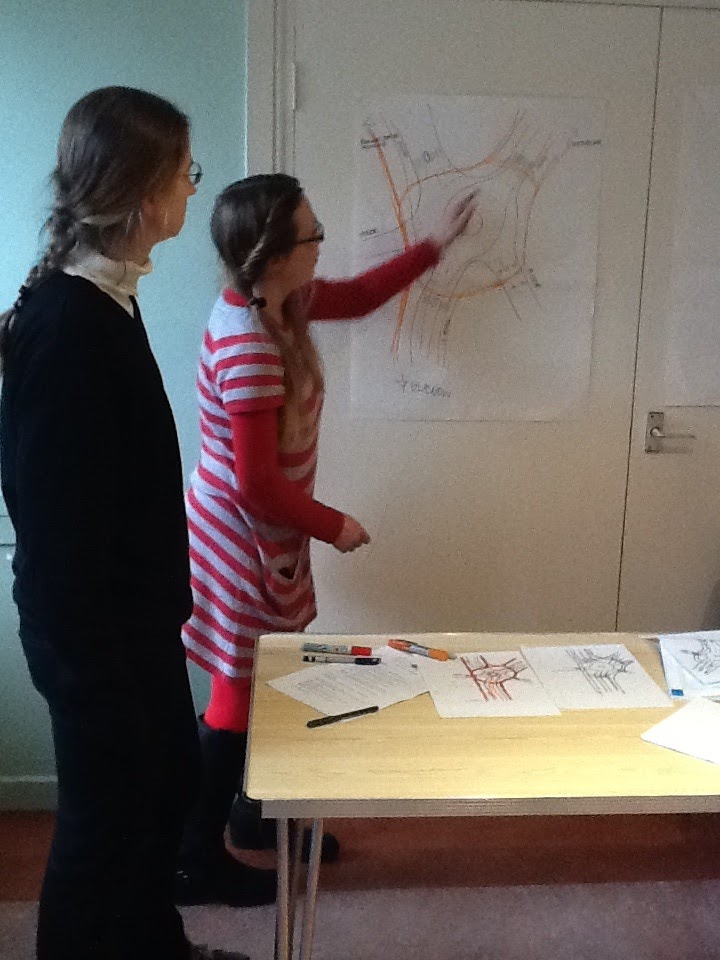
Bashing Milngavie roundabout into a more Dutch shape
A lot of time was devoted to junction design, and there was detailed consideration of one example roundabout – the one that Magnatom nearly came to grief on in Milngavie, near Glasgow. We looked at what the ideal Dutch cycle path solution to this dangerous roundabout would be, and how that might be introduced in stages, phased to reflect the importance of different routes for cyclists and the danger that they faced trying to use them, with each stage representing an incremental improvement in conditions for cyclists and pedestrians.
It is clear that the work of the Embassy has only just begun. But a solid start has been made, and, just as importantly, other organisations are taking notice, and some are following a similar path. These the Embassy is very keen to work with. Cycle campaigning in the UK has now got serious.
I was listening to The Bike Show podcast, which covers recent events. A good portion of it is given over to Mayor Boris responding to Assembly questions.
Amongst what is mainly waffle, I noticed a startling admission. At 21:50 he says that the “whole point” of the Superhighways is “to instruct the motorist that this is a place where you are going to find loads of cyclists, so be careful”.
Well, that’s cleared that up then… The CS is not, in fact, a “superhighway” for cyclists. It is, rather an overpriced and massively over engineered road sign for the benefit of those who choose to drive. How silly of us not to realise. Any expectation that the CS ought to provide priority for cycling is completely unfounded it turns out. Indeed, viewed through the cipher of his statement, the design of the CS starts to make some sense. It wasn’t built for cyclists…
Well this kind of thing is not new. I have spent a couple of decades going to meetings with council officers and consultants in various London boroughs, looking at streets that were proposed to be part of one or another "cycle network", and after being told all the reasons why none of the changes cyclists actually needed to make them safer were possible because of either lack of money, or, more importantly, competing political demands and priorities (e.g. parking supply, motor vehicle capacity, and accommodating taxis and buses), finally getting told that what would be done instead would be to put up a few direction signs for cyclists, and paint some bike logos on the road. What was the purpose of these bike logos? Well, they were supposed to be seen by drivers and to "raise awareness" of cyclists in their minds. This was always the great UK "expert" bike consultants' phrase, "raising awareness", and seemingly the purpose of the routes, and the literally millions of pounds spent on studying them and then doing nothing but getting a man out with paint and a stencil. Not protecting cyclists, just "raising awareness" of them. But where did these "experts" get this idea that such "awareness raising" actually achieved anything to improve cyclists' journeys? What was the evidence-base for it? I asked, and was never supplied with a good answer.
I have cause to often cycle on an east to west course across the Borough of Harrow, from Edgware, near the A5, to Harrow town centre, North Harrow, or Rayners Lane. If you look at the map of Harrow, you will see that there are actually only three roads that run as continuous through-roads east-west across it.
The area between Harrow town centre and the A5
So to do this journey, or many like it across this substantial slab of north-west London (population 230,000) , you have to use one of these three roads. They are:
The A410 Uxbridge Road
Streatfield Road (and its westward continuation Christchurch Avenue)
The A404 Kenton Road
The first and last of these essentially bracket the borough on the north and south sides, and are the major, purpose-built through-routes. The A410 varies between four and two lanes width, building is generally well set back from it, with service roads in places, and it is very heavily trafficked, with several bus routes. It has narrow advisory cycle lanes along some sections, and elsewhere cyclists are directed along service roads. Needless to say, few cyclists use it, with these generous cycling features.
Uxbridge Road, Harrow, typical view
The A404 is four lanes wide all the way and is heavily used, with many buses. It is often congested, particularly at the west end near Northwick Park roundabout. It has intermittent bus lanes, which of course cyclists can use. It is not a scenic nor a pleasant road to cycle on, though not as bad as some, as most of the time there is room for cars to overtake bikes. Its main hazards are the nasty multi-lane roundabouts at either end of it, Kingsbury Circle at the east end and Northwick Park roundabout at the west end. The former can be tackled by a fast, experienced and assertive cyclist, but the latter I advise all cyclists to avoid.
Kenton Road, Harrow/Brent border, typical view
Streatfield Road is the narrow residential rat-run "C" class road inbetween these two A roads (though of course they are all residential roads). This is the kind of road the Dutch would close off, or make one-way for motors in different sections, to remove the through-traffic and allow it to be a pleasant, quiet cycle through-route. As it is, it is a narrow, minor road with high speeds (often in excess of the 30mph limit), with intermittent parking and other pinch-points creating hazards for cyclists, who are constantly overtaken aggressively and with insufficient space. It also has an entirely gratuitous very wide-geometry lozenge-shaped roundabout at the Culver Grove and Kenmore Road junction. But quite a few cyclists use it in preference to the other routes.
Harrow Council seemingly have noticed this, and, presumably, as some gesture towards trying to encourage cycling, have recently painted "awareness raising" cycle symbols on it. Though I am not really sure why they have done it, as so far as I know it is not a designated bike route, and I never heard anything about it through Harrow Cyclists (the LC group). Here is the new paint-work at the Culver Grove roundabout:
Streatfield Road, Culver Grove roundabout, Harrow
And here we are looking the other way from the same point:
Streatfield Road, Culver Grove roundabout, Harrow
Note the bad linear surface defects, creating a hazard exactly where cyclists are likely to be (or likely to get pushed to by fast overtaking traffic in the wide space). Note the geometry of the exit, which makes it very hard for a cyclist on the main route, unless he/she is very fast and assertive, not to get swept to the left and cut up by left-turning traffic. Note the totally inappropriate space on the roundabout, considering it connects two-lane roads. Note how the vegetation on the roundabout blocks the view of what may be coming round it.
Rather than recognise that this road is on a cycle desire-line and fix these hazards, the council has painted these "awareness raising"cycle symbols. They go all the way down. Further west, at Kingshill Avenue, we see how restriction of the carriageway width by chevron markings and pedestrian islands, plus a median strip installed to prevent right turns from Kingshill Avenue and Kingshill Drive and to block that rat-run (for all, including cyclists), have created a "trapping area" where you do not want to be caught on your bike with an aggressive driver trying to squeeze past. Note again the hazardous broken surfaces and the magic "That'll make it all right, wont' it?" awareness-raising bike symbols.
I have cycled this road many times before the symbols were painted, at all different times of the day, and I have now cycled it several times since the symbols were painted. I can tell you that I am absolutely certain that they have made no difference to the behaviour of motorists whatever. Why should they? Motorists do not know why they are here or what they mean. It is clear to them, as it is clear to cyclists, that nothing to benefit cyclists has actually been done on this road. They can see that this is in no meaningful sense a specific "cycle route". (There are cycle advance stop lines at the Kenton Lane traffic lights, and short advisory lanes leading to them, but these existed before the new symbols were painted. The lead-in lanes are normally rendered unusable by parked cars.)
All the people who used this road as a rat-run before the symbols were painted continue to do so afterwards. They do not moderate their speed when they encounter cyclists any more than they used to. They do not give any more room or give cyclists any more consideration than they ever did. There has been no reduction in dangerous or obstructive parking. Neither have the symbols somehow magically caused an increase in the number of cyclists, which are always a very rare species in these parts. Anybody who believed these symbols would have any of these effects was living in fantasy land.
I have actually gone off using Streatfield Road recently, and been using Kenton Road more, which, although an altogether more fearsome road in terms of scale and speed of motor traffic, at lest does not have so much problem parking, and at least, most of the time, affords cars and buses sufficient room to overtake cyclists safely. The "he's aggressively revving up right behind you while you are taking the lane going through this pinch point" factor is much less.
For cycling on Streatfield Road, and innumerable other suburban rat-run roads like it all over London, is peculiarly unpleasant. The combination of restricted width, heavy traffic, speeding, impatient drivers, parking, pinch-points, bad surfaces, buses stopping (for there are buses on most of these minor suburban through-routes) and badly-designed roundabouts and junctions, leads to a massively stressful experience that people (like this man) who just see such roads on a map, and say "Yes, minor road, not A or B category, suitable place for cyclists, better than main road" simply do not understand.
The road network of Harrow, that I am demonstrating to you, with through-roads like Uxbridge Road, Kenton Road, and Streatfield Road, shows the falsity of the concept that there is a network of minor roads in London eminently more suitable for cycling on than the A roads, which just need a bit of signage and a bit of engineering work to make them into an attractive and effective network. It just isn't really like that. In reality, the political difficulty of making these roads cycle-friendly is at least as great, if not greater, than the political difficulty of installing high-quality segregated cycling infrastructure on big roads like Kenton Road – which would actually be a much more useful solution, if the junctions could be fixed as well, because another reality is that most of the places people need to go most of the time, like shops and stations, are on main roads.
So why do councils get it into their heads that there is any point in painting cycle symbols on these rat-run roads? Clearly, it's a gesture. They want to be able to say that they are thinking of cyclists, but don't want to annoy motorists by removing any space for parked or moving motor vehicles, and they think it is politically suicidal to propose closing heavily-used through roads (though when roads have been closed in similar circumstances, there is rarely a campaign by anyone to have them reopened) . These roads also cannot be traffic-calmed, as they are usually treated as priority routes by the emergency vehicles. So out comes the stencil and the paint. It's not expensive. But if one added together the cost of putting all this useless paint on all the roads in London where it has been applied, over twenty years or so, you probably would be talking about millions of pounds – enough to created one or two genuinely useful cycle facilities here and there. And that's not to mention the cost of the studies that generally precede these paint measures, which always seem to absorb most of the money allocated to cycling in the UK.
The current LCC campaign Go Dutch for "clear space for cycling on London's main roads" gets it right. Creating the space on the main roads where cyclists feel subjectively safe is fundamental to the Dutch cycling paradigm. Yes, the Dutch do a lot to minor roads as well. They do radical stuff there that has the effect of clearing the inessential motor traffic off them and establishing segregation of modes without cycle-paths. But this is the second stage. In a car-dominated society like the UK there is little political appetite for removing the motor rat-runs on the minor roads while cyclists remain such a minor political force, because of their small numbers, because, in turn, there is no obviously safe cycling space on the main roads, which are the really useful roads. In this situation that we are in, motorists, and councils, feel that they cannot sacrifice any of the current road space given over to cars.
Merely slapping down painted symbols of obscure significance, that have no effect of giving any extra legal protection to cyclists, and which do not legally oblige motorists to do anything in particular, does nothing at all for cycling. There is no "awareness raising" effect. These symbols may be noticed by a driver on his regular route once, quizzically registered in his mind, before being integrated into the constant background and forgotten, amongst all the other things that need to be given attention whilst driving.
In London we have wasted decades doing this pointless stuff. There is no evidence that it works. Cycling in suburbs like Harrow has continued falling. Bikes do not "belong" on the minor roads any more than cars do. Give cyclists safe routes on main roads, and then we can think about the rat-runs.
There are spaces in our cities that don't exist. These are the places that planners never expected, nor wanted, anybody to go, nor provided any facilities for them to be reached. They have no function except to give shape to the road junctions that flow around them. They are the bleak, dirty, litter-strewn concrete island pavements that the major road planning of the late twentieth century made so familiar to us: the centres of roundabouts, the places under flyovers. But one of these non-existent places took on a remarkable life on Friday evening. In the centre of Bow roundabout, in east London, people gathered to remember the two cyclists killed trying to negotiate that junction, on Boris Johnson's tragically mis-conceived Cycle Superhighway 2. Those people each personally had to take calculated risks even to reach that gathering point. There are no pedestrian crossings; the only way to the centre is to wait for the lights to go red and dash across at the white line, one stage at a time, from one bleak island non-place to the next. To cross when the lights are red, but when you have not seen them just go red, would be very foolish, for they can change again in an instant, and the traffic would be on top of you.
The message of the vigil
The dead cyclists were Brian Dorling, hit by a left-turning lorry while cycling east on 24 October 2011, and Svitlana Tereschenko, hit by a left-turning lorry while cycling west on 11 November 2011. The vigil was organised by the Tower Hamlets and Newham borough groups of London Cycling Campaign. Candles were lit and David Tuckwell, a local cyclist, led a minute's silence. Then the son of Brian Dorling spoke, then his widow, then the sister (I think) of Svitlana, then a local politician – I could not make out who that was, as it was hard to hear proceedings through the throng of 200 people who had turned up. A "Ghost Bike" was set up at the NW corner of the roundabout, where Brian had been killed, while a small shrine to Svitlana was seen at the SE corner, where she died. Press, TV reporters and prominent politicians attended: Brian Paddick, Liberal Democrat candidate for Mayor (who has also been supportive of the cyclists' protests at Blackfriars), and local MP Rushanara Ali. There were many children there, including (I gather) a boy who had actually witnessed Svitlana's death. Poor boy.
Ghost bike for Brian Dorling
Shrine to Lana Tereschenko
Another member of LCC said to me how sad it was to meet at such an occasion. But I said that I could see a good side to this. For of the 33,000 road deaths in the UK over the last 10 years, few can have attracted such attention, caused such outrage, and led to so much political pressure for change as these two. These two deaths were so similar in their circumstances, came so close together, and so soon after the opening of Cycle Superhighway 2, whose opening had been proceeded by such unambiguous warnings from campaigners about the danger of what had been provided there, so clearly against Transport for London's own consultants' recommendations, the deaths being so clearly due to the defects in the design of the Superhighway that anybody who studied it could see, so clearly due to negligent design, that public outrage was inevitable, as was more publicity than has probably ever before followed a cycle fatality on London's roads. The high-profile nature of Boris Johnson's Cycle Superhighways scheme, his personal association with cycling and with this scheme, and the nature of this specific route, being the recommended route for Londoners to use to cycle to the Olympic Park, ensured this. So now there is real pressure for change, both here and on the other Cycle Superhighways, and on London's dangerous junctions more generally. It is sad this was achieved through this succession of events, but it is the good side of this double tragedy.
The "cycle facilities" that killed Brian Dorling
Daytime view to show clearly the defective design (picture courtesy LCC)
The design disaster of the Cycle Superhighway on this roundabout is clearly seen in these pictures. Large lorries and other vehicles are able, and encouraged by the design, to make a high-speed, low angle left-turn across the blue cycle lane. The potential for tragedy was always here, before the lane was painted, because of the inappropriately wide geometry of the turn and the excess lane widths. A cyclist pursuing a prudent course through this roundabout, in its pre-superhighway state, would not have been on that strip on the left, but in a more central position in the left-hand lane, to be clearer of the possibility of the left-hook and more in the line of sight of drivers.
Both the blue strip and the segregated section of lane on the outer edge of the roundabout that have been provided for cyclists have clearly made a dangerous junction far worse for them. The segregated strip is the biggest error. For to aim for its narrow entrance, a cyclist is going have to take the worst possible course, the one that makes it most likely for them to be overtaken on the outside and then mown down by the inattentive driver of a left-turning lorry. The narrowness of the entrance of the segregated section and the precision of the move required to get into it will inevitably slow the cyclist, making it more likely that they will be unwittingly overtaken and ploughed into by a driver having limited visibility from his cab.
This is a totally disastrous mis-application of segregated cycle engineering to a junction – one where the basic problems of the junction have not been fixed, and the best, but still highly unsatisfactory, course for a cyclist remains a high-visibility, fast, vehicular cycling approach, yet they are forced or encouraged to modify that approach to fit in with a facility that does not protect, thus creating a hugely amplified risk. Nobody who understood cycling could have designed this.
Transport for London's consultants on the CS2 project were Jacobs Consultancy. They told TfL that signalised crossings for cyclists were needed and that off-carriageway cycle lanes should be provided around the roundabout, to "encourage less confident cyclists to use the route". Though the wording about "less-confident cyclists" is peculiar – cyclists have the right to protection whatever their level of confidence, and Brian Dorling, for one, was certainly an experienced and confident cyclist – this was correct advice, with which LCC agreed. We know why TfL did not build the crossings. This was made very clear by the answer Boris Johnson gave to London Assembly Member John Biggs in May:
TfL have been unable so far to find an immediate solution for providing controlled crossings at Bow Roundabout that doesn't push the junction over capacity and introduce significant delays to traffic.
"Traffic", here, as usual when "cycling champion" Johnson uses the word, means, of course, motor vehicles. "Significant delays" to pedestrians and cyclists don't matter in the Johnson–TfL world – significant delays such as being dead for the rest of eternity.
This blog is not afraid to pull its punches, and I think we should stop diplomatically hiding the personal decisions of Boris Johnson behind the acronym "TfL". The way TfL is set up, legally, makes the Mayor effectively its dictator. Johnson personally decided on the trade-off between delays to motor traffic and risk to cyclists at this junction, and at others like it all over London. He could have instructed TfL officials to adopt a different policy, but he did not. People have talked about "corporate manslaughter", but I am not sure there is anything particularly corporate here. If there can be said to be manslaughter connected with recent cyclist deaths at at London junctions, there is only one individual behind it. We know where the buck stops.
More broadly, one should consider that if an attempt is being made to set up a safe cycling network in a city, it would make sense to take expert advice from those who have proven experience of delivering this elsewhere in the world. There is no proven experience of creating safe and effective cycle networks in the UK, thus expertise should have been drawn from abroad, ideally from the Netherlands, and officials should have been given the freedom politically to act on the that expertise. I have been saying for the last 20 years that London should get transport engineers for the Netherlands to redesign its roads, but this never happens.
In every industry in the private sector these is a flow of expertise from one country to another; those who are the real experts in every field move internationally to raise standards everywhere. Whether you talk about manufacturing, engineering, banking, media, arts or sports, we do not live in a nationally-compartmentalised world. In every one of these fields the real experts operate internationally, and are called upon to go wherever they can best help and most increase productivity, quality and profits.
But UK road engineering is different. It seems to exist in a bubble of its own that admits little influence or interference from people trained in places that do the same better. There are two aspects here: street engineering involves interrelated technical and political issues. The correct policies need to come from political leadership, but there needs also to be the technical expertise available to best realise the political ambitions when they are clearly crystallised.
We might forget all about cyclists for a moment, and think about how to design major junctions safely for motorists. We have not a clue about this in the UK either. Standing in the centre of the Bow roundabout, it was easy to observe the designed-in chaos of the motor vehicle interactions at this intersection, with, despite the signal control, near-collisions being a constant feature, with honking of horns and sudden braking all the time showing clearly the problems created by the wrong geometry of the entrances and exits, the multiple lanes and excess lane widths. These are not problems of user behaviour. To think in this way, as Johnson seems to, is to not have progressed to a sensible, realistic understanding of the interaction of human beings with the technology of transport infrastructure. These are problems of design.
The Bow intersection is a bad example, but not untypical of major UK intersections. There are many others similar in London. There are many junctions in London that frighten not just cyclists, but motorists, and are hated by many of them. I guess Bow would be one. Another that I know, because motorists in my area have mentioned to me how much they dislike it, is Northwick Park roundabout in Harrow: another chaotic, open geometry, multi-lane gyratory. This is terrifying to cycle on, and I do not do so, except to make a left-turn, and I advise cyclists to avoid it.
Northwick Park roundabout, Harrow and Brent
Another appalling junction that I do cycle through regularly, because, as at Bow, there is no other option for crossing a major linear barrier (the River Lea in the Bow case), is Staples Corner West. This provides the only practical way to cross the North Circular Road on the east side of Brent and the west side of Barnet. Staples Corner West is very similar to Bow Interchange. In both cases the east-west and north-south routes have both been taken across on uninterrupted separate motorway-style infrastructure. In the case of Staples Corner there are two levels of flyovers, for the A5 and the North Circular Road, over a roundabout. At Bow, the A11 is taken over the roundabout and the A12 is taken under. In both cases, slip roads connect these roads to interchange at a signalised multi-lane roundabout. In both cases, cyclists following the commuting desire-lines in and out of central London are faced with a choice of whether to take the flyover, avoiding the roundabout, but risking the low-angle, high-speed interactions with motor vehicles on the slip roads, or to go round the roundabout, risking the chaos there.
Staples Corner roundabout is not quite so bad as Bow as the spaces are not so wide, but it is sufficiently bad to greatly increase my tendency to take the tube into central London rather than to cycle down the A5. There was proposed to be a Cycle Superhighway here as well, CS 11, but TfL thought better of the idea, or Barnet, which part-controls the A5 here, did not want it, so CS11 has been redirected to the A41 (where it will still not penetrate into the anti-cycling Borough of Barnet).
Staples Corner West roundabout in Brent and Barnet
The sources of danger at all these intersections for drivers, pedestrains and cyclists are the multi-lane gyratory arrangements which encourage switching of lanes, the excess lane widths and broad turning geometries which encourage too much speed, the lack of convenient pedestrian crossings at surface level (Staples Corner has a network of little-used elevated walkways, while Northwick Park has a pedestrian tunnel), and the obvious lack of safe cycle facilities.
I am sorry to have to keep repeating myself, but the fact is that the Dutch know how to do roundabouts. They have unrivalled expertise in making roundabouts safer for all road users (including motor vehicle occupants), and it is very hard to undersand why in the UK we continue to pig-headedly avoid importing their expertise. The Dutch design roundabouts according to the principles of sustainable safety, meaning that they make it hard for road users to make dangerous errors. From the Dutch SWOV (Institute for Road Safety Research):
Homogenous use of the infrastructure is one of the Sustainable Safety requirements. On urban main road intersections, where all traffic types meet, this homogeneity requirement translates into reduction of the number of potential conflicts and lower driving speeds. [Dutch] Roundabouts meet this requirement because of their features.
By "homogeneous use" they mean all road users using the infrastructure in the same correct, predictable manner, because it was designed to make them do that. This is the reverse of the junction chaos that UK designs typically create.
Dutch turbo roundabout, from SWOV publication
Here is a Dutch "turbo" roundabout for motor vehicles only. A separate cycle path can be seen to the top right of the picture. The roundabout is designed to satisfy the need for high capacity simultaneously with creating sustainable safety. Vehicles bound for particular destinations, having particular origins, follow fixed, predictable courses through the roundabout. There are two lanes, but no switching and no conflicts. There is only one way to go, chosen by the driver before he reaches the roundabout. This is the simplest possible turbo roundabout, but many more Dutch roundabout designs, of increasing complexity, and including cycle facilities, can be found in this paper.
On relatively low-traffic Dutch roundabouts, cycle lanes may be located on the carriageway round the periphery of the roundabout, provided that the geometry is such that vehicles entering and leaving the roundabout cross the cycle lane almost at right-angles. Here is such a roundabout that I photographed in Groningen:
Unsegregated cycle lane on Groningen roundabout
However this is not the safest nor most modern design, and the Dutch generally provide entirely separate cycle paths around their roundabouts now. This would be the case always when there is a high vehicle flow. The cycle paths cross the motor vehicle entrances and exits almost at right-angles. There are several possibilities for priority. In rural areas the Dutch usually have the give-way markings on the cycle track, but in urban areas, often the motor vehicles have to give way.
One-way unsignalised cycle track round roundabout near Groningen: cyclists give way
Cycle priority on cycle path round Dutch roundabout
These solutions will not be satisfactory where motor vehicle flows are very high, and here signalised crossings for the cycle paths are required, so the crossing of the path with each arm of the roundabout is turned into a separate signalised junction. These signals can either be automatic, phased with other signals, or they can be push-button, or, most satisfactory for cyclists, they can be controlled by a magnetic loop detector embedded in the path which detects the presence of a bike and gives the cyclist a green as he or she approaches the crossing.
Two-way signalised cycle path round roundabout in Utrecht
This technology is so well-established and developed in the Netherlands it is not necessary for us to dangerously experiment with cyclists on busy roundabouts in the UK. The solutions are known. David Hembrow has provided a post which shows and explains every single roundabout in Assen (there are 19 of them), showing the wide variety of designs, and the fact that they all have separate cycle paths incorporated into their design.
Though I am no traffic engineer, or indeed graphic designer, I have made the crude attempt below to show how the part of the Bow roundabout on which Brian Dorling died could be modified to make it safe for eastbound cyclists, using Dutch-style engineering. This is of course not intended to be a definitive solution, but merely demonstrative of a possibility.
My suggested design for Bow
All TfL's blue markings need to be imagined as removed. An off-road cycle track is needed to cross the entrances and exits from the A12, some way back from the point at which vehicles make their turn. The kerblines need to be altered so that the turns off the roundabout are tightened, and vehicles cross the cycle track slowly and perpendicularly. Because of the very high volume, signals are essential for the track and slip road intersections. These would allow pedestrians to cross as well. Each crossing of the track by a slip road needs to become a small signalised junction. The lights could be phased to allow cyclists fast passage across both the exit and entry slip road, stopping only once, if at all. This solution is the sort of thing that can easily be produced within existing space constraints once throughput of motor vehicles ceases to be the over-riding criterion. Motor occupants benefit too from a safer, calmer, more predictable junction.
Fixing the Bow roundabout would not fix Cycle Superhighway 2, which I cycled on my way back from the vigil on Friday. The rest of it is a travesty of safe cycle infrastructure as well. The blue lane, marked intermittently in the inner half of the bus lane, does nothing to remove conflicts between cyclists and buses and conflicts at other junctions. This lane has no legal force, not being a mandatory cycle lane (not bounded by a white line), and it gives cyclists no protection in law, nor in practice. The A11 is a horrible road with a peculiarly aggressive "Gotham City" feel to it as you cycle towards the huge, overbearing towers of mammon of the City of London, looming up ahead. The implementation of this Superhighway, of all of them, was uniquely disappointing, as the space for creating proper, segregated cycle tracks on both sides of this road was so clearly present, even without alteration of the current vehicle lanes. The road is enormously wide, with much unused pavement space.
Bow Road, the A11, photo by Oxyman, taken before the implementation of the Superhighway. Plenty of space here for a wide segregated cycle track.
Basically, the Superhighway here, as with all of them, was done quickly, on the cheap, and with no coherent thinking on what it was actually supposed to do, save for waymarking a route which was obvious anyway: it is, after all, just the main road, the one that anybody cycling from the City to Stratford has to follow.
As I pointed out in my last post, it was clear at least as far back as August 2009 that the Cycle Superhighways were going to be like this. That was when TfL told LCC that:
Cycle Superhighways does not have the time or the budget to... seek major changes to traffic operations (e.g. via side road orders or controversial Traffic Regulation Orders).
Traffic Regulation Orders are the legal mechanism used in England and Wales for all significant alterations to highways, such as altering lanes, changing parking arrangements, or altering junctions. In ruling out seeking these, the Superhighways team was making clear that nothing would actually change on these roads. At that time I advocated that LCC should condemn the Superhighways programme and call for it to be stopped. Now, at its AGM last Wednesday, LCC has finally done that. In an Emergency Motion, overwhelmingly passed, the meeting resolved to:
1. Call upon TfL to immediately redesign the Bow roundabout junction, providing continuous, safe East-West cycle crossings and safe approaches and exits.
2. Call upon TfL to halt work on the remaining Superhighway routes until issues of road space reallocation and junction danger are addressed and resolved.
3. Call upon the Mayor to intervene and give TfL the mandate and political direction to provide clear space for safe cycling on London's main roads.
4. As part of out "Go Dutch" campaign, seek a commitment from the mayoral candidates that the Cycle Superhighways will be completed (including resolving barriers on existing routes) to the highest international best practice standards, in accordance with LCC's "Go Dutch – Key Principles" document.
TfL's response so far to the furore over the Bow deaths has been to announce the following:
Work is beginning on how London gears up to move to the next level of cycling infrastructure and continuing to improve safety for cyclists.
This includes a commitment from TfL to review all major schemes planned on TfL roads as well as to review all the junctions on the existing cycle superhighways.
That work will include an assessment of Bow Roundabout, which TfL have been asked to report back to the mayor on as a matter of urgency.
This could be interpreted as progress, but it could be intepreted as fobbing-off. We have had reviews and studies of cycling in London until our eyes fall out. What we need is not more reviews by TfL, but a change in policy by Boris Johnson, away from putting motor vehicle throughput above safety for all road-users. If these reviews are a face-saving way of him making this change, that is good. But I worry that what will come out of this will be some nonsense such as merely moving the blue lane at Bow roundabout from the outside to the middle of the carriageway. "The next level of cycling infrastructure" sounds fascinating. Is this the level where cyclists only get their limbs crushed under lorries, as opposed to their heads? For I believe that is what actually happened to both the victims of Bow.
I, for one, would like to see Boris Johnson apologise personally to the relatives of Brian Dorling and Svitlana Tereschenko, and personally promise to them to start to mend London's deadly junctions, in Brian and Lana's memory. I end with a video I made of the one minute's silence on Friday.